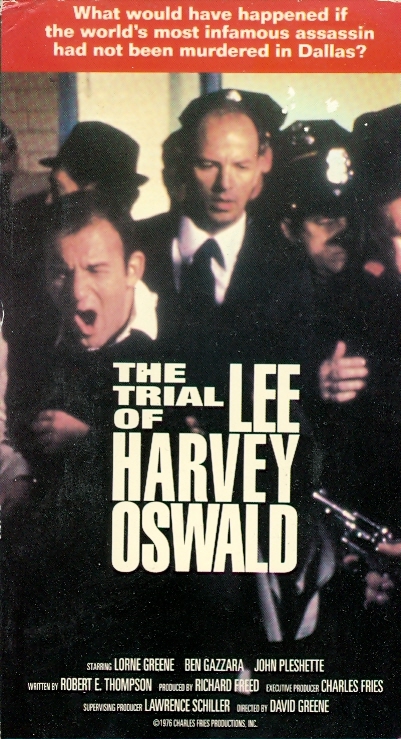
The Trial of Lee Harvey Oswald (1977, directed by David Greene and Gordon Davidson)


What if, instead of being shot by Jack Ruby, Lee Harvey Oswald had survived and been put on trial for the murder of President John F. Kennedy?

That’s the question asked by this television film.  John Pleshette plays Lee Harvey Oswald while Lorne Greene plays his attorney, Matt Weldon and Ben Gazzara plays the prosecutor, Kip Roberts.  The film imagines that the trial would have been moved to a small Texas town because Oswald presumably wouldn’t have been able to get a fair trial in Dallas.  While Roberts is forced to deal with his own doubts as to whether or not Oswald actually killed the President, Weldon is frustrated by Oswald’s paranoid and self-destructive behavior.  Oswald insists that he’s a patsy and that he was framed by “them” but he refuses to tell Weldon who they are.

With a running time of four hours, The Trial of Lee Harvey Oswald is a courtroom drama that tries to be fair to both sides and which ends with a frustrating cop-out.  While Weldon presents all of the evidence that real-life conspiracy theorists frequently cite in their attempts to prove Oswald’s innocence, Roberts makes the case that was presented in the Warren Commission.  Unfortunately, the film ends up trying too hard to avoid coming down on one side or the other and just proves that it’s impossible to be even-handed when it comes to conspiracy theories around the Kennedy assassination.  It’s either buy into the idea that it was all a huge conspiracy involving mobsters and intelligence agents or accept that it was just Oswald doing the shooting as a lone assassin.  Trying to come down in the middle, as this film does, just doesn’t work.

John Pleshette does a good job as Oswald and bears a passing resemblance to him.  Because the movie refuses to take a firm stand on whether or not Oswald’s guilty, the character is written as being a cipher who claims to be innocent but who, at the same time, also refuses to take part in his defense.  Pleshette plays up Oswald’s creepy arrogance, suggesting that Oswald was capable of trying to kill someone even if he didn’t actually assassinate JFK.  Both Greene and Gazzara are convincing as the two opposing attorneys, even if neither one of them really does much more than offer up a surface characterization.

The majority of the movie takes place in the courtroom, with a few flashbacks to Oswald’s past included to keep things from getting too stagnant.  When the film was made, people were still learning about the conspiracy theories surrounding the Kennedy assassination and The Trial of Lee Harvey Oswald might have had something new to tell them.  Seen today, the majority of the film’s evidence seems like old news.  The Trial of Lee Harvey Oswald never escapes the shadow of later films, like Oliver Stone’s JFK.

It’s hard not to regret that The Trial of Lee Harvey Oswald wasn’t willing to come definitively down on one side or the other.  Instead, it ends by telling us that we’re the jury and that the only verdict that matters is that one that we come up with.  They could have just told us that at the start of the movie and saved us all four hours.
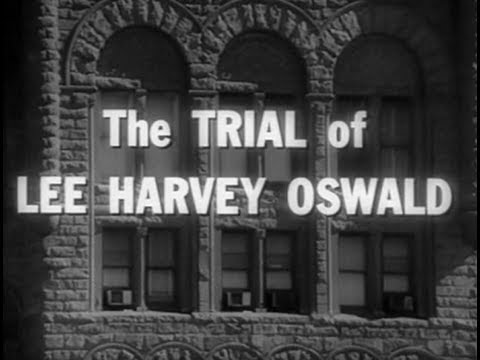
44 Days of Paranoia #5: The Trial Of Lee Harvey Oswald (dir by Larry Buchanan)


The Trial of Lee Harvey Oswald

Today has been a strange day to live and work in Dallas, Texas.  It is, of course, the 50th anniversary of the day that President John F. Kennedy was assassinated in my hometown.

As I mentioned in my review of Executive Action, those of us who live in Dallas are still expected to live in the shadow of something that happened before a lot of us were even born.  Today, the city of Dallas did everything that it could to embrace that shadow.  Despite the fact that it was cold and rainy today, a lot of people attended the memorial ceremony at Dealey Plaza.  (Despite the weather, nobody was allowed to open an umbrella during the ceremony.  Having been raised Catholic, I appreciate a little self-punishment as much as the next girl but considering how bad the weather  was, it all seems a bit much to me.)  One of the local talk radio stations spent today rebroadcasting all of its programming from November 22nd, 1963.  I guess the idea was to give people a chance to experience a terrible day in real time.  That seems a bit creepy to me but it does illustrate just how much the Kennedy assassination continues to overshadow life here in Dallas.

Considering just how much my city is identified with it, it’s perhaps appropriate that the very first film ever made about the Kennedy assassination was made by a Dallas filmmaker, the infamous Larry Buchanan.  As a filmmaker, Buchanan specialized in exploitation films that claimed to either be ripped-from-the-headlines or were presented as being lurid dramatizations of real-life events.  Hence, it’s not surprising that, in 1964, Buchanan gathered together a group of local (and obscure) Dallas actors and filmed The Trial of Lee Harvey Oswald.

Lee Harvey Oswald

The eyes of a killer?

The Trial of Lee Harvey Oswald takes place in an alternative reality in which Lee Harvey Oswald was not murdered by Jack Ruby and, instead, actually stood trial for the assassination of John F. Kennedy.  The prosecution pretty much presents the case that was made by the infamous Warren Commission.  The defense argues that the evidence against Oswald is circumstantial and that, even if Oswald did fire the fatal shots, he should still be found “not guilty for reason of existing insanity.”  The film’s audience is meant to serve as the trial’s jury.

As I watched this film, two things stood out for me.  One is the fact that Buchanan never allows us to get a good view of the defendant.  Instead, we simply see his eyes.  While this was probably due to the fact that actor Charles Mazyrack didn’t bear a strong resemblance to the real-life Oswald, it’s still an occasionally striking effect that allows the character to remain a troubling enigma.

Secondly, and this surprised me as a contemporary viewer, next to no accusations of conspiracy are made during the trial.  There’s no talk of the grassy knoll or the military-industrial complex or any of the other things that one naturally expects when it comes to a film about the Kennedy assassination.  Instead, The Trial of Lee Harvey Oswald is based solely on the information that was available to the general public in 1964.  As such, it remains an interesting historical document, a chance to get a genuine look at what people actually knew and thought in the days immediately following the Kennedy assassination.

(Interestingly enough, Buchanan’s later films would often feature shadowy government conspiracies.)

When Larry Buchanan died in 2004, The New York Times summarized his career as follows: “One quality united Mr. Buchanan’s diverse output: It was not so much that his films were bad; they were deeply, dazzlingly, unrepentantly bad.”  For the majority of Buchanan’s films, that’s true but it’s not exactly true for The Trial of Lee Harvey Oswald.  Considering that  Buchanan is best remembered for directing a film called Mars Needs Women, The Trial of Lee Harvey Oswald feels almost respectable.

In fact, the film is a bit too respectable.  The dialogue and direction are often rather dry and the mostly amateur cast alternates between overacting and not acting at all.  If there was ever a film that could have benefited from some ludicrous melodrama, it’s this one.

That said, I enjoyed The Trial of Lee Harvey Oswald because I’m a history nerd and, if nothing else, this film remains an interesting historical curio.   As well, it was filmed on location in Dallas and I can’t complain about any film that features a close-up of my favorite downtown building, the old red courthouse.

Enjoy The Trial of Lee Harvey Oswald!