
The sixteenth season of Doctor Who featured the usual six serials but, for once, they were all a part of a much bigger story. Season 16 would open with the Doctor being assigned to find the six segments of the Key of Time and it would end with an appearance from Lalla Ward, who would not only play one of the Doctor’s companion but who would (albeit briefly) become a companion to Tom Baker himself.

The Ribos Operation (1978, directed by George Spenton-Foster)
The Ribos Operation begins with the White Guardian (Cyril Luckham) materializing in the TARDIS. He has come to give the Doctor (Tom Baker) and K-9 (voiced by John Leeson) a mission. The balance of the universe is maintained by the White Guardian and the Black Guardian. The balance is at risk of collapsing unless the Doctor can track down the six segments of the Key of Time. Each segment has been hidden on a different planet, disguised as something native to that world. The White Guardian gives the Doctor a locater to help him find each planet. He also gives the Doctor a new assistant, a Time Lady named Romanadvoratrelundar (Mary Tamm). The Doctor calls her Romana.
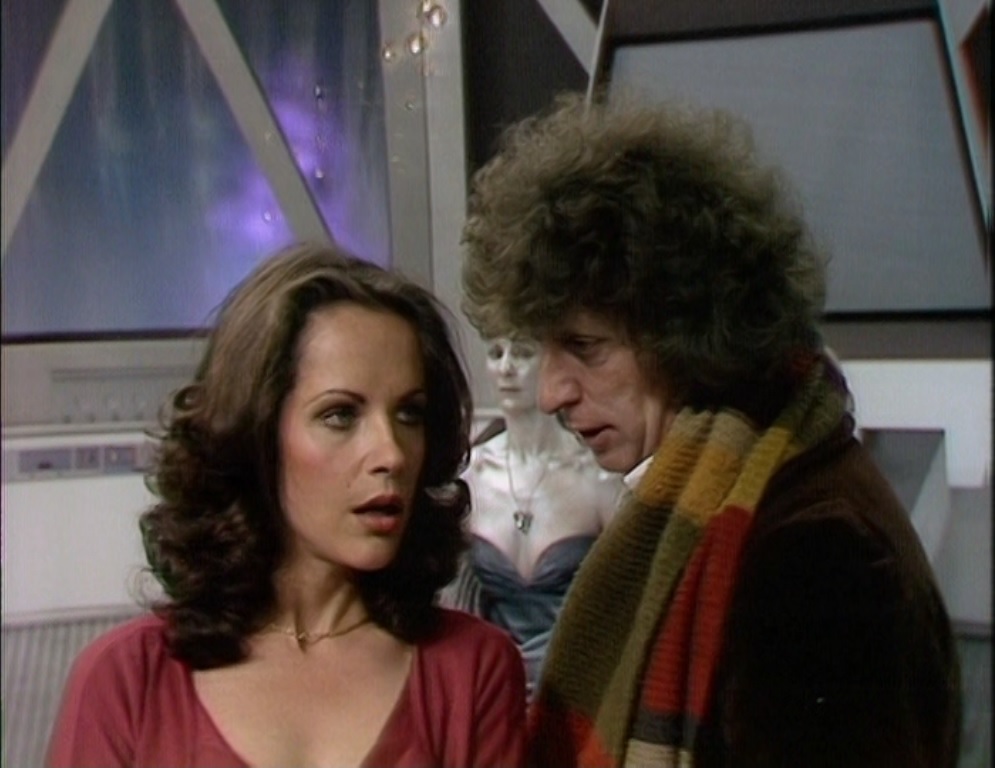
And so stars the Key of Time saga. As played by Mary Tamm, Romana was a new type of assistant for the Doctor. As a fellow Time Lord (though referred to as being a “Time Lady” because this serial was filmed in 1978), Romana has just as much knowledge as the Doctor and she does not view him with the awe that other companions viewed him. The sophisticated and almost haughty Romana is not with the Doctor for adventure. She is there to complete their assignment.
Their first mission takes them to the icy planet Ribos and finds them getting involved with a scheme by a human named Garron (Ian Cuthbertson) to sell the largely worthless planet to an exiled tyrant named Graff Vynda-K (Paul Seed). (In this case, “operation” means swindle.) When Graff discovers that he’s been cheated, he comes after both Garron and the Doctor.
The Ribos Operation is an enjoyable story. Graff is a great megalomaniacal villain and I liked the idea of trying to trick him into buying a worthless planet. It was the future equivalent of selling swampland. Mary Tamm also makes a strong impression as Romana. The Key to Time saga got off to a good start.
As for the first segment of the Key to Time, it was a piece of the fake crown jewels of Ribos.

The Pirate Planet (1978, directed by Pennant Roberts)
The Doctor and Romana are next directed to a planet called Calufrax that is known for being cold and boring. When they land, they find themselves in an apparent paradise. It turns out that they are actually on a hollowed-out planet called Zanak that materializes around other planets and, in the style of Galactus, plunder their resources. Zanak is apparently controlled by the one-eyed Captain (Bruce Purchase) but the Doctor and Romana discover that it is actually the Captain’s nurse (Rosalind Lloyd) who is calling the shots.
The Pirate Planet is famous for being one of the serials written by Douglas Adams. The loud but stupid Captain and his long-suffering assistant, Mr. Fibuli (Andrew Robertson), certainly do seem like they would be at home in one of Adams’s novels and the story overall has more humor than even the typical Tom Baker episode. It’s a clever script, though and both Purchase and Robertson give good performances as the two pirates.
The entire planet of Calufrax turns out to be a segment of the Key to Time. When I first saw this episode as a kid, that struck me as being very weird. It still seems weird but that’s Doctor Who.

The Stones of Blood (1978, directed by Darrol Blake)
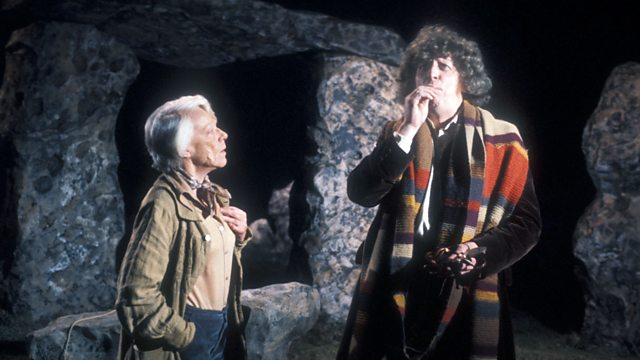
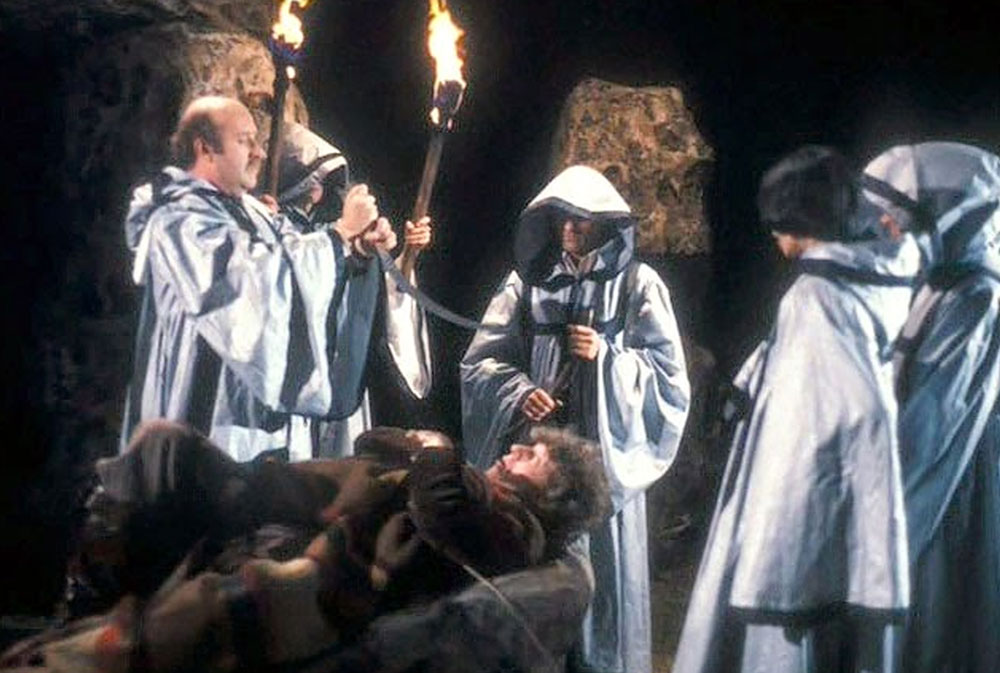
The Doctor, Romana, and K-9 are brought to modern-day Cornwall, where Prof. Emilia Rumford (Beatrix Lehmann) and her friend Vivien Fay (Susan Engel) are studying a stone circle. For the first two episodes of this serial, it appears that the main villains are going to be a group of modern-day druids but it turns out that the stones are actually aliens who feed on blood, and Vivien Fay is a galactic war criminal named Cessair and that she has stolen the Great Seal of Diplos, which also happens to be the third segment of the Key of Time.
This serial sees the Doctor returning to Earth for the first time since Image of Fendahl. The first two episodes have an almost gothic horror feel to them before the serial heads in a different, more intergalactic direction during its second half. In a clever twist, it turns out that the “stones of blood” were actually just red herrings. After spending four episodes convincing the viewers that the key would be one of the stones, it instead turned out to be the Great Seal of a planet that no one had ever heard of. This was another enjoyable serial, featuring a memorable villainess and a clever story.

The Androids of Tara (1978, directed by Michael Hayes)
Romana finds the next segment within minutes of landing on the planet Tara but the Doctor wants to take a break and do some fishing. While he is doing that, Romana is attacked by a bear and rescued by Count Grendel (Peter Jeffrey). Grendel takes Romana back to his castle, where he soon reveals that he’s not as kind as he seems.
The Androids of Tara is an adventure story that takes place on a planet where a feudal society is matched with androids and electronic weapons. This episode gives Mary Tamm quite a lot to do as she plays not only Romana but also the Taran Princess Strella and the android versions of Strella and Romana. Grendel hopes to marry Romana-as-Strella and become the ruler of Grendel. The Doctor, along with Price Reynart (Neville Jason) and the swordsmen Zadek (Simon Lack) and Farrah (Paul Lavers), works to rescue Romana. The Doctor even fights a duel with Grendel.
The Androids of Tara is a bit silly but it’s all in good fun. Tom Baker seems to enjoy playing the swashbuckler and Peter Jeffrey, a familiar character actor, is an appropriately melodramatic villain. This serial allows Mary Tamm her chance in the spotlight and she makes the most of it, reminding us that Romana could be just as strong as the Doctor.

The Power of Kroll (1978-1979, directed by Norman Stewart)
The TARDIS travels to a swamp planet where a crew of humans are running a methane refinery and the planet’s inhabitants (called Swampies, by the humans) worship a giant squid named Kroll. Kroll is giant because it ate a segment of the Key of Time. Kroll attacks both humans and Swampies until the Doctor manages to extract the Key of Time. Kroll explodes and, since Kroll was also the main source of methane on the planet, the refinery closes.
This serial made the mistake of focusing on Kroll. Like so many Doctor Who giant monsters, Kroll is not at all convincing. That and some poor acting from the guest cast and a largely humorless script all combine to make this the most forgettable part of the Key to Time saga.

The Armageddon Factor (1979, directed by Michael Hayes)
The search for the final segment leads the TARDIS to the warring plants of Atrios and Zeos. Atrios and Zeos have both been scarred by nuclear weapons. Princess Astra (Lalla Ward) of Atrios wants end the war but the fanatical Marshal (John Woodvine) is determined to continue the war. A mysterious figure known as The Shadow (William Squire) steals the TARDIS and abducts Princess Astra, who is revealed to also be the sixth segment of the Key of Time. The Shadow is working for the Black Guardian (Valentine Dyall). In pursuing The Shadow, the Doctor meets yet another renegade Time Lord and classmate, Drax (Barry Jackson).
The Armageddon Factor is about two episodes too long and is often needlessly complicated but there were a few clever moments, like the discovery that Zeos was no longer inhabited by humans and that the missiles were being launched by a super computer. (K-9 was able to communicate with it and broker a peace.) For viewers of the series, The Armageddon Factor is best-remembered for introducing Lalla Ward. Dissatisfied with the way Romana was developing, Mary Tamm announced that she was leaving at the end of the season. When Romana regenerated in the following season, she ended up looking a lot like Princess Astra of Atrios.

 Through the Shattered Lens