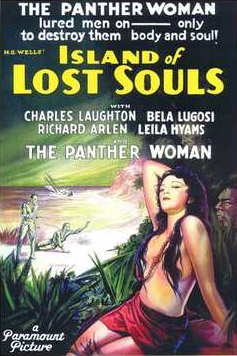
Horror Film Review: Island of Lost Souls (dir by Erle C. Kenton)


islandoflostsouls

In the 1932 film Island of Lost Souls, Ruth Thomas (Leila Hyams) has reason to be concerned.  She’s on the island of Samoa, awaiting the arrival of her fiancée, Edward Parker (Richard Arlen).  When Parker’s boat doesn’t show up, it can only mean one thing.  He’s been shipwrecked!  Did he survive or was he lost at sea?

Well, Ruth need not worry.  Parker did survive being shipwrecked.  He was picked up by a freighter carrying a wide selection of animals to an isolated island.  Unfortunately, when Parker complained about the way that Parker was abusing some of his admittedly odd-looking passengers, the captain responded by dumping Parker on that island as well.

On the island, Parker becomes the guest of Dr. Moreau (Charles Laughton) and his assistant, Montgomery (Arthur Hohl).  Parker also meets and finds himself becoming attractive to the seemingly naive Lota (Kathleen Burke).  Though Moreau seems to be a good host, Parker grows suspicious of him.  It turns out that there’s a room in Moreau’s compound, a room that Lota calls “the house of pain.”  At night, Parker can hear horrifying screams coming from the room.

Initially believing the Moreau is torturing the island’s natives, Parker soon discovers an even more disturbing truth.  Moreau has been experimenting with trying to transform animals into humans.  Lota, it turns out, was once a panther and the woods surrounding the compound are full of other Moreau creations.  Though Moreau claims that his intentions are benevolent, he rules his island like a dictator.  The animal-men are kept in line by the Sayer of the Law (Bela Lugosi) and any transgressions are punished in the House of Pain…

The Island of Lost Souls was the first cinematic adaptation of H.G. Wells’s The Island of Dr. Moreau.  (Perhaps the most famous adaptation came out in 1996 and is the subject of Lost Souls, a fascinating documentary that, I believe, can still be found on Netflix.)  I watched it last night on TCM and I have to admit that I had a mixed reaction to it.  On the one hand, the film’s atmosphere of mystery and danger is palpable and Charles Laughton’s performance definitely set a standard for all misguided scientists to follow.  The human-animals are fantastic creations and  the film’s ending still has some power.  Bela Lugosi’s performance of the Sayer of the Law was superior to his work as Dracula.  (As shown by both this film and Ninotchka, Lugosi was an outstanding character actor.)  Kathleen Burke also does a great job as Lota, which makes it all the more interesting that she was apparently cast as a result of winning a contest that was sponsored by Paramount Pictures.

(On a personal note, I always find it amusing that pre-code films always feature at least one scene of an actress removing her stockings, even if the scene itself has next to nothing to do with the rest of the film.  In this case, the legs belong to Leila Hyams.)

On the negative side, Richard Arlen is not a particularly interesting hero and, from a contemporary point of view, Island of Lost Souls is a rather slow-moving film.  Watching it today requires modern audiences to make a bit of an adjustment to their expectations.

With all that in mind, I still recommend Island of Lost Souls.  Watch it for Charles Laughton and Bela Lugosi.  Watch it as a valuable piece of cinematic history.
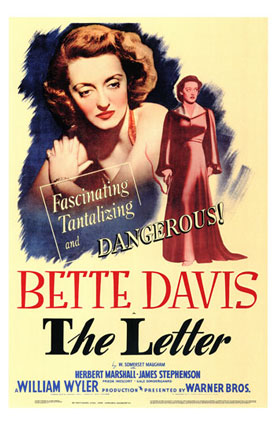
Cleaning Out The DVR #14: The Letter (dir by William Wyler)


The_Letter_poster

After watching Break-Up Nightmare, I watched one more film that was sitting on my DVR.  That film was 1940’s The Letter.  I had recorded it off of TCM and, up until last night, I had never seen it before.  I’m happy to say that I’ve seen it now because it’s a great movie, featuring a fascinating mystery, feverish atmosphere, excellent supporting performances, and a ferociously brilliant performance from the great Bette Davis.

Filmed in a dream-like noir style by William Wyler, The Letter opens on a rubber plantation in Malaysia.  It’s night and the camera pans over the native workers all trying to sleep through the hot night.  Eventually, the camera reaches the big house, where the plantation’s wealthy and, of course, white manager lives.  (The contrast between the wealthy Europeans interlopers and the natives who work for them is a reoccurring theme throughout The Letter.)  A gunshot rings out.  A man stumbles out of the house.  Following after him is Leslie Crosbie (Bette Davis).  She is carrying a gun and, as we watch, she shoots the man a few more times.  She shoots him until she’s sure that he’s dead.

Leslie is the wife of Robert Crosbie (Herbert Marshall, who also played Davis’s husband in The Little Foxes) and the man that she just killed is Geoff Hammond, a respected member of Malaysia’s European community.  When the police arrive, Leslie explains that Hammond “tried to make love to me” and that she was forced to kill him in self-defense.  Leslie is arrested for the crime and will have to face trial but everyone knows that she will be acquitted.  After all, Leslie and her husband are members are well-connected members of the upper, European class.

However, Leslie’s lawyer, Herbert Joyce (James Stephenson), has doubts about Leslie’s story.  He points out that she sounds just a little too rehearsed.  His suspicions are confirmed when his clerk, Ong Chi Seng (Sen Yung), tells him about the existence of a letter that Leslie wrote on the day that Hammond was killed.  In the letter, Leslie orders Hammond to come see her and threatens to reveal the details of their relationship if he doesn’t.  Ong explains that he only has a copy of the letter.  The original is in the hands of Hammond’s widow (Gale Sondergaard) and she’s willing to sell the letter for a substantial price.

Not surprisingly The Letter is dominated by Bette Davis but, for me, the most memorable character is the outwardly obsequies but inwardly calculating Ong Chi Seng.  Sen Yung plays him with such a polite manner and a gentle voice that it’s actually incredibly shocking when he reveals his true nature.  And yet, even after he’s been exposed as a potential blackmailer, his manner never changes.  Meanwhile, Gale Sondergaard only appears in a handful of scenes but she steals every one of them with her steely glare.

In order to get the letter away from Ong and Mrs. Hammond, Leslie and Joyce have to convince Robert to give them the money without allowing him to learn the letter’s content.  But, what neither one of them realizes, is that Mrs. Hammond has plans that go beyond mere blackmail.

The Letter is an atmospheric melodrama that plays out almost like a fever dream and it also features one of Davis’s best performances.  It was nominated for best picture but it lost to another atmospheric melodrama, Alfred Hitchcock’s Rebecca.