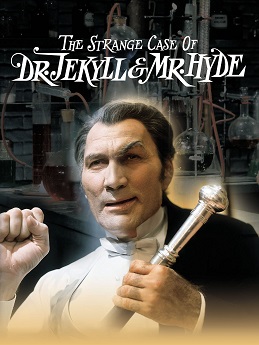
Horror Film Review: The Strange Case of Dr. Jekyll and Mr. Hyde (dir by Charles Jarrott)


First released in 1968, The Strange Case of Dr. Jekyll and Mr. Hyde is a somewhat loose adaptation of the famous novella by Robert Louis Stevenson.

Jack Palance stars as Dr. Henry Jekyll, a mild-mannered and respected doctor who lives in Victorian-era London and who is convinced that there is a good and dark side lurking in every single person.  The dark side is what forces people to break the law and fight with each other.  Jekyll feels that his experiments will allow people to get closer to their dark side and, in doing so, defeat it.  When Dr. Jekyll explains his theories to a medical association, he is violently jeered and booed.  Jekyll returns to his home, enters his laboratory, and takes a drink of the serum that he’s been developing.

The next morning, Dr. Jekyll wakes up with a hangover and no memory of how he spent the previous night.  Trying to retrace his steps, Jekyll finds himself in a dance hall where everyone is talking about a well-dressed but ugly man named Edward Hyde.  Hyde showed up the previous night, spent a lot of money on a woman named Gwyn (Billie Whitelaw), and then got into a fight with two men.  Hyde broke a window to make his escape.  Jekyll, sensing what must have happened, pays for the window on behalf of his “friend,” Edward Hyde.

Jekyll continues to drink the serum and he continues to indulge in all of the forbidden vices as Edward Hyde.  Eventually, we get to see Palance as Hyde.  Unlike a lot of other actors who have played the role, Palance uses a minimum of makeup to suggest his transformation.  Instead, he hunches over, scrunches up his face, and he has a unibrow.  One of the stranger things about this production is that we are continually told that Hyde looks nothing like Jekyll but we know that’s not true.  Instead, Hyde looks exactly like Jekyll making a funny face.

Palance gives one of his more eccentric performances as Jekyll and Hyde.  Somewhat surprisingly, he’s far more convincing as the kindly and troubled Dr. Jekyll than as the villainous Mr. Hyde.  (As Hyde, Palance is often trying to so hard to maintain his facial paralysis that it’s hard to understand exactly what it is that he’s saying.)  With each drink of the serum, Jekyll becomes a bit more confident in himself.  However, he also finds himself losing the ability to control the transformations.  One morning, he wakes up in his bed and is shocked to discover that he is still Hyde.  That same morning, he learns that Hyde is suspected of committing a senseless and brutal murder.  Jekyll has no memory of it but he knows that Hyde is guilty.  And if Hyde is guilty, so is Jekyll.  (Those who make the argument that Dr. Jekyll and Mr. Hyde is ultimately about drug addiction will find plenty to back up that argument in this production,)  Jekyll’s anguish as he realizes what he has become is rather poignant to watch.

Produced by horror impresario Dan Curtis, The Strange Case of Dr. Jekyll and Mr. Hyde can seem a bit creaky today.  It was apparently highly acclaimed when it first aired but, seen today, it can feel rather stagey and talky.  That said, the film has a strong supporting cast, with Denholm Elliott especially giving a good performance as Jekyll’s best friend.  Jack Palance’s performance is so bizarre that it transcends the usual standards used to determine good and bad.    It’s definitely a film worth watching.
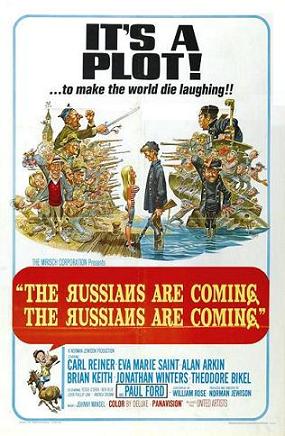
Lisa Reviews An Oscar Nominee: The Russians Are Coming, The Russians Are Coming (dir by Norman Jewison)


russians_are_coming

Earlier tonight, I watched a 1966 film called The Russians Are Coming, The Russians Are Coming.  

It’s a cheerful comedy about what happens when the captain (played by Theodore Bikel) of a Russian submarine decides that he wants to take a look at the United States.  Though he was only planning to look at America through a periscope, he accidentally runs the submarine into a sandbar sitting near Gloucester Island, which itself sits off the coast of Massachusetts.  The captain sends a nine man landing party, led by Lt. Yuri Rozanov (a youngish Alan Arkin, making his film debut and receiving an Oscar nomination for his efforts), to the island.  Their orders are simple.  Yuri and his men are too either borrow or steal a boat that can be used to push the submarine off the sandbar.  If they run into any locals, they are to claim to be Norwegian fisherman.

Needless to say, things that don’t quite go as planned.  The first Americans that Yuri and his men meet are the family of Walt Whitaker (Carl Reiner), a vacationing playwright.  Walt’s youngest son immediately identifies the Norwegian fisherman as being “Russians with submachine guns.”  When Walt laughingly asks Yuri if he’s a “Russian with a submachine gun,” Yuri produces a submachine gun and promptly takes Walt, his wife (Eva Marie Saint), and his children hostage.

Yuri may be a Russian.  He may officially be an enemy of America.  But he’s actually a pretty nice guy.  All he wants to do is find a boat, keep his men safe, and leave the island with as little drama as possible.  However, the inhabitants of the island have other plans.  As rumors spread that the Russians have landed, the eccentric and largely elderly population of Gloucester Island prepares for war.  Even as Police Chief Mattocks (Brian Keith) and his bumbling assistant, Norman Jonas (Jonathan Winters), attempt to keep everyone calm, Fendall Hawkins (Paul Ford) is organizing a militia and trying to contact the U.S. Air Force.

Meanwhile, Walt’s babysitter, Allison (Andrea Dromm) finds herself falling in love with one of the Russians, the gentle Alexei Kolchin (John Phillip Law).

As I said at the start of this review, The Russians Are Coming, The Russians Are Coming is a cheerful comedy, one with a rather gentle political subtext, suggesting that the majority of international conflicts could be avoided if people got to know each other as people as opposed to judging them based on nationality or ideology.  There’s a rather old-fashioned liberalism to it that probably seemed quite daring in 1966 but which feels rather quaint today.  Sometimes, the comedy gets a bit broad and there were a few times that I found myself surprised that the film didn’t come with a laugh track.  But overall, this is a well-acted and likable little movie.

As I watched The Russians Are Coming, The Russians Are Coming (and, as someone who is contractually obligated to use a certain number of words per review, allow me to say how much I enjoyed the length of that title), I found myself considering that the film would have seemed dated in 2013 but, with all the talk of Russian hacking in the election and everything else, it now feels a little bit more relevant.  Not a day goes by when I don’t see someone on twitter announcing that the Russians are coming.  Of course, if the film were released today, its optimistic ending would probably be denounced as an unacceptable compromise.  Peaceful co-existence is no longer as trendy as it once was.

Another interesting thing to note about The Russians Are Coming, The Russians are Coming: though the film was written by William Rose (who also wrote another example of mild 1960s feelgood liberalism, Guess Who’s Coming To Dinner), it was based on a novel by Nathaniel Benchley.  Benchley was the father of Peter Benchley, the author of Jaws.  It’s easy to see the eccentrics of Gloucester Island as distant cousins of the inhabitants of Amity Island.

As previously stated, The Russians Are Coming, The Russians Are Coming was nominated for best picture but it lost to the far more weighty A Man For All Seasons.

The Fabulous Forties #26: The Way Ahead (dir by Carol Reed)


The_Way_Ahead_VideoCover

The 26th film in Mill Creek’s Fabulous Forties box set was the 1944 British film, The Way Ahead (or, as it was retitled when it was released in America, The Immortal Battalion).

Directed by Carol Reed (who was five years away from directing the great The Third Man), The Way Ahead is a British propaganda film that was made to boost the morale of both a weary British public and the army during the final days of World War II.  Usually, when we call something propaganda, it’s meant as a term of disparagement but The Way Ahead is propaganda in the best possible way.

The film follows a group of British soldiers, from the moment that they are conscripted through their training to their first battle.  (In many ways, it’s like a more refined — which is another way of saying “more British” — version of Gung Ho!)  As usually happens in films like this, the newly conscripted soldiers come from all sections of society.  Some of them are poor.  Some of them are rich.  Some of them are married.  Some of them are single.  In fact, when the film first begins, the only thing that they all have in common is that they don’t want to be in the army.

As they begin their training, they resent their tough sergeant, Fletcher (William Hartnell), and are upset that Lt. Jim Perry (David Niven, giving a very likable performance) always seems to take Fletcher’s side in any dispute.  However, as time passes by, the soldiers start to realize that Fletcher is looking out for them and molding them into a cohesive unit.  Under his training, they go from being a group of disorganized and somewhat resentful individuals to being a tough and well-organized battalion.

Though they’re originally skeptical that they’ll ever see combat, the battalion is eventually sent to North Africa.  However, their ship is torpedoed and, in a scene that remains genuinely impressive even when viewed today, the men are forced to abandon ship while explosions and flames light up the night sky.  By the time that they do finally reach North Africa, they are more than ready to fight…

The Way Ahead plays out in a semi-documentary fashion (it even features a narrator who, at the end of the film, exhorts the audience to stay firm in their commitment) and it’s a fairly predictable film.  If you’ve ever seen a war film, you’ll probably be able to predict everything that happens in The Way Ahead.  That said, The Way Ahead is a remarkable well-made and well-acted film.  The cast is well-selected (and features a lot of familiar British characters actors, some making their film debut) and David Niven is the perfect choice for the mild-mannered but firm Lt. Perry.  Even though I’m not a huge fan of war films in general, I was still impressed with The Way Ahead.

And you can watch it below!