A Movie A Day #146: The Dogs of War (1981, directed by John Irvin)


Jamie Shannon (Christopher Walken) is a professional mercenary who is hired, by a British businessman, to overthrow the government of Zangaro.  Though Zangaro is currently ruled by a ruthless dictator, Shannon’s employers want to replace him with someone even worse, all so they can get their hands on the country’s platinum mines.  After Shannon is captured and tortured by the government, he wants nothing else to do with Zangaro.  Instead, he wants to return to New York and propose to his ex-wife (JoBeth Williams).  But, when she turns down his proposal, Shannon and his mercenary army return to Zangaro.

Before winning an Oscar for The Deer Hunter and becoming one of our most popular character actors, Christopher Walken was a finalist for the role of Han Solo in Star Wars.  If not for George Lucas’s decision to hire Harrison Ford to read lines for the actors at the auditions, Christopher Walken’s career could have developed far differently.  The Dogs of War, which was Walken’s first big film after the high of The Deer Hunter and the low of Heaven’s Gate, features Walken playing a character who has much in common with George Lucas’s original conception of Han Solo, an amoral mercenary who will work for anyone who pays him.  Walken is almost too good as Jamie, playing the part as being so aloof and ruthless that it is sometimes hard to feel any sympathy for him at all.  If he had taken that approach to playing Han Solo, audiences would have really been shocked when Han returned to attack the Death Star.  They would probably be worried that he had returned because the Empire offered him a thousand credits to kill Luke.

The Dogs of War has an intriguing premise but it’s a very slow movie that gets caught up in all the minutia that goes into staging a coup.  It’s exciting when Walken and his mercenaries finally attack the dictator’s compound but it takes forever to get there.  The book, by Frederick Forsyth, is a well-written page turner but the film adaptation largely falls flat.
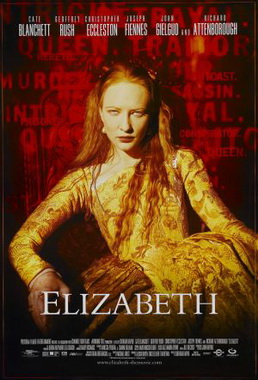
Embracing the Melodrama Part II #97: Elizabeth (dir by Shekhar Kapur)


Elizabeth_Poster“I am no man’s Elizabeth!”

— Queen Elizabeth I (Cate Blanchett) in Elizabeth (1998)

I have to admit that I always feel guilty about the fact that I love movies about British royal history.  After all, I have roots in Northern Ireland and I was raised Catholic.  If anything, I should refuse to watch films about British royalty on general principle.  I should be writing more reviews of films like Bloody Sunday.

But I can’t help myself.  Whether it’s because I enjoy looking at all of the costumes or I just have a thing for movies set in drafty old castles, I have a weakness for films about British royalty.  (And I will also admit that I sat through the entire royal wedding and I have a bit of a girlcrush on both Pippa and Kate Middleton.  As I said, I just can’t help myself.)

Of course, some of it definitely has to do with the fact that I’m an unapologetic history nerd.  I am fascinated with how people lived in the past.  And, of course, anyone who shares my obsession understands that, when it comes to history, there’s both the official story and the truth.  The official story is something that’s passed down over the centuries.  It’s what we learn in school.  The truth, however, is always far more obscure.  The truth is what historians piece together from what little gossipy evidence has managed to survive the passage of time.

We all know that the official story of Queen Elizabeth I is that she was England’s greatest Queen, she defeated the Spanish Armada, and she never married.  She was the “Virgin Queen,” forsaking love to serve her nation.  That’s the official story but is it the truth?

That’s the question at the heart of the 1998 Best Picture nominee Elizabeth.  Now, don’t get me wrong.  I’m not arguing that Elizabeth represents the truth.  Historically, the film is messy and full of speculation that is less based on evidence and more on the desire to keep things cinematic.  But still, Elizabeth is an interesting film specifically because it takes a historical figure and dares to suggest that she may have been human before she became an icon.

Cate Blanchett gives a great performance in the role of Elizabeth.  When we first meet her, she’s a somewhat silly girl who is less concerned with politics and religion and more concerned with her boyfriend, Robert Dudley (Joseph Fiennes).  Elizabeth is also the protestant half-sister of Catholic Queen Mary (Kathy Burke).  Mary is planning on ordering Elizabeth’s execution but dies of stomach cancer before she gets around to singing the order.

Suddenly, Elizabeth is Queen of England.  Young and insecure, she is, at first, manipulated by advisors like William Cecil (Richard Attenbrough), who pressures her to marry the cross-dressing Henry III (Vincent Cassel) of France.  Meanwhile, the Pope (John Gielgud) signs an order calling for Elizabeth’s death.  Catholic nobleman Thomas Howard (Christopher Eccleston) and mysterious priest John Ballard (Daniel Craig) conspire to assassinate Elizabeth.  With even Robert Dudley giving her reason to distrust him, Elizabeth discovers that her only ally is the enigmatic and ruthless “spymaster,” Francis Walsingham (Geoffrey Rush). It all ultimately ends in a sequence that basically transports the finale of The Godfather to the Elizabethan era.

I really should not like Elizabeth.  It’s undoubtedly an anti-Catholic film, though it’s nothing compared to the histrionic anti-Catholicism of its sequel, Elizabeth: The Golden Age.  But I can’t help myself, I enjoyed Elizabeth.  It was impossible for me not to relate to Cate Blanchett’s passionate performance.  (And there was just something so incredibly hot about the way Joseph Fiennes, with his intense eyes, would stare at her.)  When you ignore the film’s protestant bias and just concentrate on the performances and the gorgeous production design, you can’t help but love Elizabeth.