4 Or More Shots From 4 Or More Films is just what it says it is, 4 shots from 4 of our favorite films. As opposed to the reviews and recaps that we usually post, 4 Shots From 4 Films lets the visuals do the talking!
Today would have been Tennessee Williams’s 114th birthday! It’s time for….
4 Shots From 4 Tennessee Williams Films
A Streetcar Named Desire (1951, dir by Elia Kazan, DP: Harry Stradling)
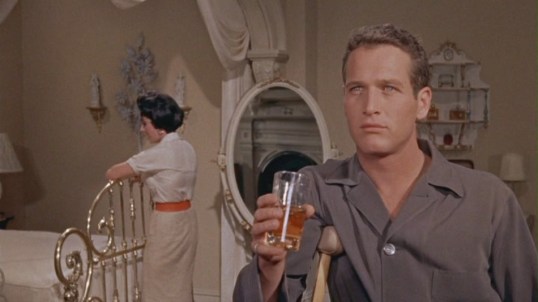
Cat On A Hot Tin Roof (1958, dir by Richard Brooks, DP: William Daniels)
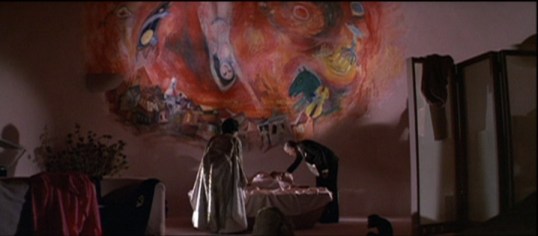
Suddenly, Last Summer (1959, dir by Joseph L. Mankiewicz, DP: Jack Hildyard)
In 1951’s A Streetcar Named Desire, the emotionally fragile Blanche (played by Vivien Leigh) has come to New Orleans to live with her younger sister, Stella (Kim Hunter). From an old and formerly wealthy Southern family, Blanche has recently lost both her job as a teacher and the plantation where she and Stella grew up. Even before that, she lost her husband to suicide. And now Blanche has been reduced to living with Stella in the run-down apartment that she shares with her brutish husband, Stanley Kowalksi (Marlon Brando).
Stanley is tough and blue-collar, an earthy gambler whose bad manners stand in sharp contrast to Blanche’s attempts to present herself as being an elegant Southern belle. Stanley, who is convinced that Blanche has money that she’s hiding from her sister, goes out of his way torment Blanche. Stella, who is pregnant, tries to keep the peace between her sister and the man who claims to love her, his family, and the Napoleonic code. (“Stella!” Stanley yells at one point, the cry of a wounded animal who desperately needs his mate.) Blanche ends up going on a tentative date with Mitch (Karl Malden), one of Stanley’s co-workers, Stanley, who sees Blanche as a threat to the life that he’s created for himself, goes out of his way to destroy even that relationship. Blanche has secrets of her own and Stanley is determined to dig them up and use them to his own advantage. When Blanche refuses to allow Stanley to destroy the fantasy world that she’s created for herself, Stanley commits an act of unspeakable violence.
Based on the play by Tennessee Williams, A Streetcar Named Desire is a recreation of the film’s legendary Broadway production. Elia Kazan, who directed the theatrical production, does the same for the film. Marlon Brando, Kim Hunter, and Karl Malden recreate their stage roles and many of the minor characters are also played by the same actors who played them on stage. The only major change to the cast is Vivien Leigh, who replaces Jessica Tandy in the role of Blanche. Tandy had won a Tony for playing the role of Blanche but the film’s producer insisted on an actress who had more box office appeal. After both Bette Davis and Olivia de Havilland (both of whom would have had too strong of a personality to be believably pushed around by Stanley) declined the role, Vivien Leigh was cast. Leigh has played Blanche on the London stage and, perhaps even more importantly, her own fragile mental health mirrored much of what Blanche had gone through before moving to New Orleans.
A few changes were made to the play. In the play, it’s made clear that Blanche’s husband committed suicide after he was caught having an affair with another man. In the film, Blanche simply says that her husband was too sensitive. The film also includes a few scenes that are set outside of the apartment in an attempt to open up the play. (That said, the film still comes across as being rather stagey.) In the play, it’s made clear what Stanley does to Blanche while Stella is at the hospital. The film leaves it ambiguous, though still providing enough hints for the audience to figure it out on their own. Finally, the film ends with a suggestion that Stanley will ultimately suffer for his bad behavior. It’s hardly a happy ending but it’s still not as dark as what happens in the play.
The film definitely retains its theatrical origins. It’s very much a filmed play and again, it can feel rather stagey. But the performance are so strong that it really doesn’t matter. A Streetcar Named Desire was the first film to win three of the acting awards, with Oscars going to Hunter, Malden, and Leigh. Marlon Brando was nominated for Best Actor but did not win, largely because he was competing against Humphrey Bogart who, himself, had never won an Oscar. (The Brando snub would be rectified when he later won for On The Waterfront.) Brando’s performance as Stanley still holds up today. He’s so ferociously charismatic that it’s actually a bit scary to watch him. One can see what drew Stella to him, even though Stanley is very much not a good man. It’s a performance that will definitely take by surprise anyone who knows Brando only from his later years, when he was known for his weight and his oft-stated boredom with acting. A Streetcar Named Desire shows just how brilliant an actor Marlon Brando was at the start of his career. The intensity of Brando’s method acting matches up perfectly with Vivien Leigh’s more traditional style of acting and the film becomes not just the story of a domineering brute and a fragile houseguest but also a metaphor for the death of the antebellum South. If Blanche represents a genteel past that may have never existed, Stanley represents the brutality of the 20th Century.
Along with the similarly dark A Place In The Sun, A Streetcar named Desire was considered to be a front runner for the 1951 Best Picture Oscar. In the end, though, the voters went for the much less depressing An American In Paris.
A Streetcar Named Desire (1951, dir by Elia Kazan, DP: Harry Stradling)
The 1958 best picture nominee, Cat On A Hot Tin Roof, opens with a 30-something Paul Newman doing something stupid.
It’s a testament to just how incredibly handsome Paul Newman was in the 1950s that he can still be sexy even while he’s stumbling around in a drunken haze and attempting to jump over hurdles on a high school football field. Newman is playing Brick Pollitt, youngest son of the wealthy cotton farmer Big Daddy Pollitt (Burl Ives). Brick was a star athlete in high school but now, he’s a drunk with an unhappy marriage and a lot of bitter feelings. When Brick attempts to jump over the hurdles, he breaks his ankle. The only thing that keeps Brick from being as big a loser as Biff Loman is the fact that he looks like Paul Newman.
Brick is married to Maggie (Elizabeth Taylor), a beautiful woman who may have grown up on the wrong side of the tracks but who has married into money. The only problem is that it doesn’t seem like Brick is ever going to get that money. With Big Daddy getting older, everyone in Mississippi is wondering which Pollitt son will inherit his fortune. Will it be drunken, self-pitying Brick or will it be Goober (Jack Carson) and his wife (Madeleine Sherwood)? One point in Goober’s favor is that he and his wife already have five rambunctious children while Brick and Maggie have none. In fact, gossip has it that Brick and Maggie aren’t even sleeping in the same bed! (While Maggie begs Brick to make love to her, Brick defiantly sleeps on the couch.) The other problem is that, for whatever reason, Brick harbors unending resentment towards … well, everything. Perhaps it has something to do with the mysterious death of Brick’s best friend and former teammate, Skipper…
Brick, Maggie, Goober, and the whole clan are in Mississippi to celebrate Big Daddy’s 65th birthday. Big Daddy is happy because he’s just been told that, despite a recent scare, he does not have cancer. What Big Daddy doesn’t know is that his doctor (Larry Gates) lied to him. Big Daddy does have cancer. In fact, Big Daddy only has a year to live.
Whenever I watch Cat On A Hot Tin Roof, I find it’s helpful to try to imagine what it would have been like to watch the movie in the 1950s. Imagine how audiences, at a time when married couples were still regularly portrayed as sleeping in separate beds and when men were naturally assumed to be the kings of their household, reacted to seeing a film where Elizabeth Taylor was literally reduced to begging Paul Newman to make love to her while Newman hopped around on a crutch and continually found himself getting stuck in embarrassing situations. Though it may seem tame by today’s standards, the film was undeniably daring for 1958 and watching it is like stepping into a time machine and discovering that, yes, there was a time when Elizabeth Taylor wearing a modest slip was considered to be the height of raciness.
Of course, the film itself is quite toned down from the Tennessee Williams’s play on which it was based. Williams reportedly hated the changes that were made in the screenplay. In the play, Skipper committed suicide after confessing that he had romantic feelings for Brick, feelings that Brick claims he did not reciprocate. That was glossed voter in the film, as was the story of Skipper’s unsuccessful attempt to prove his heterosexuality by having sex with Maggie. By removing any direct reference to the romantic undercurrent of Brick and Skipper’s relationship, the film also removes most of Brick’s motivation. (It’s still there in the subtext, of course, but it’s probable that the hints that Newman and Taylor provided in their performances went straight over the heads of most audience members.) In the play, Brick is tortured by self-doubt and questions about his own sexuality. In the film, he just comes across as being rather petulant.
And again, it’s fortunate that, in the film, Brick was played by Paul Newman. It doesn’t matter how bitter Brick becomes or how much he whines about not wanting to be around his family. One look at Newman’s blue eyes and you understand why Maggie is willing to put up with him. In the role of Maggie, Elizabeth Taylor gives a performance that manages to be both ferocious and delicate at the same time. Maggie knows how to play the genteel games of the upper class South but she’s definitely not going to let anyone push her around. It’s easy to see why Big Daddy prefers the company of Maggie to his own blood relations. It’s not just that Maggie’s beautiful, though the implication that Big Daddy is attracted to her is certainly present in the film. It’s also the she’s the only person around who is as strong and determined as him.
Indeed, seen today, Cat On A Hot Tin Roof‘s main strength is that it’s a masterclass in good acting. Williams’s dialogue is so stylized and his plot is so melodramatic that one bad performance would have caused the entire film to implode. Fortunately, Newman and Taylor make even the archest of lines sound totally natural while Burl Ives and Judith Anderson are both the epitome of flamboyant charisma as Big Daddy and Big Mama. It takes a lot of personality to earn a nickname like Big Daddy but Ives pulls it off.
Along with being a huge box office success, Cat On A Hot Tin Roof was nominated for best picture of 1958. However, it lost to Gigi.



 Through the Shattered Lens