The TSL Horror Grindhouse: Boogeyman II (dir by Ulli Lommel)


Filmed in 1982 but not released until 1984, Boogeyman II is — as the name implies — the sequel to 1980’s The Boogeyman.

What’s that, you say?  You don’t remember anything about The Boogeyman and you don’t want to take the time to read my review of it?  Well, don’t worry.  It’s not necessary to have seen the original Boogeyman to follow the sequel, largely because the sequel is full of flashbacks to the first film.  Boogeyman II is only 79 minutes long and 30 minutes of that running time is taken up with footage from the first Boogeyman.  Indeed, if you want to see the good parts of Boogeyman without having to deal with any of the filler, I would recommend just watching the first 30 minutes of Boogeyman II.

There is a plot to Boogeyman II, kind of.  Having survived the massacre of her family at the farm, the now-divorced Lacey (played by Suzanna Love, the then-wife of director Ulli Lommel) goes out to California to visit her friends, actress Bonnie (Shannah Hall) and her husband, director Mickey (Lommel).  How is it that Lacey, who was portrayed as being a simple and not particularly worldly farm wife in the first film, happens to be friends with a wealthy actress and director?  It’s never really explained.

Bonnie and Mickey ask Lacey whether or not the people who killed her family were ever caught.  Lacey replies that they can’t be caught because they’re spirits.  Over dinner, Lacey tells Bonnie and Mickey the story of the shattered mirror and the killer whose spirit was trapped in the broken glass.  Bonnie and Mickey listen sympathetically, though they both think that Lacey’s crazy.  (Perhaps they noticed that Lacey’s flashbacks include scenes in which she wasn’t even present.  Or maybe they’re wondering why Lacey would take the time to apparently describe a lengthy, bondage-themed nightmare that she had during the first film.  Or maybe they’re just amazed by the presence of John Carradine in the flashbacks.)  Bonnie and Mickey also think that Lacey’s story would make a great movie!

For some reason, Lacey is still carrying around a piece of the haunted mirror.  This is the mirror that contains the spirit that possessed her during the first film and which killed the majority of her family.  I would throw that piece of the mirror away but I guess Lacey’s more sentimental than I am.  A creepy butler named Joseph (Sholto von Douglas, a rather stiff actor who still had a fascinatingly menacing screen presence) steals the piece of the mirror and soon, Hollywood phonies are dying.

Boogeyman II was directed by the late Ulli Lommel, a German director who got his start as an associate of Rainer Werner Fassbinder’s and who eventually came to America, where he hung out with Andy Warhol, directed some documentaries about the American punk scene, and married heiress Suzanna Love.  Love bankrolled Lommel’s early films, including The Boogeyman.  With Lommel, it was always a challenge to figure out how seriously he took any of his films.  In interviews, he would joke about being an exploitation filmmaker while, at the same time, claiming that his films were designed to expose the hypocrisy of American society.  Boogeyman II is full of phony Hollywood types and there’s a scene where Mickey comments that, in America, “exploitation is a genre.”  It’s probably not a coincidence that it’s the servant, Joseph, who uses the mirror to take out the film’s wealthy victims.  The opening credits of Boogeyman II appear to literally be written in magic marker.  Is Lommel mocking expensive Hollywood productions or could Lommel only afford a box of magic markers?  I suppose both could be true.

The best parts of Boogeyman II are the flashback to the first film, which was a genuinely atmospheric horror film with some serious pacing issues.  The rest of Boogeyman II is dull, though you do have to appreciate the sense of ennui that Lommel brings to the proceedings.  Was the ennui intentional?  That’s the mystery of Ulli Lommel.

As for Lommel, he and Love eventually divorced and Lommel ended his career making trashy true crime films that went direct-to-video.  As usual, Lommel claimed that his crime films were meant to be a serious critique of everything that was wrong with America.  Lommel’s true crime films have none of the atmosphere or occasional flashes of wit that distinguished Lommel’s earlier films.  Was Lommel an incompetent director or was he a subversive artist?  Again, both could be true.  Lommel died in 2017, bringing to close an enigmatic career.
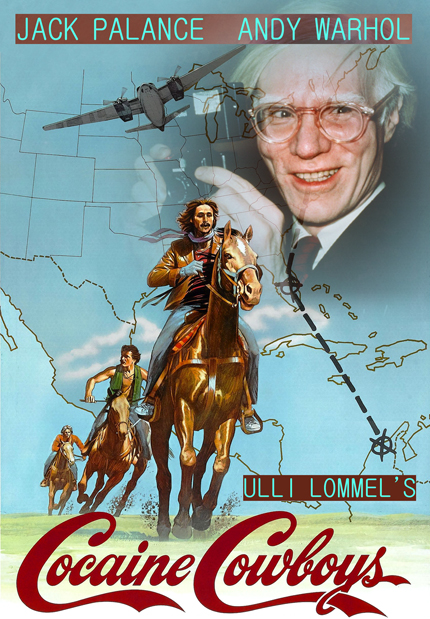
Film Review: Cocaine Cowboys (dir by Ulli Lommel)


Two million dollars worth of cocaine has gone missing in Long Island and Andy Warhol is on the case!

Believe it or not, that’s actually a fairly accurate summation of this 1979 film.  The film does feature a plot about several people looking for a lot of missing cocaine and Andy Warhol does play himself.  And Andy does discover what happened to the cocaine!  He even leaves behind some helpful Polaroids of the cocaine’s location, all of which he signs, “Good Luck, Andy!”

But, here’s the thing.  This is an 80 minutes film.  Though Andy appears at different moments throughout the film, he really only has less than 10 minutes of screentime.  He spends most of that time lurking around with a camera and muttering the occasional word of wisdom.

What’s goes on during the rest of the movie?  Not much.  While waiting to make it big with his band, Dustin (Tom Sullivan) has been making ends meet by smuggling cocaine.  Even though Dustin and the rest of the band want to get out of the drug business, their manager (Jack Palance … wait, Jack Palance!?) sets up one last score.  Unfortunately, while the cocaine is being flown out to Long Island, it falls out of the plane and lands in the water!  Uh-oh!  The drug dealers want their cocaine.  Jack Palance wants the cocaine.  The band wants to find the cocaine and they’re even willing to ride around to horses to look for it.  Some other people want the cocaine but I’m not sure who they were supposed to be.  Andy Warhol does not want the cocaine.  He just wants to talk about Interview Magazine and take pictures of the band.

Almost everyone wants to find the cocaine but, interestingly enough, they’re all pretty laid back about it.  Sure, the band might spend some time looking but they’re just as likely to be found performing a song.  To be honest, the band’s not that bad.  I went to the University of North Texas, which is famous for its music school, and the band definitely has a UNT sound to it.  They’re good without being so good that you’d ever expect them to become stars.  The band’s best song features Dustin going, “We’re cocaine cowboys,” over and over again.

According to The Warhol Diaries, the film’s star, Tom Sullivan, was a real-life drug dealer.  This movie was his attempt to recreate himself as both a film star and rock star.  It didn’t work.  This was Tom Sullivan’s only film credit and he died two years later, at the age of 23.

So, maybe you’re wondering how Jack Palance and Andy Warhol ended up in this obscure little film.  Well, I don’t know what Palance was doing there and, judging from his performance, he didn’t know either.  Warhol was in the film because 1) it was filmed at his Long Island estate and 2) he was friends with director Ulli Lommel.  Today, Lommel is best known for directing crappy true crime horror films but, at the start of his career, he was a protegé of both Rainer Werner Fassbinder’s and Andy Warhol’s.

(Lommel’s then-wife and financial backer, Suzanna Love, also appears in the film.  Horror fans will immediately recognize her from her starring turns in Lommel’s The Boogeyman and The Devonsville Terror.)

Particularly when compared to Ulli Lommel’s later, better-known films (like the unwatchable Curse of the Zodiac), Cocaine Cowboys isn’t that bad.  It’s pointless but it’s pointless by design.  Everyone in the film is so detached and out-of-it that the film becomes a portrait of ennui.  It’s a film that very much shows the influence of Fassbinder and Warhol, taking a popular genre — in this case, the drug rip-off film — and then tearing away at all of the artifice.  “Really?  The French Connection had a car chase?” the film seems to be saying, “Well, Cocaine Cowboys doesn’t have anything!  Just like real life.”

Of course, that’s not totally true.  Cocaine Cowboys does have something.  It has Andy Warhol solving a mystery and that’s got to be worth something.

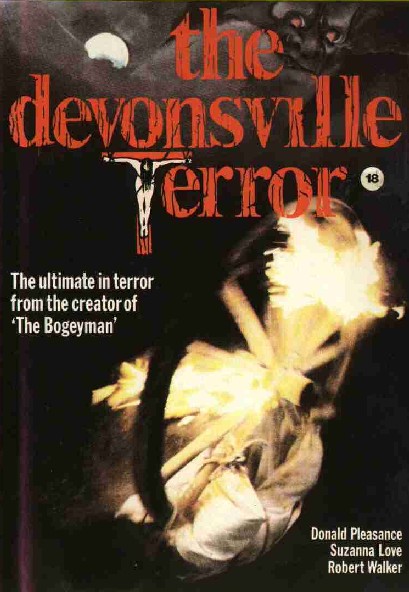
Horror Film Review: The Devonsville Terror (dir by Ulli Lommel)


DevonsvilleTerror

Who is the world’s worst director?

That’s a question that can really lead to lot of conflict.  First off, it’s a deceptively simple question.  The more you think about it, the more you realize how fragile concepts like good and bad truly are.  Some of the greatest films ever made were critical flops.  Some of the films that have been embraced by contemporary critics will definitely be less acclaimed by future viewers.  There’s a lot to take into consideration when it comes to determining whether or not a filmmaker is good, mediocre, or one of the worst of all time.  It’s something that requires a lot of careful thought and consideration and research.

Of course, if you don’t have time for all that, you can just say that the world’s worst director is Ulli Lommel and save yourself the trouble.

This German director has been making movies for longer than I’ve been alive.  He got his start in the early 70s, as an actor who frequently collaborated with the great German filmmaker Rainer Werner Fassbinder.  With Fassbinder as his producer, Lommel made a few surrealistic (and, it should be stated, critically acclaimed) films in Germany and then, in 1977, he moved to the U.S, and became friends with Andy Warhol.  He also married Suzanna Love, an actress who was the heiress to the Standard Oil Fortune and who starred in a handful of Lommel’s early films.

Today, Lommel’s reputation for being the world’s worst director is largely the result of an endless series of low-budget, straight-to-DVD films that he’s made about various real-life serial killers.  I’ve seen quite a few of these movies (and I reviewed Lommel’s Curse of the Zodiac three years ago) and they are truly bad.  Normally, I can find something to love about almost every movie that I watch but Lommel’s serial killer films are beyond terrible.  They’re so bad that they are almost impossible to review.  I mean, how many different ways can you find to say that a movie sucks so much that it will make you question whether Eadweard Muybride should ever have filmed Sallie Gardner at a Gallop in the first place?

But here’s the thing with Ulli Lommel and this what makes it especially so frustrating to see him currently doing a thousand variations on Curse of the Zodiac.  His first two horror films — both of which were filmed in the early 80s and starred Love — are not that bad.  Don’t misunderstand me.  They’re not particularly good but they still feature enough hints of genuine talent and inspiration that you have to wonder just what the Hell happened.

The first (and best known) of Lommel’s horror films was 1980’s The Boogeyman, an incredibly stupid film that still featured some good atmosphere and a few memorable deaths.  Lommel followed The Boogeyman with 1983’s The Devonsville Terror.

The Devonsville Terror may not have the same cult status as The Boogeyman but it’s actually a far more interesting film.  The film opens in the 17th Century.  In the Massachusetts town of Devonsville, three women are executed for being witches.  After the final witch is burned, her spirit appears in the sky and announces that the town is now cursed.

We then jump forward 300 years.  Dr. Warley is researching the Devonsville curse.  By researching, I mean that he continually invites citizens in Devonsville into his office and hypnotizes them, which leads to them having flashbacks to 1683 and those of us in the audience having to continually rewatch the first few minutes of the movie.  The spirit of the witch curses Dr. Warley and soon, he’s having to pull maggots out of his arm.  It doesn’t add up too much but Dr. Warley is played by Donald Pleasence so he’s at least entertaining.

Meanwhile, a new school teacher, Jenny (played by Suzanna Love), has moved into town and she’s teaching the kids to think for themselves and even goes as far as to suggest that God might be a woman!  The town leaders are shocked and more than a few of them start to suspect that she might be a reincarnated witch…

At the same time, a loser named Walter (Paull Wilson) has just murdered his wife and soon finds himself having nightmares where Jenny allows him to drown in a swamp.  “The legend’s true!” Walter shouts in his dream, “You are a witch!”

On top of that, two other liberated women have recently moved into town, which leads to a panic as the townfathers realize that their town — best known for executing three witches — is now home to three feminists!

Of course, it all leads to an attempt to duplicate the executions of 1683.  Heads explode.  Faces melt.  Don’t mess with the witches, y’all.  That’s all I’m saying.

The Devonsville Terror is a huge mess but, much like The Boogeyman, the film has a lot of atmosphere and features a good performance from Suzanna Love.  (As well, just as The Boogeyman features John Carradine not doing much of anything, Devonsville Terror features Donald Pleasence not doing much of anything.)  But the main thing I liked about The Devonsville Terror was its feminist subtext, which is not something you would typically expect to find in a horror film from the early 80s.

You have to ask yourself — how did the director of The Devonsville Terror ends up becoming the guy who directed Curse of the Zodiac and Mondo Americana?  One huge clue is probably found in the fact that Suzanna Love is nowhere to be found in any of Lommel’s later films.  According to the imdb, Lommel and Love divorced in 1987.

With Suzanna Love, Ulli Lommel was an occasionally interesting, if uneven, filmmaker.

Without her, he’s just the guy who directed Curse of the Zodiac.

Horror Film Review: The Boogeyman (dir. by Ulli Lommel)


So, last night, we finally got a proper storm here in Texas and wow, was I happy!  Quite frankly, it’s not October unless you’ve got thunder, lightening, and howling wind.  Of course, I also ended up getting caught out in the middle of it all and ended up getting soaked just from running from my car to the front door of my house.  Seriously, it’s amazing how quickly your life can turn into a wet t-shirt contest.  (Once I got inside, I did what anyone would do and jumped on twitter so I could tell everyone I was soaked.  “OMG, I’m so wet!” I tweeted, with the most innocent of intentions.)   Anyway, as I dried off, I watched The Boogeyman off of Fearnet.  No, I’m not talking about The Boogeyman that starred the oldest son from Seventh Heaven.  No, The Boogeyman I watched is a genuinely weird little artifact from 1980 and it was directed by the infamous Ulli Lommel.

A hybrid of Halloween, the Exorcist, and probably every other horror film that had been released up to 1980, The Boogeyman opens up with siblings Willy and Lacey spying on their mother having sex with her creepy boyfriend who is wearing a nylon stocking over his face.  So, naturally, Willy grabs a butcher knife and stabs the man to death.  This act of violence is reflected in the bedroom mirror and, not surprisingly, this leads to the dead boyfriend’s evil spirit getting trapped in the mirror.  Or maybe it’s just the evil of the act itself.  Or maybe it’s … well, there’s a lot of possibilities and it’s hard not to consider them all because the film considers none of them, beyond the fact that the dead boyfriend is still in the mirror (which, let’s give credit where credit is due, is actually a pretty neat idea for a horror film).

Anyway, we jump forward 20 years and now, the brother and sister have grown up.  They both live on a farm with their judgmental, self-righteous, ballet-hating aunt and uncle.  (Okay, I’m projecting a little here because I have relatives who remind me of both of these characters and I always hated having to spend any time with them over the summer because I always knew they’d be all like, “Look at us, we’re  farm folk, we’re better than you and who needs books or ballet when you got foul-smelling chickens and cows that’ll kick you in the face just because they feel like it…”  Seriously.)  Willy (now played by Nicholas Love) has been mute since the day he brutally butchered his mother’s boyfriend and oddly enough, no one seems to be disturbed by the fact that he’s a murderer.  (“He’s a good boy,” his uncle says at one point, “I just wish he could talk.”)  Lacey (played by Suzanna Love) is married to Jake Scully (Ron James) and they have a son.  Judging from the uniform he’s wearing when he’s first introduced, Jake is apparently some sort of law enforcement guy.  He’s also a total and complete chauvinistic toadsucker who (though it’s never acknowledged in the film) is pretty much responsible for every terrible thing that’s about to happen.

Lacey is suffering from intense nightmares (the nightmare sequence, by the way, is one of the film’s genuinely disturbing moments) and she keeps waking everyone up at night with her screams.  Well, of course, Jake can’t have this because they’re farm folk, after all!  So, Jake has to act like a man about it and chastises Lacey for not suppressing her feelings.  When that doesn’t work, he drags her off to a therapist.  This would seem like a good idea except for the fact that the only therapist in their little rural community appears to be John Carradine.  Carradine grimaces through his three scenes, tells Lacey that she should go back to her childhood home and see that it’s just a normal house despite its history of brutal murder, and then leaves to collect his paycheck.  

Lacey says she doesn’t want to go back to the house where the most Hellish thing ever occurred.  Jake tells her that she’s being silly and that she’s going to go relive the worst event of her life whether she wants to or not.  Seriously, Jake sucks.

So, Jake drags Lacey back to her childhood home.  The house is now inhabited by two teenage sisters and their obnoxious little brother who spends his time running around and screaming, “Boogeyman!” at random.  He’s kind of a brat but don’t worry — he eventually yells “Boogeyman!” one too many times and ends up getting his neck crushed by a falling window.  That scene, by the way, genuinely shocked me because you just don’t expect to see little kids dispatched so graphically.  But he really kinda deserved it, if just to keep him from growing up to be like Jake.

But before the little boy gets killed, we get to watch Lacey and Jake wander through the house.  It turns out that, even though the house has changed owners, the exact same mirror is still hanging in the bedroom.  Lacey looks at the mirror, sees her mother’s dead boyfriend’s reflection, and proceeds to shatter the mirror into a hundred pieces.  Jake replies that she’s being silly and proceeds to put almost all the broken shards of the evil mirror into a paper bag so he can take them back to the farm with him.  Why?  Well, because he’s Jake so anything he does must be right…

Of course, by bringing the mirror to the farm (and then deciding to put it back together — really, Jake?), Jake has also brought the evil spirit of the dead boyfriend with him as well.  Once again, Jake sucks.  Though, in his defense, Lacey was having nightmares and Willy nearly strangled a neighbor girl, before John Carradine even suggested going to the house.  And mom’s dead boyfriend liked to wear a stocking over his head but was he really evil?  After all, he’s the one who ended up getting stabbed to death…well, regardless, now people start dying and eventually a priest has to come up to the house and try to remember the final scene of the Exorcist.  So, thanks a lot, Jake!   

The Boogeyman is one of those odd films that always seems to pop up on TV and hidden away in various DVD horror compilations.  Through no fault of my own, I’ve actually seen it a handful of times and every time, I’ve discovered something else that doesn’t really work.  The last time I watched it, I found myself concentrating on just how unconvincing all the actors (with the exception of Suzanna and Nicholas Love) were.*  Slowly but surely, I found myself growing obsessed with actor Ron James, who played Lacey’s husband with all the style and charisma of a cardboard cut-out.  (Of course, it doesn’t help that James was playing a character who, to put it charitably, is kind of a sexist pig.  “C’mon, Lacey, cheer up!” he says as he forces her to visit the house where the most traumatic event of her childhood occurred.)  Whenever the movie hit one of its many slow spots, I asked myself, “I wonder if Ron James gave up during the first day of shooting or the second?” 

And yet, oddly, this is a film that’s stuck with me.  The film has an effectively Southern gothic atmosphere to it and even the stiff performances and unnatural dialogue help to give the film a certain dream-like atmosphere.  I know quite a few people who argue that Ulli Lommel is the worst director of all time** but he actually comes up with some effectively surreal and disturbing images.  The sight of the dead boyfriend, with a nylon stocking pulled down of her face, suddenly staring at Lacey from the mirror is genuinely frightening, as is Lacey’s nightmare in which she’s bound and gagged by a knife-wielding assailant.  The idea of mirrors storing everything that they witness is an intriguing one and there’s a nicely surreal sequence in which poor, mute Willy paints over every reflective surface he can find.  Whether by intentional design or not, these flashes of genuine fright and oddness are all the more effective because they’re surrounded by such mundane material.  The end result is a film that’s either brilliant or terrible depending on which point you actually start watching it. 

————————–

* Actually, the Loves were pretty bad too.

**By the way, the worst director of all time is Rod “Straw Dogs” Lurie.