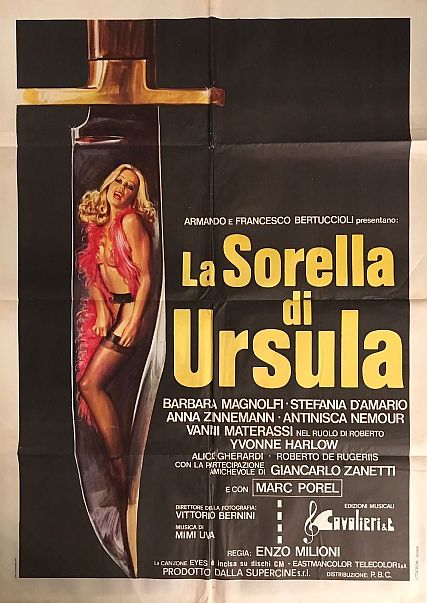
This 1978 Italian giallo tells the story of two sisters. Ursula (Barbara Magnolfi, who is best-known for playing Olga in Argento’s Suspiria) is high-strung and prone to nightmares. She claims that she can see people for who they really are. Dagmar (Stefania D’Amario) is a year or two older. She looks after her sister and makes sure that Ursula takes her pills. Still, it’s hard to escape the feeling that Dagmar would like to be free of having worry about Ursula.
After the death of their father, Ursula and Dagmar check into a hotel in an Italian resort town. Ursula wants to find their mother, a prostitute who left their father shortly after Ursula was born. Dagmar, for her part, seems to just want to take a vacation and maybe meet a few men. Ursula gives Dagmar a hard time for being promiscuous. Dagmar gives Ursula a hard time for being neurotic and not having any fun. It’s a typical family vacation.
Unfortunately, there’s also a homicidal lunatic on the loose, one that kills the promiscuous. In typical giallo fashion, he wears black gloves and, often, all we see of him is his madness-filled eyes. Unlike a lot of other giallo killers, he does not use a knife. Nor does he strangle his victims. Instead, he uses a big wooden dildo to beat people to death. Believe me, I’m probably making it sound more interesting than it actually is. For a film that wallows in sleaze, The Sister of Ursula doesn’t focus too much on the killer’s use of a dildo as a murder weapon, beyond showing its shadow on a wall at one point. It’s an odd piece of directorial restraint that feels at odds with the rest of the movie.
Describing The Sister of Ursula as being a sleazy film doesn’t begin to describe just how sleazy this film is. There’s not a single character to be found in the film who is not, in some way, perverse and the frequent soft-core sex scenes seem to exclusively take place in locations that don’t appear to have been cleaned anytime recently. (One such scene features a picture of Donald Duck hanging on the wall over the bed. That’s one of those weird but fun decorating choices that always seems to occur in giallo films.) There are many films that leave you feeling like you need to take a shower afterwards. This is one of the few films that I can think of that will leave you feeling like you need to take a shower every fifteen minutes or so.
As for the film’s mystery, it plays out at a languid pace. The story gets bogged down with a subplot about drug dealers. One would be tempted to say that the film cultivates an atmosphere of ennui but I think that’s giving The Sister of Ursula too much credit. This film was not made by a subversive artist like Jean Rollin or Jess Franco. Instead, it’s just a poorly directed and paced giallo film. That said, the Italian scenery is often lovely to look at and Barbara Magnolfi and Stefania D’Amario are believable as sisters. This is a minor giallo that’s not so much terrible as it’s just forgettable.
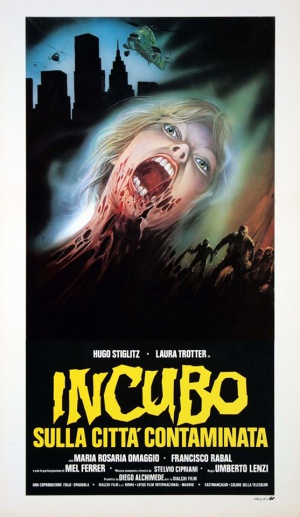
Since Case just reviewed 28 Days Later, this seems like the perfect time to say a few words about the 1980 Italian horror film, Nightmare City! Though Nightmare City has never been as critically acclaimed or as popular with audiences, it is regularly cited as probably being one of the main inspirations for 28 Days Later.
Now, don’t get me wrong. I can’t say for sure whether it was an influence or not. I listened to the entire Danny Boyle/Alex Garland commentary track on my DVD of 28 Days Later and neither of them ever mentioned Nightmare City. As well, there are some pretty big differences between Nightmare City and 28 Days Later. For one thing, 28 Days Later is a hyperkinetic Danny Boyle film whereas Nightmare City is obviously an Umberto Lenzi film, filled with over the top gore, gratuitous nudity, and nonstop violence. For that matter, the Infected in 28 Days Later still look human whereas all of the infected humans in Nightmare City are covered with what appears to be burned oatmeal. (I’m going to guess that it’s meant to be radiation scarring.)
And yet, despite all of that, it’s impossible to watch Nightmare City without thinking about 28 Days Later and vice versa. Both Nightmare City and 28 Days Later are commonly mislabeled as being zombie films, despite the fact that both of them are about people who have been driven mad by a military accident/experiment. Where you really see the influence that Nightmare City had on 28 Days Later is in the scenes in which various “infected” humans run through the streets, savagely attacking and killing anyone that they come across. For all the attention that was given to 28 Days Later‘s “fast zombies,” Nightmare City got there first. Call them human, call them infected, or call them zombies, the monsters in Nightmare City are relentless, unstoppable, and blood thirsty. Whatever flaws the movie may have, Nightmare City‘s zombies truly do belong in a nightmare.
(Except for that one scene in which a zombie extra is seen to be kicking a soccer ball while a dog chases after him but you have to look closely to notice…)
But before I say too much more about Nightmare City, I’m going to ask you to watch this tribute to the hero of Nightmare City, journalist Dean Miller:
Dean Miller was played by Spanish actor Hugo Stiglitz. (If that name sounds familiar, it may be because Quentin Tarantino named a character after him in Inglourious Basterds.) To be honest, the first time I ever saw Nightmare City, I thought that Stiglitz’s performance was one of the worst in the history of horror cinema. No matter how violent or bloody the film gets, Stiglitz rarely seems to react. He might occasionally arch an eyebrow. But, for the most part, he doesn’t seem to care. But, after subsequent viewings, I’ve come to respect the fact that, while everyone else in the film was overacting, Siglitz distinguished himself by refusing to act at all.
Nightmare City is a relentless and nonstop film. It starts out with Dean Miller being sent down to the local airport. His job is to cover the arrival of a scientist who has been assigned to investigate a recent nuclear accident. From the minute that the plane lands and a horde of hatchet-wielding zombies stream out onto the tarmac, Nightmare City is nonstop mayhem.
And, quite frankly, a lot of it doesn’t make much sense. At one point, the zombies enter a television studio and attack what appears to be the most boring dance show in the world and, as bloody and borderline disgusting as the action got, I still couldn’t get over how boring the dance show was before the zombies showed up. The other thing that struck me about that scene was that nobody at the television studio seemed to be that upset about a bunch of radiation-scarred zombies literally massacring hundreds of people on camera. Dean may have arched an eyebrow but even he didn’t seem that concerned.
(Fortunately, Dean manages to escape by grabbing a TV and throwing it at the zombies. Apparently, televisions explode if you throw them, even if they’re not plugged in at the time.)
Then the zombies attack a hospital and it’s the hospital attack that always disturbs me. There’s a scene where a nurse comes across a zombie raiding a blood bank and he shakes his head almost apologetically. Oddly, almost all of the doctors turn out to be self-defense experts. One elderly doctor even throws a scalpel at a zombie with all the skill of an Agent of SHIELD (or perhaps even …. HYDRA!)
Meanwhile, the military is supposed to be doing something but I’m not sure what. We get a lot of scenes of a general (played by Lenzi regular Mel Ferrer) staring down at a model of the city but he doesn’t ever actually seem to do anything. His assistant, meanwhile, is worried about his sculptor girlfriend being at home alone. He should be since there are two zombies in the basement, though we’re never quite sure how they got there without anyone else in the house noticing.
And the mayhem continues. There’s a zombie priest. There’s a zombie attack at an amusement park. There’s many scenes of Hugh Stiglitz staring off in the distance. At one point, his girlfriend falls off a roller coaster and we are briefly amazed at the sight of an obviously fake dummy crashing to the pavement below. But fear not because … it’s all a dream!
That’s right, Dean Miller wakes up in bed!
OH MY GOD, LISA, YOU JUST SPOILED THE MOVIE!
No, I didn’t. Believe it or not, the movie’s nowhere close to being over yet…..
Nightmare City is a hard film to review because, while it might not be good in any traditional sense, it’s also very much a one-of-a-kind movie. This is one of those relentless and shameless exploitation films that works despite itself. It’s preposterous, it’s silly, it’s often offensive, and yet it’s never less than watchable. If you’re into Italian horror, you have to see this film. If you’re into zombie cinema, you have to see this film. (If you’re not into either, you probably stopped reading this review a while ago.)
And, while you watch it, I dare you not think about 28 Days Later…
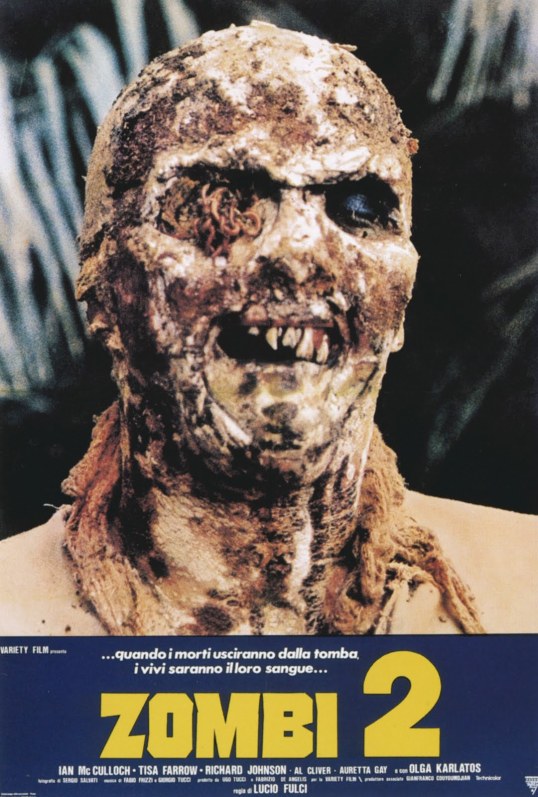
If your answer to the first question was yes, then you should definitely have had the same answer for the second. Along with launching the long and extremely influential genre of the Italian zombie film and being one of the best zombie films ever made, Zombi 2 is also one of the best horror films ever made.
First off, a few words about that title. Zombi was the Italian title for George Romero’s Dawn of the Dead. Zombi was a huge hit on Italy and, in that shameless way that is beloved by all Italian horror fans, producers Fabrizio De Angelis and Ugo Tucci decided to take advantage of Zombi‘s success by naming their upcoming zombie film Zombi 2. And, while I have always liked to think of Zombi 2 as being a prequel to Romero’s Dead trilogy, Zombi 2 is actually in no way related to Dawn of the Dead.
It has often been assumed that Zombi 2 was directly inspired by Dawn of the Dead. While Romero’s film certainly provided more of an influence than just providing a title, Zombi 2 was actually in production before Dawn of the Dead opened in Italy. And, ultimately, Zombi 2 is a far different film from Romero’s film. Eschewing the social commentary and satire that ran through Dawn of the Dead, Zombi 2 is instead a work of pure horror. They’re both excellent films but Dawn of the Dead ultimately inspires debate while Zombi 2 inspires nightmares.
Opening with a previously dead body being shot in the head as it slowly sits up on a stretcher and ending with a haunting vision of apocalypse, Zombi 2 is coated in a palpable atmosphere of doom. A boat floats into a New York harbor and the two cops who investigate are greeted by a lumbering and hungry corpse. Tisa Farrow plays the daughter of the boat’s owner. When she and a reporter (Ian McCulloch, giving a likable and bemused performance that often finds him playing straight man to a bunch of decaying corpses and which provides a nice run up for his openly subversive performance in Zombie Holocaust) team up to find her father, their investigation leads them to an isolated island where the haunted and alcoholic Dr. Menard (Richard Johnson, bringing so much gravity and self-loathing to his role that he literally elevates the entire film) is struggling to deal with an outbreak of zombies. Along with a boat captain (Al Cliver) and his girlfriend (Auretta Gay), McCulloch and Farrow try to escape the island before they end up joining the ranks of the undead…
As a director, Lucio Fulci was known for bringing his own unique visual flair to the horror genre. Fulci, perhaps more than any of the other great Italian horror directors working during the Italian horror boom of the 80s and 90s, literally brought nightmares to cinematic life. As a result, Zombi 2 is probably one of the most visually memorable zombie films ever made. From the minute that McCulloch, Farrow, Cliver, and Gay arrive on the island, you can literally feel the oppressively hot wind and dusty wind that blows through every scene. When the dead walk across the desolate landscape, Fulci emphasizes the decayed state of these zombies, forcing the audience to consider just how fragile the human body truly is. The fact that the undead manage to be so pathetic and so dangerous at the same time only serves to make them all the more frightening. When a group of conquistadors come back to life, Fulci films it from their point of view and, for a few minutes, we literally are one of the undead, clawing our way out of a grave. Needless to say, Fulci doesn’t shy away from the gore of a zombie apocalypse either. His zombies are ravenous and destructive. The Walking Dead may be bloody but it’s got nothing on Zombi 2.
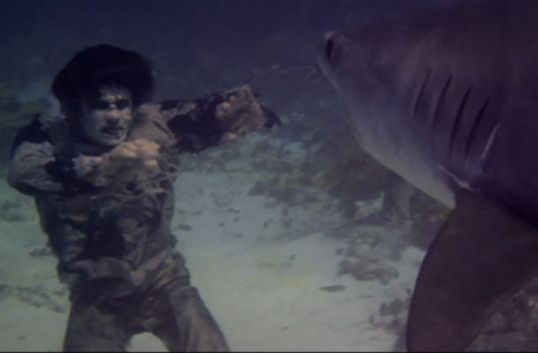
Along with the conquistador scene, Zombi 2 is especially remembered for two scenes, both of which showcase the best of both Fulci and Italian horror.
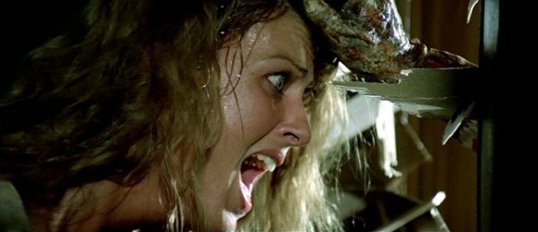
One is the scene where Dr. Menard’s wife (Olga Karlatos) is menaced by zombies after taking a shower. Even after she slams the bathroom door, a zombies hand breaks through the door and grabs her by the hair and starts to pull her through the jagged hole in the door. As she is slowly pulled to her doom, her eyeball is pierced by a splinter of wood. It’s definitely an over-the-top moment, the type of thing that we expect from an Italian horror film. But, as over-the-top as it may be, it’s also incredibly effective and terrifying. It’s a scene that lets us know that there is no escape from our fate. It’s a scene that reminds us that the zombies will always win because there is no way to lock out death.
(In fact, it’s such an iconic scene that almost all of Fulci’s subsequent films would feature a character losing an eye. Adding a certain poignancy to his trademark scenes of ocular destruction was the fact that Fulci, himself, was diabetic and reportedly often feared that he would lose his eyesight.)
The answer, of course, is that there isn’t. Ultimately, in the world of Fulci’s film, whether by causes natural or unnatural, we’re all destined to become one of the zombies.

 Through the Shattered Lens