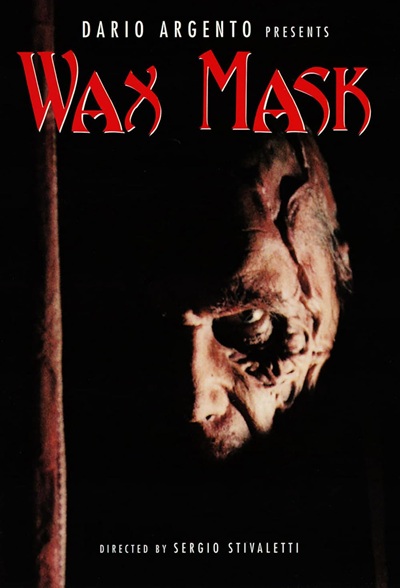
Horror Film Review: Wax Mask (dir by Sergio Stivaletti)


The 1997 Italian horror film, Wax Mask, takes place in Rome at the turn of the 20th Century.

The film opens in 1900, with a young girl named Sonia witnessing the murder of her parents by a man with an iron claw and a wax mask.  12 years later, Sonia (Romina Mondello) steps into a Rome’s newest sensation, a wax museum where all of the wax figures appear to either be victims or murderers.  The museum is meant to scare people.  One man accepted a dare to spend the night in the museum and he was found dead the next morning, frightened to death.  Sonia’s not interested in being scared.  She just needs a job.  Her mother taught her how to make clothes for wax figures.  The owner of the museum, Boris (Robert Hossein), hires her.

When Sonia leaves the museum, her picture is taken by Andrea (Riccardo Serventi Longhi), a reporter who is investigating the mysterious deaths that have been connected to the museum.  Meanwhile, Inspector Lanvin (Aldo Massasso) contacts Sonia to let her know that he’s following up some new leads concerning the still-unsolved deaths of her parents.  He seems quite concerned about her working at the museum.  When Lanvin later turns up dead, Sonia becomes concerned as well.

You can probably guess where all of this is going.  Wax Mask is a remake of House of Wax, with the action moved to Rome and also with a lot more nudity and considerably more gore.  The murders are brutal and bloody and the same can be said of what Sonia discovers when she starts to take a closer look at the wax figures in the museum.  Perhaps the most disturbing aspect of this film is the idea that the wax figures are actually suspended in a state between life and death, aware of what is happening but unable to move, speak, or do anything about it.  Wax Mask is a frequently diverting throwback to the bloody but atmospheric giallo films of the 70s.  Suspense is mixed with special effects, some of which are more effective than others.

Wax Mask was originally meant to be Lucio Fulci’s final film.  Dario Argento saw his old cinematic rival, Lucio Fulci, in 1994, by which point Fulci was using a wheelchair and was in frequent pain.  Thinking that working on a movie might be good for Fulci’s state-of-mind and overall health, Argento agreed to produce Fulci’s next film.  The idea that they came up with was to remake House of Wax.  While Argento wanted to concentrate on spectacular death scenes, Fulci wrote a script that emphasized atmosphere over blood.  Tragically, Fulci died in 1997 while the film was still in pre-production.  Argento replaced Fulci with Sergio Stivaletti, a special effects artist who has worked on several Argento films.

Stivaletti rewrote the script and put the emphasis back on the special effects.  (In the end, the killer has as much in common with The Terminator than with a traditional giallo killer.)  Stivaletti does a good job directing the film.  There are plenty of scary scenes.  The film looks good.  Even the special effect shots that don’t quite work still have a certain charm to them.  That said, it’s hard to watch the film without thinking about what Fucli, at his best, could have done with the material.

In the end, though, Wax Mask is an effective work of late era Italian horror.
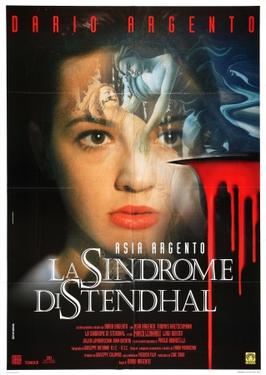
The Films of Dario Argento: The Stendhal Syndrome


The Stendhal Syndrome is a real thing.

First noted by the author Stendhal, Stendhal Syndrome is something that happens when one is confronted by a sight that they never expected to see in person.  Usually, it’s a work of great art that triggers the condition and the viewer becomes so overwhelmed by the sight of it that they’re left disorientated and even dizzy.  People have reported it happening while visiting museums or historical cities.  Recently, a few teenagers made the news when they claimed to have felt the syndrome’s symptoms while at a Taylor Swift concert.

I know that it’s a real thing because I’ve actually experienced Stendhal Syndrome.  I was in Florence, the summer after I graduated from high school.  One minute, I was fine and even feeling a little bratty, as one does when they’re 18 and they have their entire future ahead of them.  But then I looked up at the sky and I saw the skyline of Florence, with its mix of the ancient and the modern and I suddenly became aware that I was in one of the oldest cities in the world and that I was standing on a street that had existed for centuries and I was looking at buildings and statues and paintings that most people would never get a chance to see in person and suddenly, the entire world seemed to be spinning around me.  I had to actually sit down for a few minutes to catch my breath because I was so overwhelmed with emotion.  My sisters assumed I was having an asthma attack but, even then, I understood that I was feeling something far different.  At that moment, history become very real for me and I understood that I existed in the same universe as every great artist and writer.  We were all a part of the same existence.

Dario Argento’s 1996 film, The Stendhal Syndrome, also takes place in Florence and features Asia Argento as Anna Mani, a police detective who is sent to the city to capture a serial killer.  When Anna visits a museum, she is overwhelmed by what she sees.  When she looks at Botticelli’s The Birth of Venus, she hears the wind that blows Venus’s hair.  When she views Bruegel’s Landscapes With The Fall Of Icarus she, perhaps significantly, becomes Icarus and flies through the air before crashing into the water below, where she shares a passionate kiss with a fish.  In the museum, Anna faints.  She drops her purse, giving Alfredo Grossi (Thomas Kretschmann) time to not only steal her gun but also the key to her hotel room.

Dazed and not even sure of who she is, Anna returns to her hotel.  A copy of Rembrandt’s The Night Watch turns into a doorway, which she steps through.  Finding herself on a rainy city street, Anna is reminded that she’s a detective and that she’s in Florence to catch a vicious killer.  When Anna steps back into her room, she discovers that she’s not alone.  Alfredo grabs her, rapes her, and abducts her.  Anna manages to escape and runs through the streets of Florence while a naked and blood-covered Alfredo screams in the night, which is one of the most disturbing scenes that Dario Argento has ever given us.  Alfredo continues to stalk Anna while Anna goes through some changes herself, buying a blonde wig and pursuing a relationship with a French art student (Julien Lambroschini).

The Stendhal Syndrome was the first of Argento’s film to feature CGI, not just in the scenes in which Anna enters the paintings but also in scenes where were literally follow the pills that she’s taken down her throat and where a bullet is seen to enter the face of one of Alfredo’s victims.  (Alfredo looks through the resulting bullet holes and winks at Anna on the other other side.)  Sometimes, the CGI is effective and sometimes it’s a bit too cartoonish for its own good.  At its most effective, the CGI inspires us to wonder if Anna is seeing reality or if she’s still trapped in her Stendhal Syndrome-inspired fantasy world.  The scene where disturbing graffiti comes to life may not exactly look real but it’s still undeniably effective.  At other times, the special effects just come across as being a bit self-indulgent on Argento’s part.

The film is at its best when it concentrates on the cat-and-mouse game between Anna and Alfredo.  As played by Thomas Kretschmann, Alfredo is one of the most terrifying characters to ever appear in an Argento film, a handsome and seemingly charming man who is actually fueled by pure evil and hate.  Alfredo is a villain who takes a definite pride in his ability to hide his true nature from the rest of the world.  At first, Anna seems almost too physically frail and emotionally open to be believable as a police detective but she soon proves herself to be far tougher than anyone realizes.  Anna, it turns out, has secrets of her own.  Shot roughly around the same time that Asia Argento was being victimized by Harvey Weinstein, the scenes where Alfredo attacks Anna are difficult to watch, as they should be.  Dario Argento took a lot of criticism (particularly from his former partner, Daria Nicolodi) for casting his daughter in a role where she is assaulted but the film itself is fully on Anna’s side.

The second half of the film loses its way a bit, though I can’t go into too much details without spoiling the plot.  Several of the first half’s intriguing ideas are abandoned.  Asia Argento gives a strong performance during the second half of the film, one that features some of her bravest and most revealing work.  That said, despite the strength of Asia’s performance, many of Anna’s actions still don’t make sense no matter how much the film tries to convince us that they do.  That said, the final scenes still carries an impact.

In the end, the film uses Stendhal Syndrome as a gimmick.  If you want to see a realistic film about Stendhal Syndrome, you’re probably out of luck because it’s not a condition that’s easy to capture cinematically.  But, as a thriller, The Stendhal Syndrome holds up well.  This is an uneven film but ultimately, what does work outweighs what doesn’t.

The (Reviewed) Films of Dario Argento:

  1. The Bird With The Crystal Plumage
  2. Cat O’Nine Tales
  3. Four Flies on Grey Velvet
  4. Deep Red
  5. Suspiria
  6. Inferno
  7. Tenebrae
  8. Phenomena
  9. Opera
  10. Two Evil Eyes
  11. Trauma