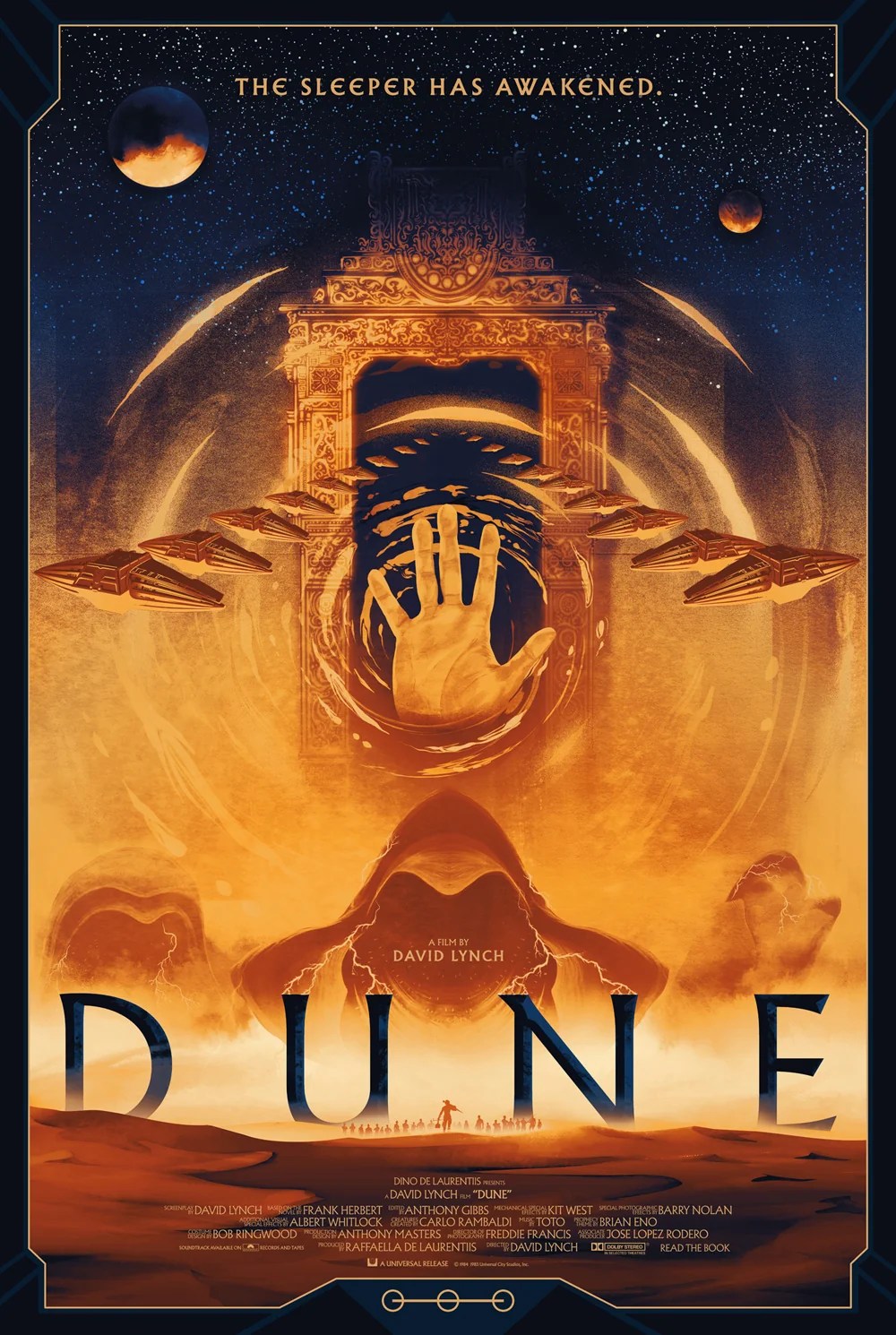
“The sleeper has awakened.” — Paul “Muad’Dib” Atreides
David Lynch’s Dune is one of those movies that somehow manages to be both a spectacular failure and a strangely hypnotic piece of cinema at the same time. It feels like a film willed into existence through pure creative tension: on one side, Frank Herbert’s dense, political, and spiritual sci‑fi novel; on the other, David Lynch’s surreal, psychological, dream‑logic sensibility. The result is a singular oddity—visually bold, dramatically uneven, and endlessly fascinating if you’re in the mood for something that feels more like a hallucination than a conventional space opera.
To call the adaptation ambitious is underselling it. After the collapse of Alejandro Jodorowsky’s infamous attempt to adapt Dune, the project eventually landed at Universal with producer Dino De Laurentiis, and Lynch—fresh off The Elephant Man—was brought in to turn Herbert’s galaxy‑spanning book into a two‑hour‑ish feature. On paper, it seems like inspired casting: Lynch had the visual imagination and emotional intensity to do something memorable with the material. But he was never a natural fit for streamlined blockbuster storytelling. His instincts live in mood, subconscious imagery, and uneasy psychological textures rather than clean plot mechanics. You can feel that clash all over the final film, and it’s part of what makes it so weirdly compelling.
Right from the opening, Dune doesn’t hold your hand. Princess Irulan’s floating head lays out a massive info‑dump about spice, the Imperium, and Arrakis that plays like someone reading you the glossary at the back of a sci‑fi novel. It’s dense, awkward, and kind of charming in its sincerity. The movie takes Herbert’s universe extremely seriously—no wink, no irony, no attempt to sand off the stranger edges. The Bene Gesserit, mentats, feudal houses, and prophecies are all presented straight, as if the audience will either keep up or be left behind. There’s something almost punk about that level of commitment.
Kyle MacLachlan, in his debut as Paul Atreides, is perfectly cast for Lynch’s take on the character. He’s got this earnest, slightly naive presence that gradually hardens as the story pushes him toward messiah status. Instead of leaning into a swashbuckling hero archetype, Lynch frames Paul’s evolution as something interior and dreamlike, almost like a spiritual awakening happening inside a hostile universe. Paul’s visions aren’t giant, crystal‑clear CGI prophecy sequences; they’re fragmented, flickering images, whispers, and flashes of desert and blood. You can feel Lynch trying to drag the sci‑fi epic into his own subconscious, even if the narrative doesn’t always keep up.
The supporting cast is packed with strong, sometimes delightfully bizarre performances. Francesca Annis gives Lady Jessica a sensual, haunted calm that fits the Bene Gesserit’s mix of discipline and manipulation. Jurgen Prochnow’s Duke Leto radiates dignified doom; he feels like a man who knows he’s walking into a trap but can’t step off the path. Then you get to the Harkonnens, where Lynch just lets his freak flag fly. Kenneth McMillan’s Baron is a grotesque comic‑book monster, oozing, cackling, floating on anti‑grav tech, and reveling in cruelty. It’s not subtle, but it is unforgettable. And of course Sting as Feyd‑Rautha, stalking around in barely‑there outfits and sneering like a rock star beamed in from another film entirely, just adds to the movie’s fever‑dream energy.
Visually, Dune is a feast and sometimes a bit of a choke. The production design leans into a kind of retro‑futurist baroque: cavernous sets, ornate technology, and spaces that feel less like functional environments and more like places out of a dark fantasy. Lynch and cinematographer Freddie Francis infuse everything with shadow, smoke, and texture, so even the quiet scenes feel heavy and loaded. The sandworms are huge, tactile, and worshipful in scale; the way they burst from the desert feels more like a religious manifestation than a monster attack. Even if you’re lost in the plot, the images stick with you—daggers, stillsuits, weirding whispers, blood on sand.
The sound and music do a ton of work in giving the film its identity. The score, primarily by Toto with contributions from Brian Eno, is this fusion of 80s rock sensibility and orchestral grandeur. It shouldn’t work, but it does; the main theme swells with tragic heroism, while other cues veer into eerie, synthy territory that matches Lynch’s off‑kilter tone. The sound design around the “weirding” abilities, the internal monologues, and the roar of the sandworms all help sell the world even when the script is sprinting past exposition. It’s one of those films where you might not fully grasp every detail, but the combined force of image and sound makes you feel like you’ve visited a real, deeply strange place.
The big structural problem, and the thing that most clearly separates Lynch’s adaptation from Denis Villeneuve’s two‑part version, is time and emphasis. Lynch is trying to cram the entire arc of Dune into a single film, and that means the plotting goes from methodical to breakneck halfway through. The first half lingers on the setup—Caladan, the move to Arrakis, the betrayal—while the second half rockets through Paul’s Fremen transformation, the guerrilla war, the sandworm riding, and the final confrontation. Subplots are hinted at and dropped, character arcs feel truncated, and the voiceover is forever trying to patch gaps the edits created. Themes like ecological transformation, the manipulation behind religious prophecy, and the long‑term horror of Paul’s rise are mostly reduced to gestures.
The best way to see Dune in Lynch’s version is actually through the extended cut, which adds a bit more context to certain scenes and lets the film breathe slightly more than the theatrical release. The theatrical cut is so aggressively compressed that pieces of motivation and setup just vanish, leaving the story feeling even more disjointed. The extended version restores some of the connective tissue—especially around Paul’s early time with the Fremen, the political maneuvering in the lead‑up to the final act, and the way certain characters orient themselves in the larger conflict. It doesn’t magically fix the studio‑driven structure or the inherent weirdness of Lynch’s choices, but it does make the film feel a little more complete, a little closer to the director’s original vision. It’s still messy, but less like a rushed homework assignment and more like a genuinely eccentric, if compromised, longform take on Herbert’s world.
Tonally, Lynch and Villeneuve are almost mirror images. Lynch’s film is cramped, loud in its weirdness, and often grotesque, playing like a baroque horror‑opera about destiny. Villeneuve’s is stately, slow‑burn, and solemn, more interested in the weight of empire, colonialism, and religious manipulation. Even their takes on Paul are distinct. In Lynch’s film, Paul ultimately plays more like a triumphant chosen one; whatever ambiguity is there gets overshadowed by the climactic victory and the literal act of making it rain as a grand, almost celebratory miracle. Villeneuve leans harder into the darker implications: Paul is framed as a potentially dangerous figure whose rise may unleash something terrible, and his two‑part arc emphasizes the holy war and fanaticism coalescing around him instead of treating his ascension as a clean win. Where Lynch’s ending lands somewhere between pulp myth and studio‑mandated uplift, Villeneuve’s execution feels closer to a tragedy about messianic power.
Knowing all that, Lynch’s Dune ends up feeling like a relic from an era when studios occasionally handed gigantic, unwieldy properties to filmmakers with intensely personal styles and just hoped for the best. It doesn’t “work” in a conventional plot sense, and if you’re coming to it after the sleek coherence of Villeneuve’s films, it can feel like a chaotic, cluttered alternate‑universe version of the same story. But that alternate universe has its own power. There’s a raw, handmade intensity to Lynch’s take—a sense that he’s trying to turn Dune into a waking dream about destiny, decay, and the seduction of power, even as the studio scissors are hacking away at his vision.
In the end, David Lynch’s Dune is a beautifully broken thing: a movie that fails as a straightforward adaptation but succeeds as a cinematic experience you can’t quite shake. Villeneuve gives you a clearer, more faithful, and philosophically aligned Dune, the one that explains itself and lets you sit with its implications. Lynch gives you the nightmare version, messy and compromised, but pulsing with strange life. If Villeneuve’s two‑part saga is the definitive modern telling, Lynch’s film—especially the extended cut—remains the haunting alternate path, a vision of Arrakis filtered through a very particular mind, sandblasted, grotesque, and unforgettable.
 Through the Shattered Lens