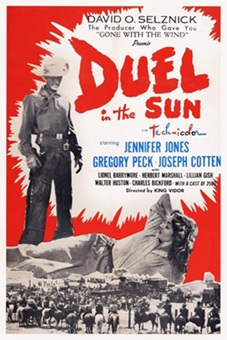
Duel In The Sun (1946, directed by King Vidor)


After her father is executed for killing her mother and her mother’s lover, “half-breed” Pearl Chavez (Jennifer Jones) is sent to live with her father’s second cousin, Laura Beth McCanles (Lillian Gish).  Laura is the wife of rancher, politician, and all-around racist Senator Jackson McCanles (Lionel Barrymore).  Worried that Pearl’s beauty and uninhibited manner will get her into trouble, Laura arranges for Pearl to meet with a minister known as The Sinkller (Walter Huston) who instructs Pearl on how to be a “good” girl.

Wanting to make Pearl bad and his, Lewton “Lewt” McCanles (Gregory Peck) becomes obsessed with Pearl and is soon forcing himself on her on a regular basis.  When the good McCanles brother, Jesse (Joseph Cotten), leaves the ranch despite being in love with Pearl, Pearl tries to find a good husband in the form of Sam Pierce (Charles Bickford).  Lewt responds by gunning Sam down and then goes on the run.  It all leads to an overwrought duel in the sun as the two doomed lovers take aim at each other.

Duel In The Sun is credited to veteran director King Vidor and there are a few shots of the western landscape that do feel typical of Vidor’s work.  However, Duel In The Sun’s true auteur was its producer, David O. Selznick.  Still looking to recapture his earlier success with Gone With The Wind and eager to make his future wife, Jennifer Jones, into an even bigger star than she was, Selznick obsessed over every detail of Duel In The Sun, pushing Vidor and a host of other directors (including Josef von Sternberg, William Dieterle, William Cameron Menzies, Otto Brower, and Sidney Franklin)  to make the film more steamy, more melodramatic, more violent, and more visually epic.  Reportedly, while Video was trying to shoot the film’s titular duel, he had to call cut several times when Selznick ran into the scene with a water bottle to spray more “sweat” onto Jones and Peck.  Today, the stiff Peck seems miscast as the black sheep of the family, the reserved Jones is even more miscast as a mestiza, and the plot is clearly too simplistic to carry the film’s epic ambitions.  A few impressive shots aside, Duel In The Sun is just boring,  In the 40s, though, the film’s relative openness about sex generated enough controversy to make Duel In The Sun into a box office hit.  It was one of the two top-grossing westerns of the 40s, beating out Red River, My Darling Clementine, Fort Apache, The Ox-Bow Incident, and several other films that were actually good.

Unlike Jones, Peck, and even usually reliable stalwart like Lionel Barrymore and Walter Huston, Joseph Cotten at least emerges from this film with his dignity intact.  Playing the good brother, Cotten gets to underplay while everyone else is overplaying and it turns out to be the right approach for him.  Surviving Duel In The Sun was no easy feat but Cotten pulled it off.

Lisa Reviews An Oscar Nominee: The Barretts of Wimpole Street (dir by Sidney Franklin)


The 1934 best picture nominee, The Barretts of Wimpole Street, takes place largely in one room.

That room is a bedroom located in a mansion that sits on Wimpole Street in London.  The room is occupied by Elizabeth (Norma Shearer), a sickly woman who has spent years in bed and who is barely able to walk.  She is the eldest of 11 siblings and all of them live in the house together, under the watchful eye of their tyrannical father, Edward (Charles Laughton).  Edward has forbidden any of his children from ever leaving home.  None of them are to get married.  In fact, none of them are to have even a relationship.  Even when he hears that a trip to Italy could actually improve Elizabeth’s health, he sternly forbids her from leaving.  Edward is obsessed with sin.  As he explains it, he was once a sinner himself.  In fact, he was such a sinner that he sometimes lost control of himself.  Now that he’s a father and a widower, Edward deals with his less savory impulses through constant prayer and he’s determined to never allow his children to fall into sin as well.

Despite her father’s attempts to keep her isolated from the outisde world, Elizabeth has managed to find an escape.  She’s a poet and her words have won her admirers from around world.  One of those admirers is another poet, a young man named Robert (Fredric March), who frequently writes her letters about his love of her work.  One day, in the middle of a snowfall, Robert shows up at the house on Wimpole Street and requests to see Elizabeth.  Robert tells her that her poetry has not only inspired him but it has also caused him to fall in love with her.  When Elizabeth explains that she is dying and cannot leave the bedroom, Robert says that she’s going to live forever.  After Robert leaves, Elizabeth manages to stand and, for the first time in years, walks over to the window to watch as he departs.

Sounds like a perfect love story, right?  Well, there’s a problem.  Edward has absolutely no intention of allowing Elizabeth to leave the house, regardless of how much her health improves after her initial meeting with Robert.  He is determined to keep her in that bedroom and, this being a pre-code film, it becomes obvious that there’s more to Edward’s behavior than just being an overprotective father.  Though the dialogue may be euphemistic, Edward’s incestuous desires are plain to see.  It’s there every time that he leers as his daughters while also saying that he’ll be sure to pray for their souls.  It’s there in the film’s final moments, when Edward makes a request that’s so dark and cruel that it will take even a modern audience by surprise.  Charles Laughton played a lot of villains over the course of his long career but Edward is perhaps the most monstrous.

As a film, The Barretts of Wimpole Street is undeniably stagy and it’s a bit overlong as well.  Charles Laughton so dominates the film with menace that he threatens to overshadow not just March and Shearer but also Maureen O’Sullivan, who plays one of Elizabeth’s sisters.  But no matter!  I absolutely love The Barretts of Wimpole Street.  The house is gorgeous, the plot is wonderfully melodramatic, and Shearer and March both have a wonderful chemistry.  You can debate whether or not March and Shearer are credible as poets but, ultimately, what matters more is that they are totally believable as soul mates.  From the minute they first meet, you simply buy them as a couple that is meant to be.  Robert’s earnestness is perfectly matched with Elizabeth’s growing strength and it’s impossible not to cheer at least a little when Elizabeth first manages to walk down a staircase without collapsing.

Of course, as any student of literature should be aware, Robert is Robert Browning and Elizabeth is Elizabeth Barrett.  In real life, Robert Browning did arrange a meeting with Elizabeth after having read her poetry and, as well, it’s been said that Elizabeth’s father did not approve of her relationship with Robert.  It’s also apparently true that Edward actually did disinherit any of his children who married.  As for the other details of Edward’s depiction in The Barretts of Wimpole Street, it’s unknown how close to the truth Laughton’s performance may have been.

The Barretts of Wimpole Street is a wonderful historical romance.  It was Oscar-nominated for best picture, though it lost to a far different romance, It Happened One Night.

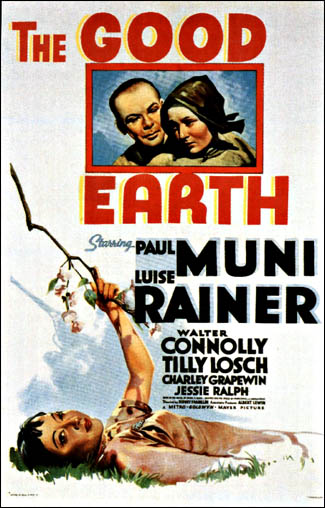
Cleaning Out The DVR #22: The Good Earth (dir by Sidney Franklin)


(For those following at home, Lisa is attempting to clean out her DVR by watching and reviewing 38 films by this Friday.  Will she make it?  Keep following the site to find out!)

Good_earth_(1937)

The 1937 film The Good Earth is a strange one.

It’s a big, epic film about life in China in the years before World War I.  It opens with a poor farmer named Wang (Paul Muni) marrying a servant girl named O-Lan (Luise Rainer).  O-Lan is quiet but strong and, with her support, Wang eventually starts to prosper.  He buys land and they have children.  Together, Wang and O-Lan manage to survive both famine and a political upheaval.  In fact, it’s China’s volatile politics that occasionally allow the family to survive.  When a revolutionary mob loots a mansion, O-Lan joins in just long enough to come across a bag of diamonds that the Wang uses to eventually buy the biggest house in town.  Once he’s become wealthy and complacent, Wang ends up taking on a younger, second wife (Tilly Losch) and O-Lan finds herself competing for his attention.  Ultimately, it’s only when Wang is again forced to tend to the Earth that he understands what is really important.

So, here’s the weird thing about The Good Earth.  It’s a film about China.  It covers several years of Chinese history and the story itself is rooted in Chinese culture.  All of the characters are meant to be Chinese.  When the movie was filmed, China was at war with Japan so it’s not surprising that the film was shot in California.  But what is interesting (though not really surprising when you consider the history of Hollywood) is that there are very few Chinese people in the cast and none of them play any of the major roles.

Instead, Wang was played by Austria-born, Chicago-raised Paul Muni.  O-Lan was played by German Luise Rainer.  Wang’s comic relief uncle was played by American character actor Walter Connolly while his father was played by a former vaudeville star from Ohio named Charley Grapewin.  All of the actors are heavily made up so that they’ll look Chinese but none of them act or sound Chinese.  It makes for a very strange viewing experience.

And it’s a bit unfortunate because there are some very good scenes in The Good Earth.  Technically, it’s a very strong film.  Towards the end, there’s a locust invasion that is still thrilling to watch.  The sets look great.  The costumes look great.  If you’re a history nerd like me, the story has the potential to be interesting.  But, whenever you start to get sucked into the film’s story, Wang starts to speak and sounds totally like a guy from Chicago and it takes you out of the movie.  The uneven mix of quality and miscast actors makes for a rather disjointed viewing experience.

As a big epic, it’s probably not surprising that The Good Earth was nominated for best picture.  However, it lost to another Paul Muni film, The Life of Emile Zola.

http://www.youtube.com/watch?v=3iEREqQjjzU