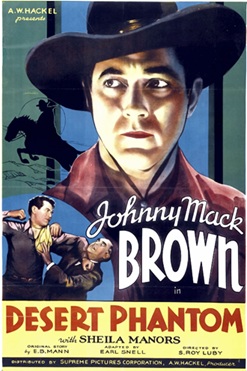
Desert Phantom (1936, directed by S. Roy Luby)


In a frontier town, rancher Jean Halloran (Sheila Bromley) has a big problem.  Someone is shooting and killing all of her ranch hands and sending her notes in which he tells her to give up her ranch and leave town.  When an ammunition salesman and trick shooter named Billy Donavon (Johnny Mack Brown), Jean hires him to serve as a bodyguard and to track down the mysterious Phantom.  Billy, however, has a secret of his own.

Desert Phantom is a remake of an old Harry Carey film.  I don’t know why Poverty Row did remakes since all of their films pretty much had the same plot regardless.  A stranger comes into town and gets involved with a female rancher and a bad guy who is trying to hide his actual identity.  In this one, Nelson McDowell gets to supply the comic relief as a befuddled veterinarian while familiar faces like Ted Adams and Karl Hackett are there to keep us guessing about how the Phantom could actually be.  If you’ve watched enough of these movies, though, you’ll always be able to guess who the bad guy is.

This isn’t the best of Johnny Mack Brown’s movies.  The Phantom’s story seems like it could have been interesting but that would have meant taking more risks than most of the Poverty Row studios were willing to do.  Johnny Mack Brown is as convincing a cowboy as always and is the film’s saving grace.  Brown was a western star precisely because he could make even something like Desert Phantom watchable.
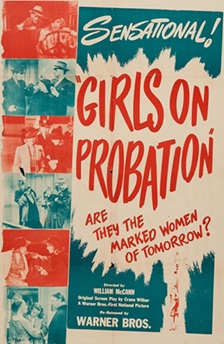
Girls On Probation (1938, directed by William C. McGann)


Eager to get away from her abusive father (Sig Ruman), Connie Heath (Jane Bryan) keeps making the mistake of hanging out with the ultimate bad friend, Hilda Engstrom (Sheila Bromley).  Hilda steals a dress from where they work and when the dress is torn, Hilda lets Connie take the blame.  When the dress’s owner (Susan Hayward, making her film debut) insists on pressing charges, insurance investigator Neil Dillon (Ronald Reagan) helps Connie get off the hook and out of jail.

Having not learned her lesson, Connie continues to hang out with Hilda and her new boyfriend, Tony Rand (Anthony Averill).  This time, Connie gets caught up in a bank robbery.  Will Neil be able to get her out of another jam?

63-minutes long, Girl on Probation is a Warner Bros. B-movie.  Ronald Reagan is surprisingly mellow as someone falling in love with a woman who keeps getting framed for his crimes she didn’t commit.  Sheila Bromley steals the show as the out-of-control dangerous blonde who tells a priest, “I’m about to meet your boss.”  The main problem with the film is that Connie is incredibly stupid.  How many times can one person be framed?  Jane Bryan, who played Connie, ended her acting career when she got married but she and her millionaire husband later helped to bankroll Reagan’s first political campaign and both of them were members of his unofficial “kitchen cabinet” when he was governor of California.

The movie has never been released on DVD and is hard to find.  It plays on TCM occasionally, which is where I saw it.  Online, the only place it appears to be streaming, ironically enough, is on a Russian site.

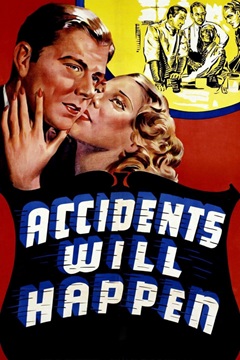
Accidents Will Happen (1938, directed by William Clemens)


Eric Gregg (Ronald Reagan) is an insurance claims adjuster who works hard, always has a cheerful attitude, and is inexplicably married to a greedy, dishonest woman named Nona (Sheila Gregg).  When Nona, sick of not being able to afford to live like a rich person, starts claiming to be a witness to accidents that didn’t really happen, it leads to Eric losing his job.  Eric is also dumped by Nona, who heads off to Reno.  Luckily, Patricia (Gloria Blondell), who works as the candy counter clerk at Eric’s office building, is just as eager to hook up with Eric and he is with her.

But what’s this?  Soon, Eric and Patricia are running insurance scams of their own and Eric is being recruited into a gang of fraudsters that’s led by Blair Thurston (Addison Richards).  Has Eric gone bad or does he have something else up his sleeve?

Accident Will Happen is one of the many B-movies that Ronald Reagan made before he briefly became a star as the result of Knute Rockne — All American and Kings Row.  It’s only 62 minutes long and the story moves quickly. The plot features a pretty obvious twist and it ends with some courtroom theatrics that I doubt anyone could have gotten away with in real life.  As with most of his B-performances, Reagan is likable even if there’s not much depth to his character.  Watching him hit bottom and then climb back up is satisfying because Reagan is so affable in the role.  Accidents Will Happen also stands out for its portrayal of an unhappy marriage, with Eric not realizing how miserable and greedy Nona is until she leaves him when he needs her the most.  Luckily, Gloria Blondell (who was the sister of Joan Blondell) is cute and perky and a far better match for our Reagan.  In the end, Ronald Reagan defeats insurance fraud as surely as he defeated the Soviets in the Cold War.

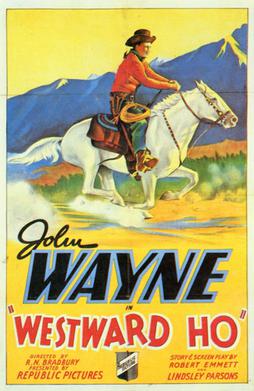
Westward Ho (1935, directed by Robert N. Bradbury)


As a young man, John Wyatt (John Wayne) witnessed an attack on a wagon train by the evil outlaw Wick Ballard (Jack Curtis).  John’s parents were killed and his younger brother Jim was abducted.  Years later, the grown John Wyatt realizes that the law cannot be depended upon in the wild west so he raises his own band of vigilantes and delivers justice to the frontier.  (Wayne’s second-in-command is played by the legendary Glenn Strange.)  Wyatt remains committed to taking down Ballard.  Going undercover as John Allen, Wyatt joins a cattle drive that he thinks will be attacked by Ballard.  Also working undercover as a member of the cattle drive is Jim Wyatt (Frank McGlynn Jr), John’s long-lost brother, who is now working for Ballard!  Both the Wyatt bothers end up falling for Mary Gordon (Sheila Bromley), the daughter of rancher Lafe Gordon (Jim Farley).

This was a good example of the the type of B-movies that John Wayne made in the years before John Ford cast him in Stagecoach.  The story is simple but Wayne gives a commanding performance as Wyatt.  Unlike many of the B-movies that featured Wayne as a callow singing cowboy or a fun-loving rogue, Westward Ho features Wayne playing the type of character that he would often play after he became a star.  Wyatt is determined to get justice for his family and to protect the innocents who are attacked by men like Ballard.  The presence of his brother in the enemy camp adds an extra dimension to Westward Ho.  Wyatt learns that vengeance isn’t everything.

It’s only 61 minutes long but it tells a good story and it has all the gunfights and horse chases that Western fans expect from their movies.  Of Wayne’s poverty row westerns, Westward Ho is one of the better ones.