At the height of World War II, Commander Casey Abbott (Ronald Reagan) breaks up with nurse Helen Blair (Nancy Davis, the future first lady) and takes command of a submarine that has been tasked with mapping out Japanese mine fields. Abbott struggles at first with commanding his submarine. After a popular diver — and Helen’s new boyfriend — is killed during a mission, much of the crew holds Abbott responsible. While Abbott is able to win back the respect of the crew, he still struggles with his second-in-command, Don Landon (Arthur Franz). Landon wants to command his own submarine but when Abbott gives him a negative recommendation, Landon is forced to consider his past actions. Landon eventually discovers just how difficult it is to be in charge.
Full of stock footage and chintzy special effects, Hellcats of the Navy was the movie that Ronald Reagan considered to be so bad that it led to him retiring from feature films and devoting himself to mastering the emerging medium of television. Gene Hackman had his Welcome To Mooseport. Ronald Reagan had his Hellcats of the Navy. It’s definitely on the cheap and predictable side but, when I watched it earlier today, I discovered it wasn’t as bad as I had heard. Reagan actually gives a pretty good performance as Abbott and the film does show that even a good commander will make mistakes. The main problem is that it’s just not a very exciting film and a good deal of the undersea footage was clumsily lifted from other movies.
Hellcats of the Navy was the one movie that co-starred both Ronnie and Nancy and it’s worth watching for curiosity’s sake. Nancy isn’t in much of the movie and it’s really a role that anyone could have played. There’s not a lot of romantic chemistry between Ronnie and Nancy, they’re both too reserved for that. This film still shows the likability and the natural authority that led to Ronald Reagan launching a second career in politics.
Just think, if Hellcats of the Navy had been a better movie, the past 45 years might have been very different.
1948’s Blonde Ice tells the story of Claire Cummings (Leslie Brooks), the society columnist for a San Francisco newspaper. Almost every man that Claire meets falls in love with her.
Les Burns (Robert Paige), the paper’s cynical sports reporter? Les is so in love with Claire that he keeps getting involved with her despite the fact that she cheats on him with almost every man that she meets.
Al Herrick (James Griffith)? Yep, he’s still in love with her too.
Carl Hanneman (John Holland), one of the wealthiest men in San Francisco? Carl is so in love with Claire that he’s willing to marry her even after he catches her kissing Les on the day of the wedding!
Congressional candidate Stanley Mason (Michael Whalen)? He’s so in love with Claire that he’s willing to sacrifice his political career just to be with her.
How about Blackie Talon (Russ Vincent), the pilot who witnesses Claire doing some things that she probably wouldn’t want the world to know about? Well, Blackie never gets around to declaring his love for Claire but his obsession with blackmailing her is probably just his way of dealing with the massive crush that he has on her.
The only person who doesn’t appear to be in love with Claire is Dr. Kippinger (David Leonard), a psychiatrist who immediately picks up on the fact that Claire is cold and manipulative. There’s a reason why Les refers to her as being …. can you guess? …. “Blonde Ice!”
Of course, even with all of these men falling in love with her, no one loves Claire as much as Claire loves herself. Claire is a narcissist and a sociopath and she has no problem killing one lover and framing another for the crime. In fact, it’s something that she attempts to do several times over the course of Blonde Ice. Claire, it has to be said, is pretty clever about it too. Her natural ability to manipulate, combined with her total lack of empathy for anyone but herself, makes Claire a dangerous character.
Blonde Ice is somewhat obscure as noirs go. It was clearly a poverty row production, with only a 74-minute running time and a cast largely made up of obscure contract players. And yet, Blonde Ice is a personal favorite of mine, largely because of the ferocious performance of Leslie Brooks. Brooks rips into the role of the femme fatale, delivering her cynical lines with aplomb and murdering anyone who gets in her way. Considering that this film was made in 1948, I was actually a bit shocked at just how high the body count climbed in just an hour and a few minutes. Claire is basically willing to kill anyone and the film often seems to take a perverse delight in showing how easily she can convince others of her innocence. Perhaps the most interesting thing about the film is that Claire attempt to frame the same man for not one but two murders and, even after all that, he still doesn’t seem to be emotionally capable of telling her to get out of his life. In a world of weak men, Claire comes in, takes control, and offers up no apologies.
Obscure though the film may be, Blonde Ice is an enjoyable noir and can be found on YouTube.
(With the Oscars scheduled to be awarded on March 4th, I have decided to review at least one Oscar-nominated film a day. These films could be nominees or they could be winners. They could be from this year’s Oscars or they could be a previous year’s nominee! We’ll see how things play out. Today, I take a look at the 1940 best picture nominee, The Grapes of Wrath!)
How dark can one mainstream Hollywood film from 1940 possibly be?
Watch The Grapes of Wrath to find out.
Based on the novel by John Steinbeck and directed by John Ford, The Grapes of Wrath tells the story of the Joad family and their efforts to neither get sent to prison nor starve to death during the Great Depression. When they lose their farm in Oklahoma, they head for California. Pa Joad (Russell Simpson) has a flyer that says someone is looking for men and women to work as pickers out west. The 12 members of the Joad Family load all of their possessions into a dilapidated old truck and they hit the road. It quickly becomes apparent that they’re not the only family basing all of their hopes on the vague promises offered up by that flyer. No matter how much Pa may claim different, it’s obvious that California is not going to be the promised land and that not all the members of the family are going to survive the trip.
Tom Joad (Henry Fonda) is the oldest of the Joad sons. He’s just been released from prison and he’s killed in the past. Having been in prison during the start of the Great Depression, Tom doesn’t realize how bad things truly are until he arrives home and sees someone he grew up with using a tractor to knock down a house. (It’s just business, of course. The owners of the house can’t pay their bills so the house gets destroyed.) The film’s story is largely told through Tom’s eyes and Henry Fonda gives a sympathetic performance, one the gets the audience to empathize with and relate to a character who is a total outsider.
As for the rest of the Joad Family, Ma (Jane Darwell) is the glue who holds them together and who refuses to allow them to surrender to despair. (And yet even Ma is forced to make some tough choices when the starving children of one work camp ask her to share her family’s meal with them.) Rosasharan (Dorris Bowdon) is pregnant while Grandpa (Charley Grapewin) is too sickly for the trip but doesn’t have anywhere else to go. And then there’s Casy (John Carradine), the former preacher turned labor organizer. Casy is not blood-related but he soon becomes a member of the family.
The Joads have a healthy distrust of the police and other authority figures and that turns out to be a good thing because there aren’t many good cops to be found between Oklahoma and California. Instead, the police merely serve to protect the rich from the poor. Whenever the workers talk about forming a union and demanding more than 5 cents per box for their hard work, the police are there to break heads and arrest any troublemakers on trumped up charges. Whenever a town decides that they don’t want any “Okies” entering the town and “stealing” jobs, the police are there to block the roads.
The Grapes of Wrath provides a portrait of the rough edges of America, the places and the people who were being ignored in 1940 and who are still too often ignored today. John Ford may not be the first director that comes to mind when you think of “film noir” but that’s exactly what The Grapes of Wrath feels like. During the night scenes, desperate faces emerge from the darkness while menacing figures lurk in the shadows. When the sun does rise, the black-and-white images are so harsh that you almost wish the moon would return. The same western landscape that Ford celebrated in his westerns emerges as a wasteland in The Grapes of Wrath. The American frontier is full of distrust, anger, greed, and ultimately starvation. (Reportedly, the film was often shown in the Soviet Union as a portrait of the failure of America and capitalism. However, it was discovered that Soviet citizens were amazed that, in America, even a family as poor as the Joads could still afford a car. The Grapes of Wrath was promptly banned after that.) John Ford is often thought of as being a sentimental director but there’s little beauty or hope to be found in the images of The Grapes of Wrath. (Just compare the way The Grapes of Wrath treats poverty to the way Ford portrayed it in How Green Was My Valley.) Instead, the film’s only hint of optimism comes from the unbreakable familial bond that holds the Joads together.
As dark as it may be, the film is nowhere near as pessimistic as the original novel. The novel ends with a stillborn baby and a stranger starving to death in a barn. The film doesn’t go quite that far and, in fact, offers up some deus ex machina in the form of a sympathetic government bureaucrat. (Apparently, authority figures weren’t bad as long as they worked for the federal government.) That the book is darker than the movie is not surprising. John Steinbeck was a socialist while John Ford was a Republican with a weakness for FDR. That said, even though the film does end on a more hopeful note than the novel, you still never quite buy that things are ever going to get better for anyone in the movie. You want things to get better but, deep down, you know it’s not going to happen. Tom says that he’s going to fight for a better world and Fonda’s delivers the line with such passion that you want him to succeed even if you know he probably won’t. Ma Joad says the people will never be defeated and, again, you briefly believe her even if there’s not much evidence to back her up.
Even when viewed today, The Grapes of Wrath is still a powerful film and I can only guess what it must have been like to see the film in 1940, when the Great Depression was still going on and people like the Joads were still making the journey to California. Not surprisingly, it was nominated for best picture of 1940, though it lost to Alfred Hitchcock’s Rebecca.
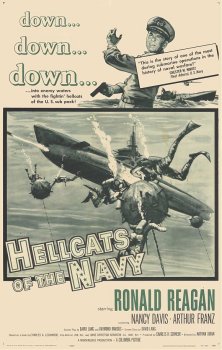 At the height of World War II, Commander Casey Abbott (Ronald Reagan) breaks up with nurse Helen Blair (Nancy Davis, the future first lady) and takes command of a submarine that has been tasked with mapping out Japanese mine fields. Abbott struggles at first with commanding his submarine. After a popular diver — and Helen’s new boyfriend — is killed during a mission, much of the crew holds Abbott responsible. While Abbott is able to win back the respect of the crew, he still struggles with his second-in-command, Don Landon (Arthur Franz). Landon wants to command his own submarine but when Abbott gives him a negative recommendation, Landon is forced to consider his past actions. Landon eventually discovers just how difficult it is to be in charge.

 Through the Shattered Lens