The Unnominated #11: The General (dir by John Boorman)


Though the Academy of Motion Picture Arts and Sciences claim that the Oscars honor the best of the year, we all know that there are always worthy films and performances that end up getting overlooked.  Sometimes, it’s because the competition too fierce.  Sometimes, it’s because the film itself was too controversial.  Often, it’s just a case of a film’s quality not being fully recognized until years after its initial released.  This series of reviews takes a look at the films and performances that should have been nominated but were, for whatever reason, overlooked.  These are the Unnominated.

Directed by John Boorman, 1998’s The General tells the story of Martin Cahill.

Martin Cahill (Brendan Gleeson) was a Dublin-based crime lord, a thief by trade who never made any apologies for his profession.  The film opens with the end of Martin Cahill’s life.  Leaving his suburban home, he’s sitting behind the steering wheel of his car when a young man runs up and shoots him in the face.  Cahill’s car rolls forward while his wife (Maria Doyle Kennedy) screams for help.  Cahill has been assassinated in front of his family and the reaction of the local police is to celebrate until Cahill’s oldest nemesis, Inspector Ned Kenney (Jon Voight), announces that they have nothing to cheer about.  The film leaves it somewhat ambiguous as to who shot Cahill, though it heavily suggests that he was shot by the IRA, both because of their mistaken belief that he was moving drugs into the neighborhood but also because of his refusal to share his profits with them.

The film flashes back and we watch as Martin Cahill, a rebellious young man who stole to impress girls and to get a shot back at the establishment, grows up to become Martin Cahill, the crime lord that the papers nickname The General.  Cahill is a professional thief and he’s fairly honest about it.  When his government-controlled flat is torn down, Cahill camps out on the site in a tent, refusing to leave because the location of the new building is to close to the police station.  He says he’d rather be moved to a richer part of town.  It’s better for his work.  As portrayed by Brendan Gleeson, Cahill is a fascinating and complex character, a ruthless criminal who is also devoted to his pigeons, his children and both his wife and his girlfriend (Angeline Bail).  (Fortunately, for Martin, his wife and his girlfriend know about each other and are good friends.)  He’s the type of crime lord who will test a man’s loyalty by nailing him to a pool table and then take him to the hospital afterwards.  “Sorry, Martin,” another associate says after Martin shoots him in the leg to make a fake break-in look authentic.  It’s hard not to like the film’s version of Martin Cahill, an intelligent and ultimately honest man who understands the importance of allowing his enemies to believe him to be a buffoon.  He may be a criminal but he considers it to be an honest living, unlike the government officials who force unwanted laws and exorbitant taxation on the citizenry  Director John Boorman certainly seems to like Cahill, which is interesting as Boorman was actually the victim of one of Cahill’s robberies.  (Boorman recreates the robbery in the film.)

The film went unnominated at the Oscars, which were dominated that year by Shakespeare in Love and Saving Private Ryan.  Brendan Gleeson definitely deserved a nomination for his charismatic performance as Martin Cahill.  Equally worthy of a nomination was Seamus Deasy’s black-and-white cinematography, which gives the film the dream-like feel of a half-remembered legend.  (The version of the film that’s on Tubi features desaturated color.  It’s actually an effective look for the film’s story but I still prefer the black-and-white original.)  Neither was nominated and, indeed, Brendan Gleeson would have to wait until 2023 to finally receive his first Oscar nominations for The Banshees of Inisherin.
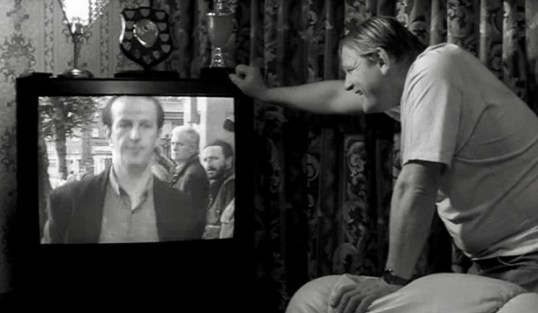
The General (1998, dir by John Boorman, DP: Seamus Deasy)

Previous entries in The Unnominated:

  1. Auto Focus 
  2. Star 80
  3. Monty Python and The Holy Grail
  4. Johnny Got His Gun
  5. Saint Jack
  6. Office Space
  7. Play Misty For Me
  8. The Long Riders
  9. Mean Streets
  10. The Long Goodbye

Film Review: Michael Collins (dir by Neil Jordan)


Released in 1996, Michael Collins tells the story of the early 20th century struggle of Ireland to gain independence from Britain.

Liam Neeson stars as Michael “Mick” Collins, the revolutionary leader who perfected the use of guerilla warfare against the British and then, in the greatest of ironies, found himself fighting some of his former allies during the Irish Civil War.  Aidan Quinn plays Mick’s friend and fellow revolutionary, Harry Boland.  Both Harry and Mick fall in love with Kitty Kiernan (Julia Roberts).  Stephen Rea shows up as Ned Broy, a member of the Dublin police department who is inspired by Mick’s words to become a double agent.  Charles Dance has a cameo as the fearsome Soames, a British intelligence agent who is sent to Ireland to violently put down the Irish insurgency.  Finally, Alan Rickman plays Eamon de Valera, who goes from being one of Mick’s strongest allies to being one of his fiercest rivals.  The film follows Collins from the Easter Rising of 1916 to his eventual assassination in 1922, providing a look at the history of Ireland that is as much directed towards those outside of Ireland as those on the inside.

When watching Michael Collins, it helps to have a working knowledge of Irish history.  Otherwise, it can occasionally be a bit difficult to keep track of who is angry with who at any particular point in time.  Of course, it should be noted that the movie itself is not exactly historically accurate.  In the film, the gentle and likable Ned Broy becomes a victim of British bloodlust.  In real life, Ned Broy outlived Michael Collins by several decades and died peacefully at the age of 84.  For that matter, the film presents Eamon de Valera as being coldly Machiavellian and it suggests that de Valera was jealous of Mick’s popularity.  Though both Rickman and director Neil Jordan later said it wasn’t intentional, the film also seems to suggest that de Valera played a role in Collins’s assassination.  While Eamon de Valera remains a controversial figure for many reasons (including his neutrality during World War II), Jordan has said that he feels de Valera was not necessarily treated fairly in Michael Collins and indeed, de Valera — who plays as big a role in the founding of the Irish republic as anyone — is portrayed as often being ineffectual and unwilling to truly put himself at risk to fight the British.  De Valera’s relationship with Collins was undoubtedly more complex than portrayed in this film but, when one makes a movie for an international audience, nuance is often the first thing that’s abandoned.

Seen today, 29 years after it was released, Michael Collins is an impressively made film that has a few inescapable flaws.  It’s gorgeous to look at, full of moody shots of dark Dublin streets.  The violence is often shocking and Jordan doesn’t shy away from considering the moral implications of Collins’s guerilla warfare.  Michael Collins doesn’t make the mistake of blindly celebrating violence, which would be a valuable lesson for the world’s current crop of self-styled revolutionaries if they were only willing to hear it.  Having gotten used to seeing Liam Neeson cast in one generic action film after another, it was interesting to watch Michael Collins and see what a good actor he truly could be.  Even in 1996, He was perhaps a few years too old to playing a man who was only 31 when he died but Neeson still plays the role with a ferocious charisma that makes him believable as a leader.  His scenes with Aidan Quinn have a joie de vivre that brings out the both in best actors.  Alan Rickman is memorably sinister as Eamon de Valera and Stephen Rea’s gentle style makes Ned Broy into a truly tragic figure.  That said, the very American Julia Roberts feels miscast as Kitty Kiernan.  One gets the feeling that she was cast solely for her box office appeal.  Every film, the feeling goes, needs  a love story and those love stories need to be between people with familiar faces and Roberts is such a familiar face that her every appearance in the film feels like a distraction from the story being told.  That said, the film captures the excitement and danger of being in the middle of history-making events.  It’s a historical epic that’s never boring and manages to hold the viewer’s interest.

Michael Collins is ultimately a flawed but entertaining look at the early days of the Irish republic.