RUDY! RUDY! RUDY!! 


It’s Good Friday and I’ve taken the day off from work to relax and spend some time in reflection and prayer on this important day on the Christian calendar. I woke up this morning and wasn’t quite ready to get out of bed, so I started flipping through Netflix’s selection and came across RUDY (1993). I try not to overwatch RUDY because I love the way it makes me feel, and I don’t want it to become so familiar that I lose that feeling. But it’s been a couple of years, so I decided to give it another spin. 

As I’m sure most of you know, RUDY is based on the life of Daniel “Rudy” Ruettiger (Sean Astin), the 3rd of 14 children from a family in Joliet, IL, who dreamed of playing football at Notre Dame. There were a number of obstacles to that dream, namely that his family didn’t have much money, he didn’t have good grades, he was 5’6” tall and he didn’t have much football talent. What he did have was heart, and we watch Rudy persevere as he goes to school at neighboring Holy Cross while trying to get accepted in Notre Dame. Nothing ever comes easy for Rudy, but through determination, hard work, and sheer will he eventually makes his way to Notre Dame, joins the football team’s practice squad, and gets to suit up for one game in his senior year. 

RUDY is a movie that affects me deeply. It really shouldn’t come as a surprise as it was written by Angelo Pizzo and directed by David Anspaugh, the team behind HOOSIERS (1986), one of my very favorite movies of all time. While there will never be a movie about my life, I know all too well what it’s like to love something so much, but not really be designed for it. In RUDY, the character Fortune, played by Charles S. Dutton in an incredible performance, tells a discouraged Rudy, “You’re 5 foot nothin’, 100 and nothin’, and you have barely a speck of athletic ability. And you hung in there with the best college football players in the land for 2 years.” Those were basically my specs when I was a senior playing high school basketball in a small town in Central Arkansas (5’7,” 125 and I couldn’t jump). I loved the game so much and put everything I had into it during my pee wee, junior high and senior high years. In 1991, I was named to the Arkansas’ All-State high school basketball team. Due to my lack of athleticism, I would not be able to play at the collegiate level, but I’ve always felt pride that I was able to maximize what talent God did bless me with in the game of basketball. That hard work ethic has served me well throughout my life. It’s so inspiring to watch a movie where a person perseveres against difficult odds, faces disappointments, keeps moving forward, works harder than everyone else, faces more obstacles, and then finally gets to see that work pay off. In a day and time where so many want all the rewards that life has to offer, without putting in any of the work, the story of RUDY stands the test of time and needs to be seen and heard. 
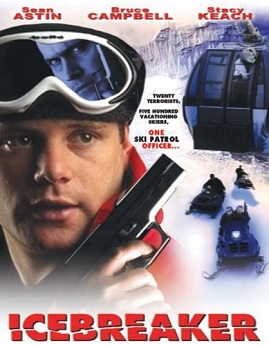
Icebreaker (2000, directed by David Giancola)


Carl Grieg (Bruce Campbell) is a terminally ill terrorist who takes over a Vermont ski resort while his henchpeople search the nearby mountains for a lost shipment on plutonium.  The only man who can stop Carl is a wiseass but determined ski patroller, Matt Foster (Sean Astin).  Not only does Matt have to stop Carl from getting his hands on the plutonium but he also has to save his fiancée (Suzanne Turner) and her father (Stacy Keach), both of whom are being held hostage by Carl.  Since his future father-in-law thinks that he’s nothing more than good for nothing ski bum, this is Matt’s chance to prove himself worthy of joining the family.

Icebreaker tries to be Die Hard in a Ski Lodge but it fails because Sean Astin is no one’s idea of an action star.  With his laid back and goofy manner, Astin miscast as someone who can leap from from an exploding ski lift and land in the snow with barely a scratch on him.  This was the last film that Sean Astin made before Peter Jackson offered him the role of Sam in the Lord of the Rings trilogy.  Needless to say, Astin was much better cast in that role than as a knock-off of Bruce Willis.

As for the rest of the cast, Bruce Campbell hams it up as Carl and, while it is always good to see Bruce, he also appears to be having so much fun that it makes him a less than convincing terrorist.  With his shaved head, it’s easy to mistake Bruce for Billy Zane.  Stacy Keach does a good job playing someone who is never not annoyed.  Considering that his daughter wants to marry a ski bum and they’re being held hostage by a villain who wants to make his very own nuclear bomb, can you blame him?

There’s some skiing action but none of it is really memorable.  There is also a scene featuring repeated shots of a counter on a bomb, announcing that Astin only had 30 seconds to do what he needs to do before everything explodes.  I think the timer may have been broken because it took a lot long than 30 seconds for that countdown to reach zero.  If you really want to see Die Hard In A Ski Resort, I suggest sticking with Cliffhanger.  That one not only only has Sylvester Stallone and Michael Rooker cracking jokes but also John Lithgow speaking with a posh accent.

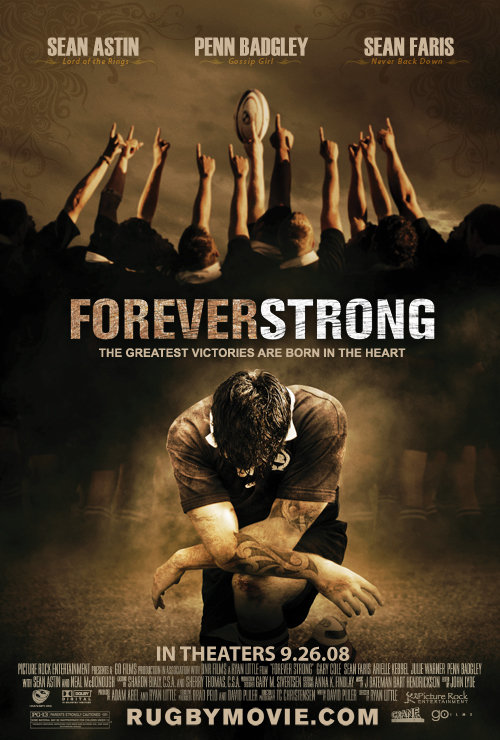
I Watched Forever Strong (2008, dir. by Ryan Little)


Rick Penning (Sean Faris) is the captain of his high school rugby team and the team’s highest scorer.  He’s also the son of the team’s coach (Neal McDonough).  Coach Penning is obsessed with winning at all costs and refuses to tell his son that he’s proud of him.  Coach Penning believes that emotion equals weakness and that only losers brag about doing their best.  After a loss to the Highland High school rugby team, which is coached by Larry Gelwix (Gary Cole), Rick and his teammates blow of steam by drinking, driving, and crashing a car.

Rick is sentenced to juvie but his case officer (Sean Astin) can see that Rick needs rugby in his life so he arranges for Rick to play with the Highland Team.  At first, Rick resents the new team and doesn’t want to follow Coach Gelwix’s advice on or off the field.  Coach Gelwix makes the team do community projects while they’re not training and Rick says that’s not his thing.  Rick just wants to score points and he doesn’t care about teamwork.  But the team and the coach eventually win Rick over and, once Rick gets over being selfish and starts playing for the team instead of just himself, Highland High starts winning games and Rick becomes the team’s newest captain.  But, when Rick gets paroled from juvie, he’s sent back home to his father, who expects Rick to reveal all of Highland’s secret plays and weaknesses.  When Rick refuses to betray Coach Gelwix, his former teammates frame him and get him sent back to juvie.  Rick ends up playing for Highland again, just in time for the state championship and a chance to lead Highland against his father’s team.

Forever Strong had a good message but, from the first minute, I know what was going to happen and how it was going to all end.  The story was pretty predictable and the movie seemed to assume that everyone watching would already know everything that they needed to know about rugby.  At my high school, athletics pretty much meant football.  I don’t think we even had a rugby team.  (If we did, we never cheered at their games, which I feel bad about.)  Whenever everyone in the movie was arguing about the right way to play rugby and which position on the team was the most important, I was lost.  I did like Gary Cole as Coach Gelwix.  He was the type of coach that every parent should hope coaches their child’s team.

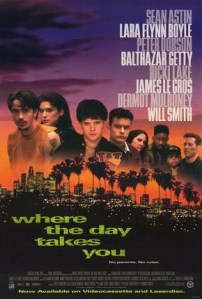
A Movie A Day #88: Where The Day Takes You (1992, directed by Marc Rocco)


This month, since the site is currently reviewing every episode of Twin Peaks, each entry in Move A Day is going to have a Twin Peaks connection.  Where The Day Takes You is a movie that has not just one but two connections to Twin Peaks.

Where The Day Takes You is an episodic film about young runaways living on the streets of Los Angeles.  Led by 22 year-old King (Dermot Mulroney), who ran away from home when he was 16, the runaways form a surrogate family.  While being constantly harassed by both the police and well-meaning social workers, some of the runaways get addicted to drugs while others turn to prostitution in order to survive.  Some find love.  Some find death.  They all go where the day takes you.  (Not sure if that was the movie’s tag line but it should have been.)

Where The Day Takes You is a gritty and often tough film, though it’s effectiveness is undercut by a predictable ending and the presence of too many familiar faces in the cast.  The runaways are made up of a who’s who of prominent young actors from the 1990s.  Balthazar Getty plays King’s second-in-command.  Sean Astin plays an obviously doomed drug addict.  Alyssa Milano and David Arquette play prostitutes.  Ricki Lake and James Le Gros play comedic relief.  Will Smith, in his film debut, plays a wheelchair-bound runaway.  Christian Slater and Laura San Giacomo show up as social workers while the police are represented by Rachel Ticotin and Adam Baldwin.  Everyone gives a good performance but the film would have worked better with unknown actors or even real runaways.  No matter how good a performance Sean Astin gives as a heroin addict, he is always going to be Sean Astin and it is always going to be difficult to look at him without saying, “I might not be able to carry the ring but I can carry you!”

The movie’s first Twin Peaks connection is that Lara Flynn Boyle, who played innocent Donna Hayward on Twin Peaks, plays innocent runaway Heather in Where The Day Takes You.  The role is cliché but Boyle shows the same charm that she showed while playing Donna.

The movie’s second Twin Peaks connection is more unexpected.  Kyle MacLachlan is effectively cast against type as Ted, the drug dealer who keeps most of the runaways hooked on heroin and who is perfectly willing to leave an overdosed junkie in a garbage bin.  Ted is about as far from Dale Cooper as you can get.

Film Review: White Water Summer (dir by Jeff Bleckner)


wws-02

White Water Summer is a weird movie that was made in either 1985 or 1987 (more on that in a minute.)  It stars a youngish Kevin Bacon and a very young Sean Astin.  It starts out as a comedy and then it turns into a tribute to male bonding bullshit and then it’s a comedy again and then it’s a thriller and then it’s back to the male bonding as Kevin and Sean go camping together and then it’s a thriller and then Sean Astin has to cross a rickety bridge and the whole movie turns into Lord of the Rings.  And then Kevin Bacon starts singing and you’re like, “Oh my God, this is a musical too!”  And then suddenly, Kevin Bacon starts acting all crazy-like and it’s a thriller again.  But then Kevin breaks his leg and it’s up to Sean Astin to save his life, despite the fact that Kevin appeared to be attempting to kill all the campers just a few minutes earlier.  So, I guess that would count as more male bonding BS.

(One great thing about being a girl is that I’ve never had to prove myself by going camping.  Or, for that matter, killing a wild boar while armed only with a sharpened stick.  Seriously, I imagine that would be difficult and messy!  BLEH!)

Another reason why White Water Summer is a weird movie is because it’s on TV like every other week.  According to what I’ve read online, White Water Summer was not even released into theaters.  (Even stranger, I have yet to find a single interview where Kevin Bacon even acknowledges that this film exists and that’s saying something when you consider that Kevin has never been shy about mentioning how many bad films he’s appeared in.  Kevin regularly talks about Quicksilver, for fug’s sake!)  And yet somehow, this film that nobody appears to have wanted has achieved an odd sort of basic cable immortality.

And that immortality is why I’m taking the time to review this movie.  Because, seriously, White Water Summer seems to show up on TV even more than The Shawshank Redemption or reruns of Cops!  That’s a lot!

Anyway, as for the film itself, it’s basically a celebration of male bonding bullshit.  Alan (Sean Astin) is a sheltered kid from New York.  He’s into astronomy and plays chess.  To toughen him up, his parents arrange for Alan to go on a camping trip with Vic (Kevin Bacon), this ultra intense guide who talks in zen riddles and occasionally dangles people over the edge of a mountain.  Alan doesn’t want to go and, at first, he struggles to get along with the other three boys on the hike.

However, soon all of the boys have a common bond.  They all fear (and yet, because this is male bonding bullshit, strangely respect) Vic, who apparently is a bit of authoritarian.  Vic is determined to make them into men and his techniques including forcing them to cross a rickety bridge, forcing them to fish by hand, forcing them to carry a canoe across a hill, and finally abandoning them for a night in the middle of the wilderness.  At one point, when Alan ends up falling off a mountain and finds himself dangling in mid-air at the end of a rope.  Vic refuses to help him.  Instead, Alan must find his own way to get back on the mountain. Alan manages to do just that but seriously, what the Hell is Vic thinking?  At times, the movie suggests that Vic is a sociopath and then, at other times, it suggests that his methods are actually working.  After all, by the end of the summer, Alan is a lot more confident and he also knows how catch fish.

And really, that’s what makes this movie so strange.  It has no idea who Vic is supposed to be and, as a result, the film doesn’t know if it’s a comedy, a thriller, or a coming-of-age adventure movie.  Towards the end of the movie, Vic finally goes too far and gets smacked in the face with an oar.  This leads to Vic breaking his leg and suddenly, it’s up to Alan to save Vic’s life.  In order to do so, Alan has to call on a combination of his own intelligence and the survival skills that he learned from Vic.  So, that would seem to suggest that the movie is partially pro-Vic but, if that’s the case, why was Vic also portrayed as being somewhat psychotic?  Is this film pro-psychopath or is it just anti-Alan?  It’s hard to tell.

Making things even stranger is Alan’s narration.  In between scenes of camping, hiking, and attacking, we get these weird little vignettes of a slightly older Sean Astin speaking directly to the audience.  (According to the imdb, the camping scenes were filmed in 1985 while Astin’s narration was filmed in 1987.)  Narrator Alan is snarky and sarcastic, which would suggest that he doesn’t feel that he learned anything of value from the whole experience.  So does older Alan regret saving Vic’s life?  Does he still resent the fact that his parents forced him to go on the hike?  Or is he just trying to impress us with attitude?  Again, it’s hard to tell exactly what the film was trying to accomplish.

WWS

Watching White Water Summer, it’s obvious that, in 1985, there were difficulties that probably left the film incomplete.  Astin’s 1987 narration was obviously tacked on in a desperate attempt to try to save the movie.  To be perfectly honest, it’s fascinating to witness how haphazardly this film was put together.  One of the pleasures of White Water Summer is watching this oddly edited film and trying to figure out what exactly happened.

Anyway, I’ve never been into the whole camping or hiking thing and, after watching White Water Summer, I have no regrets.*  And yet, this is another one of those films that I do think that everyone should watch at least once, just because the movie itself is so weird.

Add to that, it’s on TV all the time!

—–

* Now Wild, that’s a great hiking film!

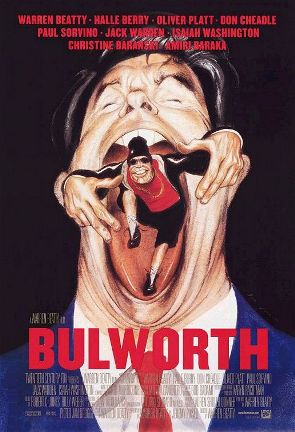
Shattered Politics #62: Bulworth (dir by Warren Beatty)


BulworthSo, if you’ve ever wondered what happened to Robert Redford’s Bill McKay after he was elected to the U.S. Senate at the end of The Candidate, I imagine that he probably ended up becoming something like the protagonist of 1998’s Bulworth, U.S. Sen. Jay Bulworth.

As played by Warren Beatty, Bulworth is a veteran senator.  A former liberal firebrand, he may still decorate his office with pictures of him meeting Bobby Kennedy and Martin Luther King but Bulworth sold out a long time ago.  Now, he just says whatever has to say in order to get elected, including pretending to have a happy marriage. He has become a part of everything that’s wrong with Washington.

Sick of both politics and life in general, Bulworth decides that he’d rather be dead.  But, in order to make sure that his daughter collects on his $10,000,000 life insurance policy, Bulworth cannot commit suicide.  Instead, he arranges for a contract to be taken out on his life.  In two days, Bulworth will be assassinated.

Returning to California for his campaign, Bulworth gets drunk and suddenly starts to say what he actually believes.  He attacks the Washington establishment.  He attacks the voters.  He attacks the insurance companies and comes out for single payer health insurance.  With his desperate press secretary (Oliver Platt) chasing behind him, Bulworth spends the night dancing at a club where he discovers marijuana and meets a girl named Nina (Halle Berry).

(Platt, meanwhile, discovers that he really, really likes cocaine.)

Soon, Nina and Bulworth are hiding out in the ghetto, where Bulworth meets both Nina’s brother (Isiah Washington) and local drug dealer, L.D. (Don Cheadle), and gets a lesson about how economics actually work in the ghetto.  Soon, Bulworth is appearing on CNN where he raps his new political platform and suggests that the solutions for all of America’s problems would be for everyone to just keep having sex until eventually everyone is the same color.

Of course, what Bulworth doesn’t know is that Nina also happens to be the assassin who has been contracted to kill him…

I have mixed feelings about Bulworth.  On the one hand, the film starts out strong.  You don’t have to agree with the film’s politics in order to appreciate the film’s passion,  Bulworth is an angry film and one that’s willing to say some potentially unpopular things.  It’s a film about politics that doesn’t resort to the easy solutions that were proposed by some of the other films that I’ve reviewed for Shattered Politics.  Warren Beatty does a pretty good job of portraying Bulworth’s initial mental breakdown and Oliver Platt is a manic wonder as he consumes more and more cocaine.

But, once Warren Beatty starts rapping, the film starts to fall apart and becomes a bit too cartoonish for its own good.  You get the feeling that Warren Beatty, at this point, is just trying to live out the liberal fantasy of being the only wealthy white man in America to understand what it’s like to be poor and black in America.

Bulworth starts out well but ultimately, it begins better than it ends.

http://www.youtube.com/watch?v=-0SgQKpWGD4

6 Trailers To Keep Things Cheerful


After spending two weeks researching the career of Jason Voorhees, I am in the mood for some movies that feature absolutely no one getting brutally murdered. That’s why this edition of Lisa Marie’s Favorite Grindhouse and Exploitation Trailers is dedicated to some of the most light-weight comedies ever made. 

(Yes, I realize that these films aren’t exactly grindhouse films but they’re close enough.)

1) Making the Grade (1984)

This trailer almost feels like a parody, doesn’t it?  In fact, it very well could be.  Has anyone ever actually seen this Making the Grade movie?

2) White Water Summer (1987)

This is a weird movie that, for some reason, tends to pop up on TV every few months or so.  Kevin Bacon is a nature guide who appears to be sociopath and Sean Astin is the kid that he bullies nonstop.  Eventually, Bacon breaks his leg and Astin saves his life or something like that.  The whole movie just has a really weird feel to it.

3) Private Lessons (1981)

These next three trailers form a trilogy of sorts.  We start off with Private Lessons, which — let’s be honest — is a pretty creepy trailer.

4) Private School (1983)

The 2nd part of the private trilogy was directed by Noel Black who also directed one of the best films of the 60s, Pretty Poison.

5) Private Resort (1985)

And then we come to this…Private Resort.  Much like White Water Summer, Private Resort used to always show up on Sunday afternoon TV and I’ve never really understood why.  That said, I watched it a few times because I’ll watch Johnny Depp in anything.

6) Fraternity Vacation (1985)

And finally, let’s wrap things up with Fraternity Vacation, starring future Oscar winner Tim Robbins.