The TSL Horror Grindhouse: The Dunwich Horror (dir by Daniel Haller)


Look at me/I’m Sandra Dee….

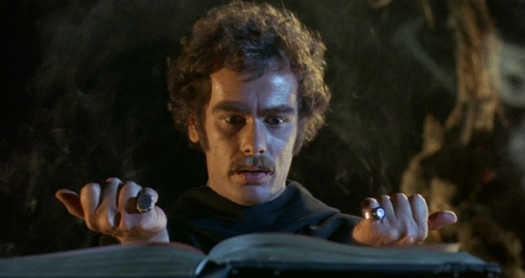
First released in the groovy and psychedelic year of 1970, The Dunwich Horror stars Sandra Dee as Nancy, an somewhat innocent grad student at Massachusetts’s Miskatonic University.  When the mysterious Wilbur Wheatley (Dean Stockwell) comes to the university and asks to take a look at a very rare book called The Necronomicon, Nancy agrees.  She does so even though there’s only one edition of The Necronomicon in existence and it’s supposed to be protected at all costs.  Maybe it’s Wilbur’s hypnotic eyes that convince Nancy to allow him to see and manhandle the book.  Prof. Henry Armitage (Ed Begley) is not happy to see Wilbur reading the book and he warns Nancy that the Wheatleys are no good.

Nancy still agrees to give Wilbur a ride back to his hometown of Dunwich.  She finds herself enchanted by the mysterious Wilbur and she’s intrigued as to why so many people in the town seem to hate Wilbur and his father (Sam Jaffe).  Soon, she is staying at Wilbur’s mansion and has apparently forgotten about actually returning to Miskatonic.  She has fallen under Wilbur’s spell and it soon becomes clear that Wilbur has sinister plans of his own.  It’s time to start chanting about the Old Ones and the eldritch powers while naked cultists run along the beach and Nancy writhes on an altar.  We are in Lovecraft county!

Actually, it’s tempting to wonder just how exactly H.P. Lovecraft would have felt about this adaptation of his short story.  On the one hand, it captures the chilly New England atmosphere of Lovecraft’s work and it features references to such Lovecraft mainstays as Miskatonic University, the Necronomicon, and the Old Ones.  As was often the case with Lovecraft’s stories, the main characters are students and academics.  At the same time, this is very much a film of the late 60s/early 70s.  That means that there are random naked hippies, odd camera angles, and frequent use of the zoom lens.  The film makes frequent use of solarization and other psychedelic effects that were all the rage in 1970.  Lovecraft may have been an unconventional thinker but I’m still not sure he would have appreciated seeing his fearsome cult transformed into a bunch of body-painting hippies.

Really, the true pleasure of The Dunwich Horror is watching a very earnest Sandra Dee act opposite a very stoned Dean Stockwell.  Stockwell was a charter member of the Hollywood counterculture, a friend of Dennis Hopper’s who had gone from being a top Hollywood child actor to playing hippie gurus in numerous AIP films.  As for Sandra Dee, one gets the feeling that this film was an attempt to change her square image.  When Wilbur tells Nancy that her nightmares sound like they’re sexual in origin and then explores her feelings about sex, Nancy replies, “I like sex,” and it’s obviously meant to be a moment that will make the audience say, “Hey, she’s one of us!”  But Sandra Dee delivers the line so hesitantly that it actually has the opposite effect.  Stockwell rather smoothely slips into the role of the eccentric Wilbur.  Wilbur is meant to be an outsider and one gets the feeling that’s how Stockwell viewed himself in 1970.  Sandra Dee, meanwhile, seems to be trying really hard to convince the viewer that she’s not the same actress who played Gidget and starred in A Summer Place, even though she clearly is.  It creates an oddly fascinating chemistry between the two of them.  Evil Wilbur actually comes across as being more honest than virtuous Nancy.

Executive produced by Roger Corman, The Dunwich Horror is an undeniably campy film but, if you’re a fan of the early 70s grindhouse and drive-in scene, it’s just silly enough to be entertaining.  Even when the film itself descends into nonsense, Stockwell’s bizarre charisma keeps things watchable and there are a few memorable supporting performances.  (Talia Shire has a small but memorable roll as a nurse.)  It’s a film that stays true to the spirit of Lovecraft, despite all of the hippies.
Retro Television Review: Fantasy Island 6.16 “Eternal Flame/My Date With Burt”


Welcome to Retro Television Reviews, a feature where we review some of our favorite and least favorite shows of the past!  On Tuesdays, I will be reviewing the original Fantasy Island, which ran on ABC from 1977 to 1984.  Unfortunately, the show has been removed from most streaming sites.  Fortunately, I’ve got nearly every episode on my DVR.

This week, our trip is all about getting older.

Episode 6.16 “Eternal Flame/My Date With Burt”

(Dir by Don Weis, originally aired on March 5th, 1983)

When I first saw that one of the fantasies this week was called “My Date With Burt,” my immediate assumption was that someone would come to Fantasy Island and demand to go on a date with Burt Reynolds.  I was actually looking forward to seeing if Burt would play himself or if they would just have some stand-in who was always shot from behind.  Unfortunately, I was wrong.

The Burt in this case is Burt Hunter (Ron Ely), an actor who is the latest to be cast as a James Bond-type of secret agent.  Margaret Winslow (Sandra Dee) has a crush on him and wants to meet him.  For his part, Burt is depressed because he’s getting older and the producers of his films want to replace him with a younger actor.  At first, Burt just goes out with Margaret in order to generate some publicity for himself.  He hires a stuntman to fake a fight so that Burt can emerge as a big ol’ hero.  Burt is trying to save his career but Margaret is not amused by any of that.  Margaret realizes that films are not real life.  Margaret’s pretty old to only now be figuring that out.  Anyway, Margaret and Burt still fall in love and leave the Island together.

This fantasy was predictable but it did give us one of those fun Tattoo subplots where Tattoo claimed to be Burt Hamilton’s best friend and tried to get involved in managing his career.  Tattoo always had a side hustle going and good for him!  One gets the feeling that Roarke didn’t pay him that much.  Seriously, Tattoo was always trying to find a way to make more money.  Pay the man what he’s worth, Mr. Roarke!

Our other fantasy features Linwood Bolton and Randi Oakes as Alex and Diana Weston, two newlyweds who want to find the Fountain of Youth so that they can be young and in love forever.  Yay!  Roarke has them take a dip in a pool and, when they emerge, they’re on an isolated island that is ruled over by Ra-Mas (Alex Cord) and Maatira (the great Stella Stevens).  Maatira will let them drink from the fountain but there’s a catch …. one of the cups is full of poison!  Alex can be eternally young and he can be spend the rest of eternity as Maatira’s lover but Diana has to die.  And Diana does die.  Luckily, the water from the fountain can also bring people back to life.

This was a weird fantasy and you really do have to wonder what would have happened if Alex hadn’t come to his senses and if Diana hadn’t been revived.  Would Roarke have just shrugged and told Tattoo to burn Diana’s passport?  It just doesn’t seem like that would be good for business.  That said, Stella Stevens was an actress who was always willing to embrace the melodrama and she does so here, keeping things somewhat entertaining.

This was a pleasant if not particularly memorable trip to the Island.

Retro Television Reviews: Houston, We’ve Got A Problem (dir by Lawrence Doheny)


Welcome to Retro Television Reviews, a feature where we review some of our favorite and least favorite shows of the past!  On Sundays, I will be reviewing the made-for-television movies that used to be a primetime mainstay.  Today’s film is 1974’s Houston, We’ve Got A Problem!  It  can be viewed on YouTube!

The year is 1970 and Apollo 13 is the latest manned NASA mission into space.  The head of the mission of Jim Lovell and the destination is the Moon.  Unfortunately, the American public has gotten so used to the idea of men going to the Moon that hardly anyone is paying attention to Apollo 13.  That changes when Lovell contacts mission control in Houston and utters those famous words, “Houston …. we’ve had a problem.”  An oxygen tank has exploded, crippling the spacecraft and leaving the three men in danger.  If Houston can’t figure out how to bring them home, Apollo 13 could turn into an orbiting tomb.

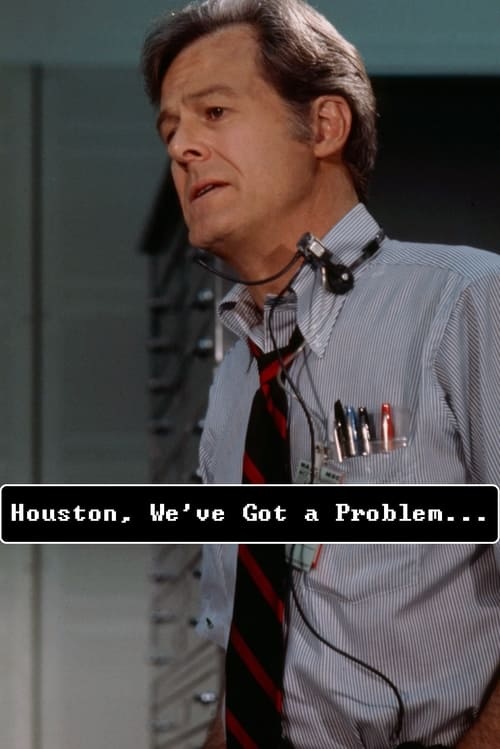
Yes, this film tells the story of the same crisis that Ron Howard recreated in Apollo 13.  The difference between Houston, We’ve Got A Problem and Apollo 13 (beyond the fact that one was a big budget Hollywood production and the other a low-budget made-for-TV movie), is that Apollo 13 largely focused on the men trapped in space while Houston, We’ve Got A Problem is totally Earthbound.  In fact, Jim Lovell does not even appear in the ’74 film, though his voice is heard.  (The film features the actual communications between the crew and Mission Control.)  Instead, the entire film follows the men on the ground as, under the leadership of Gene Kranz (Ed Nelson), they try to figure out how to bring the crew of Apollo 13 home.  Houston, We’ve Got A Problem is a far more low-key film than Apollo 13, one that features narration from Eli Wallach to give it an effective documentary feel but one that also lacks the moments of wit and emotion that distinguished Apollo 13.  

NASA cooperated with the making of the film and it works best when it focuses on the men brainstorming on how to solve the biggest crisis that the American space program had ever faced to that date.  The film is less effective when it tries to portray the effects of the men’s work on their home lives.  Sandra Dee is wasted as the wife who can’t understand why her engineer husband (reliably bland Gary Collins) can’t spend more time at home.  Clu Gulager plays the guy who fears he’s missing out on time with his son.  Robert Culp plays the man with a heart condition who places his hand over his chest whenever anything stressful happens.  Steve Franken has to choose between his religious obligations and his obligation to NASA.  The melodrama of those fictional moments are awkwardly mixed with the based-in-fact moments of everyone calmly and rationally discussing the best way to save the crew.  Jim Lovell, as a matter of fact, complained that Houston, We’ve Got A Problem did a disservice to the flight controllers by presenting them all as being hopelessly inept in their lives outside of mission control.  (Lovell was reportedly much happier with Apollo 13.)

Because it features the actual conversations between the crew and Mission Control, Houston, We’ve Got A Problem is interesting as a historical document but it never escapes the shadow of Ron Howard’s better-known film.

Retro Television Review: Fantasy Island (dir by Richard Lang)


Welcome to Retro Television Reviews, a feature where we review some of our favorite and least favorite shows of the past!  On Tuesdays, I will be reviewing the original Fantasy Island, which ran on ABC from 1977 to 1996.  The entire show is currently streaming on Tubi!

Ah, Fantasy Island!

There have been several versions of Fantasy Island.  In the late 90s, there was a version that featured Malcolm McDowell as the somewhat aloof owner of the island.  More recently, there was a movie that featured Michael Pena as the owner of the Island and which tried to turn the whole thing into a horror franchise.  It wasn’t very good.  And right now, there’s a show on Fox that features Roselyn Sanchez as the grand niece of the island’s original owner.  The Fox series is about to start its second season.  It’s a bit silly, which is why I kind of love it.

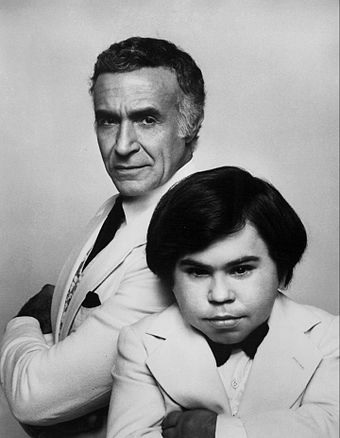
And then there’s the Fantasy Island that started it all, the Aaron Spelling-produced series that ran from 1977 to 1984 on ABC and which has lived on in reruns and on streaming platforms like Tubi.  Both the original series and all of its subsequent spin-offs took place on a mysterious tropical island where people would pay to live out their fantasies.  In the original series, the island was run by Mr. Roarke (Ricardo Montalban), who wore a white suit and encouraged everyone to smile whenever the guests arrived.  Serving as Mr. Roarke’s second-in-command was Tattoo (Herve Villechaize), who was 3’11, always wore a matching white suit, and announced the arrival of the plane by ringing a bell and shouting, “The plane, the plane!”  Of course, each week would bring in a different group of guest stars.  They would come to the island with a fantasy and, hopefully, they would learn that reality was the only fantasy that they needed.

All seven seasons of the original Fantasy Island are currently streaming on Tubi.  However, if you want to see the 1977 pilot film that started it all, you have to go to YouTube.

In many ways, the 90-minute pilot film feels like a typical episode of Fantasy Island.  It’s interesting to see that the show’s basic premise and format was already set in stone when the pilot was filmed.  (Pilots are notorious for often being dramatically different from the shows that they were created to sell.)  The pilot opens with the plane arriving (and yes, from the start, Tattoo rings the bell and shouts, “The plane!”) and three guests meeting Mr. Roarke.  Our three guest stars are Bill Bixby, Hugh O’Brian, and Eleanor Parker.  Bixby plays Arnold Greenwood, a former war correspondent who wants to be reunited with Francesca (Sandra Dee), the woman with whom he fell in love during World War II.  O’Brian is Paul, a famous big game hunter who wants to be hunted for once.  Eleanor Parker is Eunice Hollander Barnes, one of the world’s richest women.  She wants to fake her death so she can see who, from her life, would actually mourn her and who would just try to steal her fortune.

If the pilot’s format is the same as the series that followed, the general tone is somewhat different.  Mr. Roarke is an almost sinister figure, one who doesn’t really seem to think much of his guests and who is quick to point out that no one gets a fantasy until they’ve paid him the required $50,000.  (That’s $50,000 in 1970s money.  I have to admit that when Mr. Roarke first mentioned how much the fantasies cost, I was like, “Hey, I could afford this place!”)

Consider the story of the hunter.  Paul wants to be hunted because he’s suicidal.  His real fantasy is to die.  The night before Paul’s fantasy is to begin, Michelle (Victoria Principal) shows up at Paul’s room.  Michelle explains that Mr. Roarke has hired her to provide Paul with companionship during the night.  Unfortunately, Michelle ends up handcuffed to Paul and, as a result, she’s hunted along with him!  Now, you could argue that Mr. Roarke did this to teach Paul to think about someone other than himself.  But what if Paul hadn’t learned the lesson?  Then Michelle would be dead too!  What would Mr. Roarke do then?  Just have Tattoo dump the bodies in the lagoon?  “To hell with you, Roarke!” Paul yells and who can blame him?

And then there’s our war correspondent, Arnold.  Arnold’s fantasy seems simple enough but then it turns out that the reason he lost contact with Francesca is because he murdered her!  As a result of his fantasy, Arnold not only relives the first time he met Francesca but also how their relationship ended.  The entire experience leaves Arnold laughing like a madman as his sanity slips away.

As for Eunice’s story, it’s pretty stupid.  She dresses up like a maid so that she can listen to what people have to say about her once they think she’s dead.  It’s like an episode of Undercover Boss.  At least former Kennedy in-law Peter Lawford makes an appearance as Eunice’s husband.  Eunice ends up far less traumatized than either Paul or Arnold but she still had to fake her death to come to peace with her life.

The pilot is entertaining.  One can understand why it would lead to a series.  The island is lovely to look at.  Even with the somewhat sinister tone of two of the stories, it’s still impossible to watch the pilot without wondering what type of fantasy you would pursue if you went to the Island.  For me, that’s always been the main appeal of all of the various versions of Fantasy Island.  Still, it’s interesting that the fantasies themselves are less comforting than what I think many would expect on account of the show’s reputation.  For all the criticism that Blumhouse received for their reinterpretation of Fantasy Island, they were not the first to imagine Mr. Roarke as being somewhat less than benevolent.  Of course, when the actual series started, Mr. Roarke was a far friendlier host.

Next week, the series begins and hopefully, no further guests are traumatized to the point of catatonia.

Halloween Havoc!: THE DUNWICH HORROR (AIP 1970)


gary loggins's avatarcracked rear viewer

THE DUNWICH HORROR is another film I saw when it was first released, on a double bill with the Spaghetti Western GOD FORGIVES, I DON’T. Unfortunately, this one fails to stand the test of time, with it’s trippy special effects and a somnambulant performance by Dean Stockwell , who was pretty obviously stoned out of his gourd during the shooting.

Professor of the occult Henry Armitage is lecturing on the Necronomicon, a book said to hold the key to the gate to another dimension, where a race of monsters known as “the old ones” dwell. Creepy Wilbur Whateley, great grandson of occultist Oliver, shows an abonrmal interest in the book. In fact, Wilbur wants to possess the Necronomicon to bring “the old ones” back to rule the Earth once again. To achieve this, he pretty much kidnaps and drugs student Nancy Wagner, hoping to use her in a bizarre sex…

View original post 363 more words

Horror on TV: Night Gallery 3.5 “Spectre in Tap Shoes”


Spectre in Tap Shoes


Tonight’s horror on TV is an episode of Night Gallery that was originally broadcast on October 29th, 1972. It’s a ghost story that features dancing so, of course, I like it!


Enjoy Spectre in Tap Shoes!


Embracing the Melodrama #16: A Summer Place (dir by Delmer Daves)


A Summer Place

Judging from the films I’ve seen from the decade, the 50s were a time when everyone was obsessed with sex but nobody felt comfortable talking about it.  Boys were, of course, allowed to do whatever they wanted, as long as they kept their hair perfectly straight and went out for a school team or two.  Girls, meanwhile, were divided into “good girls” and “bad girls.”  The most important thing in the world was to remain a good girl and to understand that the bad girls really weren’t having as much fun as they appeared to be having.  As for adults, their lives apparently revolved around sheltering their daughters and encouraging their sons to go get laid.  Now, to be honest, the culture really hasn’t changed that much.  I guess what distinguished 50s hypocrisy from the hypocrisy of today is that people in the 50s were apparently so much more sincere about that hypocrisy.

Case in point: 1959’s A Summer Place.  A Summer Place is one of those films where everyone is obsessed with sex but nobody can ever come right out and admit it.  It’s a film where people seem to exclusively speak in the language of euphemism.  It’s a film, about sex, in which you never see anyone actually having sex though, of course, there is an unplanned pregnancy towards the end of it.  That was the 50s for you.  Have sex outside of marriage once and you’re pretty much guaranteed to get knocked up.  You just better hope that the father is played by Troy Donahue.

(Has ever an actor has a more appropriate name than Troy Donahue?  The name itself just resonates a certain handsome blandness.)

In A Summer Place, Troy Donahue plays all-American boy Johnny Hunter.  Johnny’s father (played by Arthur Kennedy) is an alcoholic.  Johnny’s mother, Sylvia (Dorothy McGuire), is frustrated with her perpetually drunk husband and spends her days dreaming of a lifeguard that she once knew.  The Hunters own an inn, located on beautiful Pine Island off the coast of Maine.

One summer, Ken (Richard Egan) and his cold wife Helen (Constance Ford) come to stay at the inn.  Accompanying them is their teenage daughter, Molly (Sandra Dee).  Helen insists on trying to control every aspect of Molly’s life.  Ken, on the other hand, takes a much more relaxed attitude towards his daughter.  When Molly complains that Helen forces her to wear a bra and a girdle, Ken grabs his daughter’s underwear and tosses it all into the ocean.

(Uhmmm …. yeah, that’s more than a little creepy…)

Molly meets Johnny and, despite the fact that the stiff Troy Donahue generates absolutely zero romantic  sparks, the two of them soon fall in love. (It probably has something to do with the Theme From A Summer Place, a hypnotic piece of music that plays on the soundtrack whenever the two of them so much as even glance in each other’s direction.)  Helen, however, doesn’t want Molly to have anything to do with Johnny.  When Molly and Johnny spend a day stranded on an island together, Helen forcefully checks to make sure that Molly’s virginity is still intact while Molly repeatedly shouts, “I WANT MY FADDAH!  I WANT MY  FADDAH!”

However, her father is not there because he’s too busy having an affair of his own.  It turns out that Ken is the former lifeguard who Sylvia Hunter once loved…

And through all of the complications and the melodrama (and believe me, there’s a lot), the Theme From A Summer Place keeps on playing in the background.

Apparently, A Summer Place was considered to be incredibly risqué back in 1959.  Watched today, it all seems to be rather quaint and, in its way, oddly likable.  It’s not necessarily a good film but it’s an agreeable enough offering if you’re looking to waste two hours with whatever happens to be on TCM.  As opposed to some of the other regular directors of 50s melodrama —  like Douglas Sirk and Nicholas Ray — director Delmer Daves made films where the only subtext was unintentional.   As a result of Daves’s direction and Donahue’s “nice young man” blandness, A Summer Place is a pleasant film that never quite becomes a memorable one.

Still, just try to get that music out of your head…

a summer place, sandra dee, troy donahue


Lisa Marie Does 6 Trailers In The Snow


I was so happy today and it didn’t  even have anything to do with the movies, either!  Early this afternoon, I was watching my cat twitch in his sleep (he has very violent dreams, apparently) when I happened to look out my bedroom window and you know what I saw?  Snow!  “Yay!” I yelled, waking up the cat. 

Now, I know that everyone else in the country gets a blizzard every other month but I live in Texas so snow is kind of a big deal to me.  I jumped off my bed, threw my Hello Kitty robe on, and went running down stairs.  I threw open the door, ran out to the front porch, and then slipped and fell right on my backside. 

My neighbor stared at me from his yard.  “Are you okay?” he asked. 

“Yay!”  I replied, “it’s snowing!”

He nodded and then went, “Better hope those power lines don’t ice over or we might be without electricity.”

At that point, I resolved to never speak to my neighbor again.

So, I was very, very happy but now, the snow’s gone.  It’s moved along to Arkansas and Mississippi.  Now, the only thing falling rom the sky is freezing rain and the roads will probably be really icy and scary when I’m going to work tomorrow.  So, as I sit here all kinds of pantsless with a big purple bruise on my ass, I’m cheering myself up by putting together the latest installment of Lisa Marie’s Favorite Grindhouse and Exploitation Trailers.

1) The Dunwich Horror

From 1970: Dean Stockwell kidnaps and brainwashes Sandra Dee and he’s doing it all in the name of all mighty Cthulhu.  This is actually kind of a fun film as long as you can get the image of H.P. Lovecraft spinning in his grave out of your mind.

2) Curtains

I’ve never seen this 80s slasher film but I’ve read about its troubled production on various web sites.  I’m kinda embarrassed to admit it but I actually get scared when I see this trailer.  First off, that mask is disturbing.  And secondly, that doll…

3) Black Belt Jones

Fortunately, even if this world does occasionally give us a demon doll, it can also give us a Black Belt Jones.  I loved the trailer as soon as I saw Gloria Hendry shooting the dishes…

4) Frightmare

From Peter Walker, comes one of the greatest British horror films ever made.  It’s all about cannibalism, psychology, and fire place pokers.

5) Faceless

Jess Franco has directed close to a thousand films and approximately 12 of them are worth watching.  This is one of the lucky dozen, a remake of Eyes Without A Face.  The film gave Brigitte LaHaie her best role outside of the films of Jean Rollin and it also co-stars the great Caroline Munro.  And since it’s a Franco film, Howard Vernon plays a character named Dr. Orloff.  Plus, its got that cute little panther animation at the start of the trailer.

6) Electra Glide In Blue

Finally, it’s up to Robert Blake to restore some order.  This is actually a fairly interesting little movie as long as you realize that it’s such a 70s film, it might as well be wearing a suit with lapels stretching all the way to the end of the shoulders.