Retro Television Review: Miami Vice 3.21 “Knock Knock …. Who’s There?”


Welcome to Retro Television Reviews, a feature where we review some of our favorite and least favorite shows of the past!  On Mondays, I will be reviewing Miami Vice, which ran on NBC from 1984 to 1989.  The entire show can be purchased on Prime!

This week, the one hand doesn’t know what the other one is doing.  That’s life in Miami.,

Episode 3.21 “Knock Knock …. Who’s There?”

(Dir by Tony Wharmby, originally aired on March 27th, 1987)

An drug buy that Crockett and Tubbs (as Burnett and Cooper) set up with Esteban Montoyo (a miscast Ian McShane), falls apart when a group of DEA agents show up.  Or, at least, they say that they’re DEA agents.  Oddly, they just take the money and the drugs and then leave, saying that Miami metro will take care of the rest.

It quickly becomes apparent that the DEA agents were fake but Crockett and Tubbs have no way to confirm that because the DEA refuses to share any information about their activities with the Vice Squad.  Even though the DEA and detectives are all after the same people and are supposedly soldiers in the same war, they don’t trust each other and they don’t share information.  Meanwhile, Internal Affairs is convinced that Crockett and Tubbs stole the money and the drugs for themselves and are determined to prove it.  Apparently, it doesn’t matter that Crockett and Tubbs have killed a variety of different drug lords over the past three seasons.  No one in Miami trusts anyone!

As for the fake DEA busts, they’re being set up by an agent named Linda Colby (Elizabeth Ashley).  Linda’s husband (Jimmie Ray Weeks) is a former agent who is now in a wheelchair and who is a friend of Crockett’s.  Their son is in the hospital, fighting for his life.  Linda’s crimes are helping her to pay for his treatment.  It’s not greed that motivates her, or at least greed isn’t the only thing.  She’s also motivated by love.

Of course, in the end, she still gets shot during a showdown between Crockett, Tubbs, and Montoya.  Unlike the majority of Miami Vice‘s guest stars, Linda survives being shot.  But, as she’s lying on the stretcher, Crockett has to arrest her.  Linda says that Crockett would have done the same thing for his son.  With tears in his eyes, Crockett proceeds to recite Linda’s Miranda rights.  Though Crockett doesn’t say it, he knows that she’s right but he’s also a cop and he has no choice but to arrest her.  Now, her son will no longer receive medical treatment and his mother is going to be in jail.  Wow, Miami Vice, depressing much?

Of course, happy endings were a rarity on Miami Vice.  That was one of the show’s strengths.  No one ever got a truly happy ending.  Every drug lord that Crockett and Tubbs took down would be replaced by someone else.  Anyone who ever tried to help usually fell victim to a bullet.  People like Linda did things for desperate reasons and paid the price, all in the service of an unwinnable war.

This episode was uneven.  Ian McShane was not a particularly interesting villain and Crockett getting his cover blown happens so frequently that it’s no longer a shock.  But that final scene definitely packed a punch.  Never have the Miranda rights sounded so hollow.

Next week …. it’s Crockett and Tubbs vs. a motorcycle gang!  We’ll see what happens.  It can’t be any more depressing than this episode.
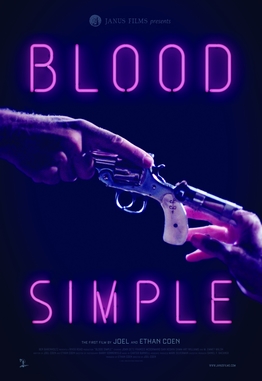
Sundance Film Review: Blood Simple (dir by Joel Coen)


(The 2018 Sundance Film Festival opens tonight!  Over the years, Sundance has become the premiere festival for independent film.  Not only have some of the best American films ever made premiered at Sundance, but it’s become the first stop in many a successful Oscar campaign.  Manchester By The Sea, Whiplash, Brooklyn, Beasts of the Southern Wild: all of them started their journey to a best picture nomination at Sundance.  For the duration of this year’s Sundance Film Festival, from today to the 28th, I’ll be reviewing films that first made a splash at Sundance.)

Blood Simple is an essential film.

If you love American movies, this is a movie that you have to see.  A delirious tribute to film noir, it’s a film that takes place in the darkest corners of America.  This is a film that shows that stories of love, betrayal, and murder can be just as complicated in the middle of America as in California and New York.

If you’re fascinated by the history of indie cinema, Blood Simple is a film that you have to see.  Joel and Ethan Coen, at a time when they were best known for their work with director Sam Raimi, created a trailer for Blood Simple long before they shot the actual movie.  They used this trailer to raise the film’s small budget.  Blood Simple was not only their directorial debut (though only Joel received a directorial credit, while the screenplay was credited to Ethan) but it was also both the feature debut of Frances McDormand and cinematographer (and future director) Barry Sonnenfeld’s first major credit as well.

If, like me, you love films about Texas, Blood Simple is an essential.  Long before they made No Country For Old Men, the Coens filmed Blood Simple in Texas.  Texas is as much a character in Blood Simple as Minnesota and the Dakotas were in Fargo.  Along with their twisty crime plots, Fargo, No Country, and Blood Simple all share a similarly cynical and fatalistic view of human nature, one that is perfectly reflected by the bleak locations where their stories take place.  Watching Blood Simple, it’s easy to imagine that, once the film ended, it fell to No Country‘s Sheriff Ed Tom Bell to laconically look over the carnage and try to figure out what the Hell just happened.

Like many Coen Brothers films, Blood Simple starts out simply and then gets progressively more and more complicated.  Almost all of those complications are due to a combination of human stupidity and greed.  Abby (Frances McDormand) and Ray (John Getz) are having an affair.  Abby’s husband, Marty (Dan Hedaya), owns the bar where Ray works as a bartender.  Marty hires a sleazy private detective named Loren Visser (M. Emmett Walsh) to kill Abby and Ray.  Visser has other plans.  By the end of the movie, almost everyone is dead but no one’s sure why.

The film largely serves as a showcase for Walsh, so much so that McDormand, Hedaya and Getz run the risk of getting lost in the shuffle.  That’s a shame, because all three give excellent performances.  McDormand brings strength and determination to the role of Abby.  Meanwhile, both Getz and Hedaya play two very familiar types.  Anyone who has spent any time in Texas will immediately recognize the characters played by Getz and Hedaya.  Ray may not be the smartest guy in the world but he’ll keep your car running and your glass full.  He’s probably never going to amount too much but he’s what is universally known as a good guy.  On the other hand, Marty, as played by Hedaya, is perhaps one of the most pathetic characters to ever appear in an American film.  Film noirs are full of betrayed husbands but it’s hard to think of a bigger loser than Marty.  Marty is the guy who tries to act tough but even he secretly knows that no one will ever take him seriously.  With the combination of his northern accent and his pathetic attempts to dress “western,” Marty is an outsider in Texas, one who is too stupid to realize just how far outside he actually is.

That said, the film is dominated by M. Emmett Walsh.  As played by Walsh, Loren Visser is one half sleazy redneck and one half demon from Hell.  Speaking in a sarcastic drawl and seemingly amused by all the chaos he has created, Walsh turns Visser into a truly fascinating villain.  He may be evil but you can’t stop watching him.  Walsh’s best moment is also his last in the film, a sarcastic one-liner that suggests that everything that has happened was caused more for his own amusement than anything else.  Visser is clever but not even he can escape the random whims of fate.

Violent and, as is typical for the Coens, darkly humorous, Blood Simple won the Grand Jury Prize at the 1985 Sundance Film Festival.  Though it was only a modest box office success, it not only launched the careers of the Coen Brothers but continues to be on the most influential independent films ever made.  The film remains impressive today.  Whenever I see it, I’m always stunned to see how, even with their first film, the Coens had already developed their own very unique aesthetic.

Blood Simple is an essential film.