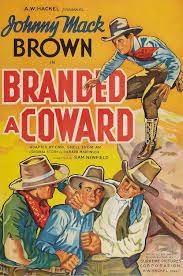
Branded A Coward (1935, directed by Sam Newfield)


When Johnny Hume was just a young boy, he witnessed his entire family being killed by a group of bandits led by the mysterious Cat.  Johnny grows up to be a trick-shot artist but, despite his skill with a gun, he can’t stand to point it at anyone or to be near any sort of gunfights.  When a fight breaks out in a saloon, he hides behind a bar and is labeled a coward.

Still, Johnny and his sidekick (Syd Saylor) somehow find the strength to run off a bunch of stagecoach robbers and save passenger Ethel Carson (Billie Seward).  Johnny is offered a chance to become the new town marshal.  Johnny, despite his fear of gunfights, accepts after he hears that the Cat is back in business.  Johnny wants revenge but the Cat turns out to be not who he was expecting.

Branded A Coward may be a zero-budget Poverty Row western but it’s actually has an interesting story and a good (if not entirely unexpected) twist towards the end.  Johnny Mack Brown was one of the better actors amongst the cowboys who starred in the westerns put out by PRC and directed by Sam Newfield.  Brown does a good job portraying Johnny’s fear and also his determination to get justice for his family.  Johnny proves he’s no coward but at what cost?

The plot here is a little darker than most of the westerns that were coming out at this time.  Every Poverty Row western featured a comic relief sidekick but this might be the only to feature the sidekick getting killed.  In the role of Oscar, Syd Saylor leaned very heavily on his fake stuttering shtick, to the extent that it actually got offensive.  I wasn’t sorry to see his character go.  Johnny Mack Brown didn’t need any help to get justice.

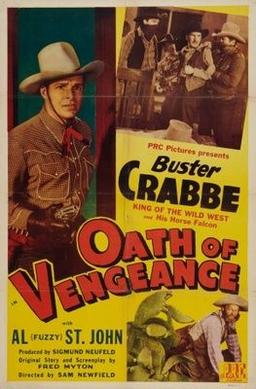
Oath of Vengeance (1944, directed by Sam Newfield)


In a small frontier town, the ranchers and the farmers are nearly at war with each other.  Cattle are being rustled.  The head of the farmers (Karl Hackett) is accused of killing a ranch hand.  Store owner Fuzzy Q. Jones (Al St. John) suspects that it’s all a set-up and he’s not going to stand for it.  If the farmers kill all the ranchers and the ranchers kill all the farmers, there won’t be anyone left to shop at his store.  Fuzzy calls in his friend, Billy Carson (Buster Crabbe).

Buster Crabbe may have gotten his start in the westerns by playing Billy the Kid but the producers of his films eventually realized that there was only so long that Buster could play a character known as “the Kid” and Billy the Kid’s reputation as an outlaw was actually not helpful at the box office because parents didn’t want to send their kids to a matinee that might teach them the wrong lessons.  After a handful of “Billy the Kid” films, Buster’s western hero suddenly had a new name.  Billy Carson was a standard western do-gooder, called in whenever a town needed to be cleaned up or his old sidekick Fuzzy needed some help around the store.  Crabbe was a convincing hero no matter what but the Billy Carson films lacked the thing that made the Billy the Kid films interesting.  Usually, no one was trying to arrest Billy Carson.

Oath of Vengeance isn’t bad, at least not by the standards of Poverty Row westerns.  There’s plenty of fights and Crabbe, being a former Olympian, looks convincing with he throws a punch.  The plot is a pretty standard B-western plot but Crabbe’s natural likability carries the day.  Fans of the genre will be happy to see Charles King and Kermit Maynard, playing bad guys.  Frank Ellis plays the ranch hand whose murder sets off the story.  It’s always good to see the old gang back together again.

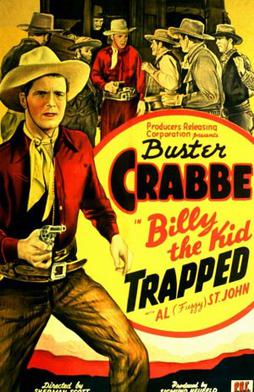
Billy The Kid Trapped (1942, directed by Sam Newfield)


Billy “The Kid” Bonney (Buster Crabbe) and his two buddies Fuzzy (Al St. John) and Jeff (Bud McTaggart) are just trying to mind their own business and make a living in the old west but they keep getting accused of every crime that happens.  This time, they’re sentenced to hang for a crime they didn’t commit.  Luckily, a group of strangers break Billy and his friends out of jail and send them on their way to the next town.  However, the men who broke them out of jail are soon committing crimes while disguised as Billy, Fuzzy, and Jeff!  Billy teams up with Sherriff Masters (Ted Adams) to stop the imposters, who are working for Boss Jim Stanton (Glenn Strange).

One of the joys of Poverty Row westers like this one is that they always featured the same stock company.  Al St. John was everyone’s sidekick.  Ted Adams was often a sheriff.  Glenn Strange was always the criminal mastermind pulling the strings.  Milton Kibbee was always a corrupt judge or ranch owner.  George Cheseboro, Horace B. Carpenter, Jack Curtis, and Budd Buster are amongst the very familiar faces in Billy The Kid Trapped.  It gives each film a homey feel that will be appreciated by fans of the genre.  The hero of the films often changed but the stock company always remained the same.

I like the idea behind Billy The Kid Trapped but the film still feels repetitive, even though it’s less than an hour long.  After Billy captures the men who are imitating him and his friends, a crooked judge sets the men free and the immediately go back to imitating Billy.  Billy has to capture them all over again.  No wonder Billy aged so quickly!  (Buster Crabbe was in his mid-thirties when he was playing The Kid.)  The movie does have all the usual gunfights and horse chases that people watch these movies for.  It’s comforting that, no matter what, the villain is always going to turn out to be Glenn Strange.

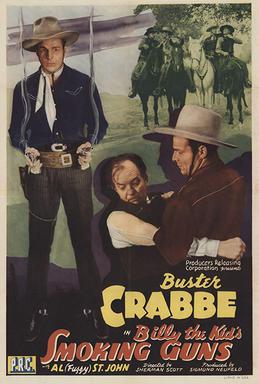
Billy The Kid’s Smoking Guns (1942, directed by Sam Newfield)


It’s a tale as old as time.  During the days when the west was wild, the U.S. Army is planning on setting up a new outpost near a town so the bad guys want to run all the ranchers off of their land so that they can be the ones to sell it.  Sheriff Carson (Ted Adams) is corrupt and working for the bad guys so the ranchers have to turn to Billy the Kid (Buster Crabbe) and his sidekicks, Jeff (Dave O’Brien) and Fuzzy (Al St. John) for help.  When Jeff is wounded in a fight, Fuzzy takes him to Doc Hagen (Milton Kibbee), little suspecting the doctor is actually the leader of the bad guys and using his medical practice to kill anyone who won’t give up their land!

Coming to us straight from Poverty Row, this B-western is interesting in that it seems to take a very cynical view of law enforcement.  Sheriff Carson is corrupt and Billy and his friends are running from the law themselves.  Buster Crabbe’s Billy the Kid films always kept it unclear why Billy was in trouble with the authorities.  Crabbe’s Billy the Kid always seemed to be the nicest guy in the west.  (Of course, Crabbe was also 33 and no longer seemed like he should have been known as “the Kid.”)  Eventually, the series was retconned and Buster Crabbe was no longer playing Billy the Kid but instead he was playing an upstanding citizen named Billy Carson.

Crabbe may not be a convincing outlaw but he is a convincing hero, which is all these films really required.  Billy the Kid’s Smoking Guns is a little bit interesting because of the character of Doc Hagen, whose occupation makes him a little more memorable than typical B-western bad guy.  The film is also interesting in that, for once, there’s no love interest.  Instead, it’s just men in hats shooting at each other.  That probably made the film’s youthful target audience happy.

The real-life Billy The Kid was killed when he was only 21 and after he had been an outlaw for only three years.  Buster Crabbe would g0 on to play Billy (or o some variation of Billy) until he was closing in on 40.


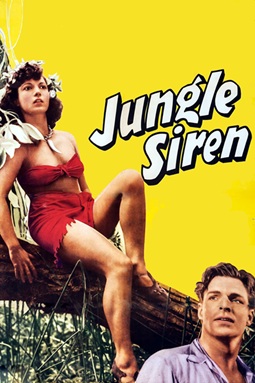
Jungle Siren (1942, directed by Sam Newfield)


Captain Gary Hart (Buster Crabbe) and his sidekick, Sgt. Mike Jenkins (Paul Bryar), are sent to the jungles of Africa, where Nazi infiltrators are encouraging Chief Selangi (Jess Lee Brooks) to side with the Third Reich and allow them to set up a base.  In their effort to stop the Nazis, Hart and Jenkins are aided by Kuhlaya (Ann Corio), a woman whose parents were killed by Selangi and who now lives in the jungle with a chimpanzee and a doctor (Milton Kibbee) who serves as her protector.  Kuhlaya carries a bow and arrow, which she used to battle the Nazis.  Hart and Jenkins have actual guns and probably could have ended the Nazi plot early just by using them as soon as they arrived but then the movie couldn’t be stretched to 68 minutes.

This is a pretty bad Poverty Row film, memorable just for Crabbe’s typically earnest and athletic performance and the presence of Ann Corio, who was a famous stripper in the 40s who tried to transition into films after Mayor La Guardia ordered the closure of New York’s burlesque houses.  Corio had legs for miles but she was a terrible actress.  At one point, Mike Jenkins says that if he keeps exercising, “I’ll have a physique like Buster Crabbe!”  That’s about as clever as this slow-moving film gets.

As is typical of jungle films that were made in the 40s, the “tribesmen” are pretty much treated as if they’re interchangeable and the only one who is given a personality is the evil Selangi.  Several of them are killed over the course of the movie, not because they were doing anything wrong but just because they were in the wrong place.  (The most egregious example is an innocent native who ends up with one of Kuhlaya’s arrows in his back because he was unfortunate enough to step in front of Selangi at the last moment.)  No one, our heroes included, really seems to care about them or their future.  Even by the standards of the era, Jungle Siren feels extremely condescending and prejudiced in its portrayal of the natives.  The idea that the Nazis, with their Aryan obsession, would ever team up with Chief Selangi is just one of the film’s problems.

Director Sam Newfield was responsible for some entertaining and cheap westerns.  I’ve reviewed a few of them.  He should have stayed out the jungle.

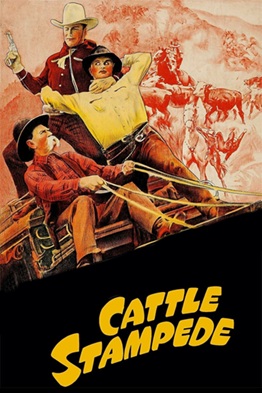
Cattle Stampede (1943, directed by Sam Newfield)


Billy the Kid (Buster Crabbe), that western do-gooder who has been framed for crimes that he didn’t commit, narrowly escapes being captured by a group of bounty hunters.  To thank the man who helped him and his sidekick, Fuzzy Q. Jones (Al  St. John), escape, Billy agrees to help the man’s family make a cattle drive.  It turns out that local ranchers are being targeted by rustlers who cause the cattle to stampede and then buy up what’s left of the herd at a discount.  Even though Mary Dawson (Frances Gladwin) doesn’t trust Billy and initially suspects him of being one of the rustlers, Billy and Fuzzy take over the cattle drive and protect the family from Coulter (Glenn Strange) and Elkins (Frank Ellis).  They even prove their worth by rescuing Mary after she’s kidnapped by the villains.

This is one of the many Poverty Row westerns to feature Billy the Kid not as an outlaw but instead as a hero.  Best-known for playing Tarzan, Flash Gordon, and Buck Rogers, Buster Crabbe was a believable hero even if he was more than a little too old to be nicknamed “the kid.”  Al St. John provides the comedic relief and veteran bad guys Charles King, Glenn Strange and Frank Ellis go through the motions as the villains, much as they did in countless other westerns of the era.  Cattle Stampede is typical of the cheap western programmers that came out of the Poverty Row studios in the 40s.  It was simplistic and predictable but featured enough western action to keep the kids in the audience entertained.  Today, its main selling point is a nostalgic one.

The Billy the Kid films are always strange because they avoid the reason why Billy is being pursued by the law and instead just present him as being another generic western hero.  It seems like a waste of a good legend.

The Lone Rider Rides On (1941, directed by Sam Newfield)


In the days of the wild west, Tom Cameron (George Houston) rides the range alone, seeking vengeance for the murder of his family.  They were killed when their wagon train was ambushed by the same outlaws who has previously sold them a plot of land.  Tom was a child at the time and he only remembers that the leader of the outlaws had a distinctive facial scar.  Tom Cameron is The Lone Rider.

No, not the Long Ranger.  The Lone Rider!  George Houston was an opera star who made for a surprisingly convincing gunslinger and the movie opens with him singing I Am The Lone Rider, just to make sure that it was understood that his vengeance-driven vigilante was a completely different character from that other vengeance-driven vigilante.  The Lone Rider is looking to avenge his family and, with the help of store keeper “Fuzzy” Jones (professional sidekick Al St. John), the Lone Rider does just that.  Though this is a standard B-western, the plot is a little more serious than most other B-movies.  This was the first of several Lone Rider movies and, despite the obviously low budget, there’s some emotional heft to its story.  Tom discovers that his brother (Lee Powell), who he thought had died in the attack, actually survived and joined up with the gang.  The story is about both Tom’s vengeance and his brother’s redemption.  Fans of the genre will enjoy the film’s classic western story and George Houston’s convincing performance as a gunslinger on a mission.

The Lone Rider would ride on for 16 more movies, the last one being released in 1944.  In 1942, George Houston was replaced in the lead role by Robert Livingston.  Houston went from starring in westerns to becoming one of Hollywood’s most respected vocal coaches.  (Howard Keel was one of his students.)  Shortly after the Lone Rider road for the last time, George Houston died while planning his musical comeback.  He had a heart attack and the police, thinking he was just intoxicated, tossed him in the drunk tank where he subsequently died.  He was only 48 years old.

Billy The Kid’s Range War (1941, directed by Sam Newfield)


Billy the Kid was a big damn hero.

At least that’s the claim of Billy The Kid’s Range War, in which Billy (played by middle-aged Bob Steele) is a do-gooder with a comedic sidekick named Fuzzy (Al St. John) and a hankering to help Ellen Gorman (Joan Barclay) bring a new stagecoach line to town.  Williams (Karl Hackett) does want to the Gorman family to success so he hires Buck (Rex Lease) to dress up like Billy the Kid and ride a horse that looks like Billy the Kid’s and commit crimes, like killing Ellen’s father.  Framed for all those crimes that he didn’t commit and with his best friend (Carleton Young) ordered to arrest him, Billy decides to go under cover so that he can clear his good name.  Someone pretending to be Billy the Kid got him into this mess.  Now, Billy’s going to get out of it by pretending to be someone else.

The action is pretty standard for a B-western.  Mostly, it’s interesting to see a movie where Billy the Kid is actually a nice guy who gets framed.  No wonder a whole generation grew up with no idea about true history of the American frontier.  Sam Newfield directed a handful of Billy the Kid films and the capable Bob Steele starred in most of them but this is the only one that I’ve sat down and watched and it actually left me missing the production values of the Johnny Mack Brown films.  For fans of these type of westerns, there’s the promise of seeing familiar actors like George Cheseboro and Ted Adams doing there thing.  Even the outstanding character actor Milton Kibbee makes an appearance.  For those who do not like westerns, this film is not going to change their minds.

Despite the promise of the title, there is no range war in this movie.  There’s just Billy the Kid, trying to clear his good name.

Boothill Brigade (1937, directed by Sam Newfield)


Rancher Jeff Reynolds (Frank LaRue) used to be one of the good guys on the frontier but he’s recently changed.  He fired all of his loyal ranch hands and instead hired a motely crew of outlaws.  He’s buying up land and evicting the squatters who have been living there.  About the only good thing he does is hire Lon Cardigan (Johnny Mack Brown) to be his new herd boss.  Lon is engaged to Reynolds’s daughter, Bobbie (Claire Rochelle).  With the help of Bobbie and comic relief cook Calico Haynes (Horace Murphy), Lon tries to figure out why Reynolds is now doing the bidding of the evil John Porter (Ed Cassidy).

The title is the most exciting thing about this movie, which is one of those old B-movies that puts the “creak” in creaky.  There’s surprisingly little gunplay but there is a lot of horse riding.  For a film that runs less than an hour, a surprising amount of it is just shots of people riding from one location to another.  The horses’ hooves sound impressive on the soundtrack but it’s not exactly exciting.  As always, Johnny Mack Brown is a convincing cowboy.  It’s a good thing he looks like he knows what he’s doing when he’s riding a horse!  The plot was standard B-western fluff.  Johnny Mack Brown appeared in a ton of westerns and almost all of them seemed to feature the same range war.  There are better Johnny Mack Brown movies out there.  This one is for completists only.

Guns In The Dark (1937, directed by Sam Newfield)


In Mexico, two American cowboys, Johnny Darrel (Johnny Mack Brown) and Dick Martin (Julian Madison) join a poker game to try to win some money and help out their buddy, Oscar (Sid Saylor).  When they discover that cantina owner Manuel Mendez (Ted Adams) has rigged the game, a fight breaks out.  The lights turn off.  In the darkness, several guns are fired.  When the lights come back up, Dick is dead.  Mendez convinces Johnny that he accidentally shot his friend in the fight.  Guilt-stricken, Johnny tosses aside his guns and returns to Texas.

Johnny has sworn that he will never shoot another gun but when he’s hired to work at a ranch owned by Joan Williams (Claire Rochelle), he finds himself in the middle of a range war between Joan and Brace Stevens (Dick Curtis), with Mendez also making an unwelcome return to Johnny’s life.  Even after Johnny discovers the truth about what happened that night at the cantina, he doesn’t pick up a gun.  Instead, Johnny fights the bad guys with lassos and plates.

Guns In The Dark is only 54 minutes long and it features actors who will be familiar to any fan of the old B-westerns.  Sidekcick Sid Saylor’s stuttering schtick gets old quickly but Johnny Mack Brown is as likable as always in Guns In The Dark and he comes across as being an authentic cowboy even when he’s not carrying a gun  Given that this film features even more horse chases than the typical Johnny Mack Brown b-western, it’s good that Brown is so convincing.  What isn’t convincing is how stupid Johnny Darrel is required to be in order for him to fall for Mendez’s lie in the first place.  I appreciated the change of pace from Brown just using a gun to stop the bad guys but I wish the reason behind it had been more convincing.  This isn’t one of Johnny Mack Brown’s more memorable westerns though, as always, it’s easy to see why he was one of the early stars of the genre.