Today is Slow Art Day, which is a day in which we are encouraged to celebrate art by going to a museum taking our time to truly appreciate what we’re seeing. This also seems like the perfect day to select Jane Zhang’s Dust My Shoulders Off for our music video of the day!
The video features Zhang at a museum, literally becoming a part of 11 different paintings. Over the course of the video, the following paintings are recreated:
Nighthawks by Edward Hopper
Self Portrait by Vincent Van Gogh
The Gleaners by Jean-François Millet
Meisje met de parel by Johannes Vermeer
Christina’s World by Andrew Wyeth
Un dimanche après-midi à l’Île de la Grande Jatte by Georges Seurat
I have to admit that I’m always a little bit cynical whenever I hear various film fans bemoaning films that were never made. These are the films that were nearly made but ended up being abandoned because the production company ran out of money or maybe a lead actor died or maybe the studio refused to release it or else they released it in a heavily edited form. There’s a certain tendency among hipsters to decide that any movie that they will never be able to see would automatically have been the greatest film ever. It’s rare that anyone ever suggests that maybe it’s for the best that Stanley Kubrick never made his version of Napoleon or that maybe Ridley Scott’s version of I Am Legend would have been just as bad as the version that starred Will Smith or even that the footage that we have of Orson Welles’s unfinished The Other Side of The Wind doesn’t look that impressive.
In fact, some day, I want to see a documentary about an abandoned film where everyone says, “Oh my God, I’m glad that movie never got made. It would have sucked!”
However, that documentary is never going to be made. The great thing about praising a film that was never made was that you don’t have to worry about anyone watching the film and then going, “You have no idea what you’re talking about!”
For instance, I recently watched an excellent documentary called Jodorowsky’s Dune. This film tells the story of how the iconoclastic director Alejandro Jodorowsky attempted to make a film out of the science fiction novel Dune in the mid-70s. During the documentary, Jodorowsky explains that his version of the story would, in many ways, be different from the book. Since I’ve never read the book nor have I seen any of the various adaptations that actually were eventually produced, I can’t say whether Jodorowsky’s changes would have been an improvement. For that matter, I can’t say whether or not Jodorowsky’s film would have been great or if it would have been a legendary misfire. I’ve seen El Topo and The Holy Mountain so I’m pretty sure that his version of Dune would have been uniquely his own. But there’s no way for me — or anyone else for that matter — to say whether or not the film would have been any good because, after assembling an intriguing cast (Orson Welles, Mick Jagger, Salvador Dali, and David Carradine) and recruiting several talented artists and technicians (H.R. Giger, Dan O’Bannon, Chris Foss, and Moebius), Jodorowsky was never able to make his film. The Hollywood studios took one look at Jodorowsky’s vision and said, “There’s no way were paying for that.”
However, the documentary goes on to make a very intriguing argument that Jodorowsky’s Dune may be the most influential film never made. Many of the people who collaborated with Jodorowsky would go on to work on other science fiction films and, when they did, they brought with them many of the ideas and concepts that were originally developed for Dune. The documentary not only suggests that this might be true but also offers up some pretty compelling evidence, showing us how everything from Raiders of the Lost Ark to Prometheus has featured scenes that originally appeared in Jodorowsky’s Dune storyboards.
I may not be totally convinced that Jodorowsky’s Dune would have been the greatest film ever made but I love this documentary. The majority of it is spent just listening as Jodorowsky, alternating between English and Spanish, tells us the story of what he hoped to do with Dune and how, ultimately, he could not do it. Jordorowsky’s love of film and art is obvious with each word that he says. Whether he’s talking about meeting Salvador Dali or passionately advocating for creativity and imagination, Alejandro Jodorowsky is never less than charming and inspiring.
If you love movies, you’ll love Jodorowsky’s Dune. If you don’t love movies, Jodorowsky’s Dune will change your mind.
The first 20-30 years of the 20th century was an ever-changing time for the burgeoning film industry not just in North America but in Europe. Many filmmakers in Europe began to take the motion picture camera and began to use them in ways which went beyond just capturing motion and sound then selling them to the masses as a new form of entertainment.
In Germany, we had the rise of German Expressionist movement with such luminaries as F.W. Murnau, Robert Weine, Fritz Lang and Paul Wegener. Over in France the 20’s saw the rise of a new movement in cinema that would quickly become the Surrealist movement which would include such filmmakers as Jean Cocteau, Germaine Dulac and René Clair. There is one filmmaker who made a major impact on French Surrealist cinema during the 20’s and he was actually a Spaniard whose first film became a major sensation then and continues to be one to this day: Luis Buñuel.
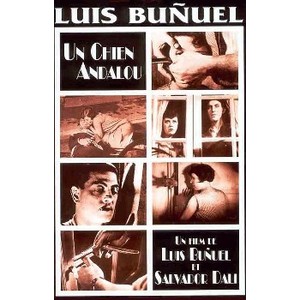
Buñuel’s first film was actually a short film he had made with the help of Spanish surrealist painter Salvador Dalí. Un Chien Andalou (An Andalusian Dog) is a 16-minute film well-known for Buñuel’s use of disjointed chronology to give the film that very surreal quality we tend to attribute to our dreams. The film has Dalí’s influence in almost every scene and one of which would go down in film history as one of the more shocking visual sequences ever put on film. I would describe it but it’s better to just see it for yourself below.
Un Chien Andalou doesn’t really make much sense when one tries to watch it in a purely structured narrative. The film’s inherent genius comes from the fact that it’s chaotic in how it unfolds with scenes chronologically moving back and forth with no impact on the characters within them. Some have called this film a perfect example of dream logic in that while the scenes in themselves do not make any sense when looked at individually they do seem to share particular traits when seen as a whole.
It’s difficult to say whether this film was entertaining. For someone looking to learn more about the craft of filmmaking, especially the part on storytelling, then Un Chien Andalou is quite an eye-opener. But In the end, Luis Buñuel’s first film has less to do with trying to entertaining and more of one filmmaker’s attempt to put into film the very intangible quality and nature of one’s dreams.
Un Chien Andalou is what I’d call the anti-Inception. Where Nolan’s film about dreams still retained a surreal quality to them they were still very much structured with order in mind. Buñuel’s short film is all about the chaos nature of dreams and no one has done it better since the day he released this classic in 1929.


 Through the Shattered Lens