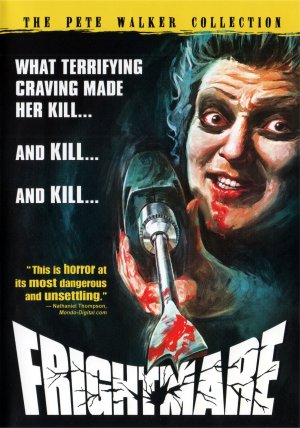
The TSL’s Daily Horror Grindhouse: Frightmare (dir by Pete Walker)


Frightmare_FilmPoster

Since I already reviewed one British film about cannibalism earlier today, I figured why not review another one?  Pete Walker’s film Frightmare was released in 1974, two years after the release of Death Line.  You have to wonder what was going on in British society in the early 70s that led to so many cannibal films.  When watched together, Frightmare and Death Line present a vision of a society that was devouring itself, both literally and figuratively.

Frightmare tells the story of Dorothy (Shelia Keith) and Edmund Yates (Rupert Davies).  Dorothy is a fortune teller who has something of a violent temper.  Edmund is her loving but abused husband.  However, Dorothy has more than just a temper.  She also has a taste for human flesh.  She’s just spent 15 years in prison, convicted of killing and eating a man.  However, she has now been “found sane,” (and that’s a term that is repeated, with increasing irony, throughout the entire film) and she has been released.  She’s even reading fortunes again!

Jackie (Deborah Fairfax) is Edmund’s daughter by his first marriage.  She’s devoted to her father and, at the same time, scared of her mother.  She doesn’t believe that her mother is truly sane, despite the fact that her psychiatrist boyfriend, the well-meaning but arrogant Graham (Paul Greenwood), continues to remind her that Dorothy has been “found sane.”  Jackie knows that Dorothy still wants to eat human flesh so, every weekend, she takes the train to Dorothy’s home and delivers meat.  Jackie tells Dorothy that it’s human flesh but, in reality, it’s just a placebo.  When Graham finds out what Jackie’s doing, he is outraged.  After all, Dorothy has been found sane!

Jackie, however, has other things to worry about.  Her younger half-sister, the rebellious Debbie (Kim Butcher), is living with her.  Along with dating an obnoxious biker, Debbie also resents the fact that Jackie is obviously Edmund’s favorite.  And, as quickly becomes clear, Debbie is as much of a sociopath as her mother…

Speaking of which, Dorothy may have been found sane but it’s obvious that she’s not.  (Throughout the film, no matter how erratic Dorothy’s behavior becomes, Graham continually assures us that she has been found sane.)  It also become obvious that Jackie’s placebos are not doing the trick.  Dorothy is once again murdering the random people who come to get their fortunes told.  And Edmund is helping her cover up the crimes, all the while pathetically telling anyone who will listen, “They said she was sane….they said she was sane…”

Frightmare is one of those films that you really do have to see in order to understand just how effective it is.  It’s an undoubtedly pulpy story and there’s not a subtle moment to be found in the entire film but it doesn’t matter.  Frightmare is properly named because it is pure nightmare fuel.  This is a film that work both as a family melodrama and a satire on the trust that people put into authority (the authorities said that Dorothy was sane so, everyone assumes, she must be) but ultimately, this is an intense and frightening little film.  That’s largely due to Sheila Keith’s ferocious performance.  She turns Dorothy into a force of cannibalistic nature.

Feel free to have a Death Line/Frightmare double feature.  Just don’t expect to have much of an appetite afterward…
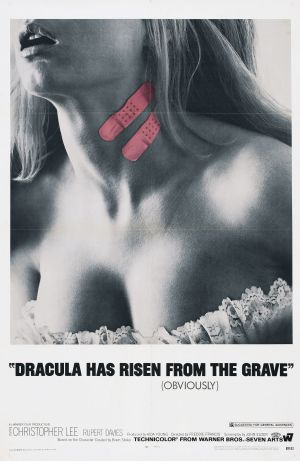
Horror Film Review: Dracula Has Risen From The Grave (dir by Freddie Francis)


DraculahasrisenThere’s a scene in 1968’s Dracula Has Risen From The Grave in which Maria (Veronica Carlson), the innocent niece of Monsignor Muller (Rupert Davies), sneaks out of her bedroom window and walks across the rooftops of a small village in Eastern Europe.  She’s making her way to the bedroom of her boyfriend Paul (Barry Andrews), who the Monsignor has ordered her to stop seeing on account of the fact that Paul is an atheist.  The camera views Maria from above with her pink dress and blonde hair contrasting against the gray city streets below her.  It’s a beautiful scene and it is so visually stunning that you can forgive the fact that it doesn’t really move the story forward.

In its way, this scene is the epitome of everything that works about Dracula Has Risen From The Grave.  Director Freddie Francis was an award-winning cinematographer who stepped in, at the last moment, to direct after original director Terrence Fisher broke his leg.  Dracula Has Risen From The Grave is full of stunning imagery — shadow-filled forests, beautifully ornate bedrooms, and decaying castles and churches.  When Christopher Lee’s Dracula shows up on screen, he literally seems to emerge from the shadows and when he attacks one barmaid who has made the mistake of disobeying him, the entire image is briefly tinted a blood red.  When Dracula approaches his victims, his bloodshot eyes fill the entire screen.  The film is full of so many memorable images that it’s easy to forgive the fact that, dramatically, Dracula Has Risen From The Grave is somewhat inert.

Picking up from where Dracula, Prince of Darkness left off, Dracula Has Risen From The Grave shows what happens when Monsignor Muller and a cowardly priest (Ewan Hooper) perform an exorcism at Dracula’s castle.  The priest, frightened by thunder, attempts to flee but instead just ends up slipping and banging his head on a rock.  The priest’s blood awakens Dracula (Christopher Lee) who, after putting the priest under his mental control, then seeks revenge on Muller by making Maria his bride.  It’s up to Paul to try to save Maria’s life but, unfortunately, Paul is such an atheist that he refuses to recite a prayer even after he drives a stake through Dracula’s heart.  This leads to perhaps the most dramatic staking fail in the history of vampire cinema.

Seriously, don’t trust atheists to kill your vampires…

How you respond to Dracula Has Risen From The Grave will probably depend on how much originality you demand from your 1960s British vampire films.  Storywise, the film is nothing that you haven’t seen before and Barry Andrews doesn’t exactly make for an exciting hero.  But, for me, the film’s visuals make up for the occasional weakness of the plot.

Add to that, Christopher Lee is in top form as Dracula.  I’ve been trying to figure out the appeal of Lee’s Dracula because, unlike a lot of other actors who have played the role, Lee never attempts to turn the vampire into a sympathetic character.  There is no romance to Lee’s Dracula.  Unlike other cinematic vampires, Lee’s Dracula doesn’t spend his time mourning for a lost love or yearning for a release from having to be a prisoner to his undead state.  Lee’s Dracula doesn’t even have the sense of humor that modern audiences have come to expect from their iconic villains.  Instead, Lee’s Dracula is pure evil and yet, at the same time, Lee is such an imposing and charismatic actor that he makes evil compelling.

As I watched Dracula Has Risen From The Grave, I realized why Lee’s Dracula has such appeal.  Lee’s Dracula sees what he wants and he takes it.  He doesn’t allow anything to stand in his way and whenever boring mortals like Paul or the Monsignor attempt to stop him, he simply tosses them out of the way.

He’s evil.

He’s frightening.

And that’s exactly the way he should be.

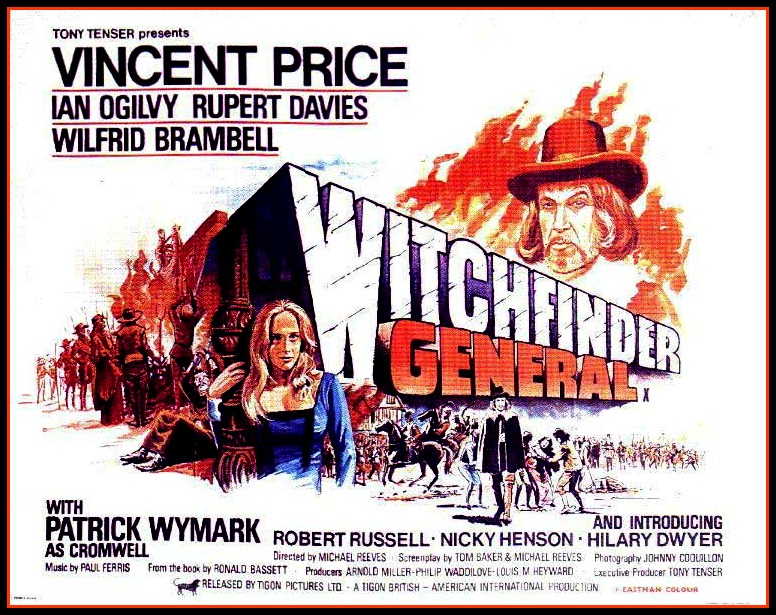
Quickie Review: Witchfinder General (dir. by Michael Reeves)


The late 1960’s saw a major shift in horror films. There have always been horror films which had an inordinate amount of gore and violence, but were always relegated to the niche cinemas which catered to horror exploitation films. In 1968 it all changed with the release of George A. Romero’s Night of the Living Dead. Not only did this film graphically show gore and violence on the screen it also paired it with a well-told story. Another film which became infamous the very same year for it’s portrayal of torture, rape and sadism on the screen was British filmmaker Michael Reeves’ horror film, Witchfinder General.

Witchfinder General starred horror icon Vincent Price in the title role as Matthew Hopkins who was tasked as the Witchfinder General by the Cromwell government during the English Civil War of the 17th-century. His Hopkins would travel the region of East Anglia (Cromwell-controlled territory) rooting out witchcraft and sorcery wherever they might be found. Assisting him in this task is the thuggish, brute Stearne (played by Robert Russell) who relished in torturing suspected witches in towns the two visit. It’s during one such visit to the town of Brandeston, Suffolk that Hopkins and Stearne begin a sequence of events which would pit them against the soldier Richard Marshall (who also happens to fight on the same side as Hopkins and Stearne) whose fiancee and her uncle became the latest victims of the Witchfinder General’s sadistic methods of rooting out confessions.

The film as a horror has less to do with the supernatural, but more of the hypocritical horror which begets a political environment where powerful men contest for more power and uses fear and the superstitious ignorance of a populace to cement their power. In this amoral vacuum comes in the opportunistic Matthew Hopkins who uses the power given to him by his government to not just do his duty to eradicate witchcraft but also abuse it for his own personal (and as seen in the film a way to sate his own personal lusts) gain. It’s this hypocritical nature of who was suppose to be a Puritanical and righteous agent of God which emphasizes the true historical horror of religion and politics becoming one and the same.

Vincent Price as Matthew Hopkins was at the top of his game in Witchfinder General. He gives his role not just an air of superiority over everyone he meets and deals with, but he also makes Hopkins’ truly an amoral character who sees nothing wrong in taking advantage of his position and actually feels like he deserves the desperate attentions of those willing to do anything to save their loved ones from his machinations. Robert Russell as his licentious and sadistic assistant Stearne also does a great job in portraying an individual who might seem brutish and thuggish, but who was also more honest with is situation than his master. It makes for an interesting pair despite their roles being the film’s prime antagonists.

The film more than truly earned the outcry it received upon it’s release in 1968 as scenes of torture and sadism was extreme for a British horror film industry so used to the Gothic sensibilities of the Hammer Films of the era. Graphic depictions of burnings, torture and drowning were done not to seem gratuitious or to cater to the burgeoning gorehound crowd of the era, but done so matter-of-factly that they seem even more horrific.

The Witchfinder General really helped usher in the death of gothic horror which dominated the genre with the Hammer Films in the UK and the Edgar Allan Poe films of Roger Corman in the US. The film continues to impress new generations of horror fans and is still considered by older fans of the genre as one of the best horror films ever made. For some the film might look dated due to the acting (most of the actors of the era were stage actors first and film ones second) and the effects work, but they also fail to look at the film in context of the era and how even by today’s standard it would still shock those not well-versed in the genre of horror. They definitely don’t make horror films like this anymore and that’s a shame on many levels.