Is 1927’s Metropolis a horror film?
If pressed, I could certainly make the argument that it could be considered to be at least partially a horror film. It’s work of German Expressionism, a cinematic movement that was definitely an influence on the emerging horror genre. It features a mad scientist named Rotwang (Rudolph Klein-Rogge), who designs a robot that he hopes he can transform into his lost love, a woman who instead chose to be with the wealthy and powerful Joh Fredersen (Alfred Abel). The robot instead adopts the form of the saintly Maria (Brigitte Helm) and becomes a temptress who inspires a violent revolution in Fredersen’s city. At one point, when Fredersen’s son, Freder (Gustav Frohlich), falls ill, he has a hallucination of the machines under the city transforming into a demon the devours the workers. Later, statues of the Seven Deadly Sins come to life. The film ends with the message that “The Mediator Between the Head and the Hands Must Be the Heart,” which is exactly the type of empty slogan that repressive regimes have used to defend their own horrific abuses of power. It’s right up there with John Lennon’s Imagine as far as horrifying ideological statements are concerned. (The world will live as one as long as everyone imagines the exact same thing. Don’t ask what will happen to those who imagine something different than an empty world shaped by ideology.)
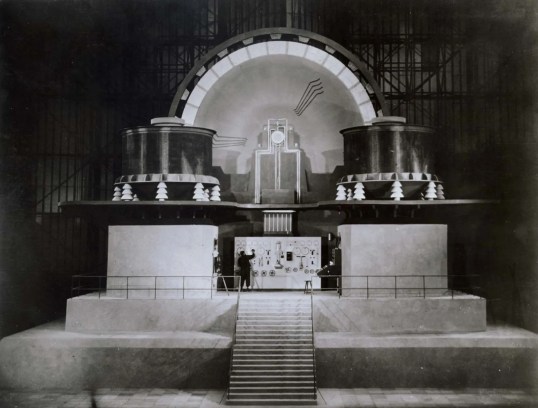
That said, Metropolis is, at best, a horror-adjacent film. As much as I want to hammer it into a straight horror film for the sake of October, Metropolis is better describe as being one of the first great science fiction films. Director Fritz Lang creates two visually stunning worlds, one on top of the other. Above ground, the city of Metropolis is all about towering skyscrapers, airplanes (at a time when they were still a novelty), high speed rail, and even the occasional zeppelin. It’s a sleek and beautiful city, where the inhabitants all seem to be rich and everyone is too busy enjoying the gardens and the clubs to truly pay much attention to what is happening beneath them. Underground is where one finds the machines that keep the city moving and also the anonymous workers who often risk their lives to keep those machines from breaking down. Underground, the city is dirty and dark and the workers go about their activities with the realization that things are never going to get better for them. Above ground, Metropolis is paradise but below it, the city is a hellscape.
Joh Fredersen is the man who created and controls Metropolis. His office is in the new Tower of Babel, a symbol of how there’s no communication between Fredersen and those who work underneath the city. He’s not an evil man, as much he’s just one who chooses to remain unaware about the conditions underground. When his son meets and falls in love with the peaceful activist Maria, Fredersen does not listen to either one of them but instead plots on how to discredit her. Fredersen’s old friend Rotwang has a robot but, what Frederson does not know, is that Rotwang has never forgiven Fredersen for marrying the woman that Rotwang loved. Rotwang creates his robot not to discredit Maria but to instead inspire the workers to destroy the machines and kill Fredersen’s son.
(Like so many other Marxist films, Metropolis ultimately doesn’t have much respect for the workers that it tries to uplift. They’re almost all portrayed as being easily led and incapable of thinking for themselves. At best, they’re noble savages. At worst, they’re drones.)
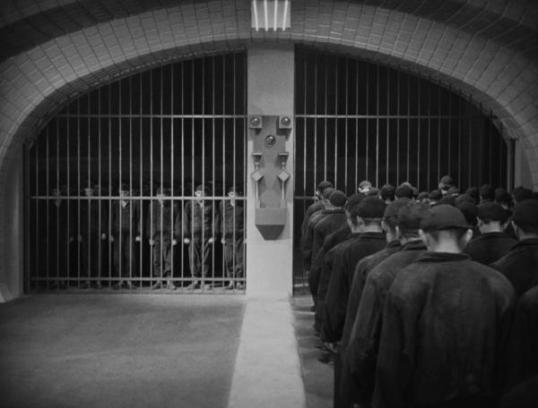
Even seen today, Metropolis remains a technical marvel. The underground scenes, with their emphasis on huge machines that seem to dwarf the men who work on them, are still visually powerful while the above ground scenes still make Metropolis itself look like the type of city where many of us would want to live. The scenes in which the robot is transformed into Maria is a silent spectacle of lights, science and madness. Beyond that, the acting holds up surprisingly well for a silent film. Alfred Abel plays Fredersen not as being a tyrant but instead as just a man who has been rich for so long that he’s no longer aware of how anyone else is living. Rudolf Klein-Rogge turns Rotwang into one of the great mad scientists. And Brigitte Helm leads the worker’s rebellion with a nearly feral intensity. Her dance scene is a classic, with every move meant to seduce the citizens of Metropolis into destroying their own city.
Metropolis remains a visual feast and, over the course of nearly 100 years, it’s inspired countless other science fiction and horror films. Every film that features a dystopian future city owes a debt to Metropolis. It may only be horror adjacent but it’s still worth seeing this October season.

 Through the Shattered Lens