Today’s Horror on the Lens is the 1959 Roger Corman film, Wasp Woman!
In this film, Janice Starlin (Susan Cabot) is the head of a cosmetic company. When she discovers that her sales are suffering because the public has noticed that she is getting older, Janice does what any dedicated CEO would do! She agrees to undergo a radical treatment involving the royal jelly taken from a queen wasp.
Do you think this treatment will make Janice look younger?
Or will it lead to her periodically transforming into a monstrous creature?
Before watching a film like 1940’s Foreign Correspondent, it helps to know a little something about history.
Nowadays, when we think about World War II, there’s a tendency to assume that, from the minute that Hitler came to power in Germany and started to invade the rest of Europe, the entire world united against the Nazis. The truth is actually far more complex. The world was still recovering from World War I and throughout the 1930s, even as the Axis powers were growing more and more aggressive, respected intellectual leaders and politicians continued to argue that peace must be maintained at all costs. Pacifism was such a popular concept that otherwise intelligent people were perfectly willing to make excuses for Hitler and Mussolini. For five years, the UK followed a policy of appeasement towards Nazi Germany. Even after war broke out between Britain and Germany, the U.S. remained officially neutral. In the 1940 presidential election, President Franklin D. Roosevelt — running on a platform of neutrality — was overwhelmingly reelected over internationalist Wendell Willkie.
Foreign Correspondent, an American film made by a British director, opens before the start of World War II. An American newspaper editor, Mr. Powers (Harry Davenport), is frustrated because none of his foreign correspondents seem to be able to understand the truth of the situation in Europe. They all claim that there is going to be no war in Europe but Mr. Powers feels differently. He also feels that the newspaper’s most celebrated and respected foreign correspondents are just a bunch of out-of-touch elitists. Instead of sending another upper class academic, Mr. Powers decides to send a hard-boiled crime reporter to cover the situation in Europe. Johnny Jones (Joel McCrea) has never been to Europe and that’s exactly why Mr. Powers decides to send him. In one of the film’s more clever moments, he does, however, insist that Johnny write under the more distinguished sounding name of “Huntley Haverstock.”
(Foreign Correspondent‘s pointed criticism of out-of-touch elitists repeating the establishment line remains just as relevant today as it was in 1940.)
From the minute the brash and tough Johnny arrives in Europe, he finds himself caught up in a huge conspiracy. He’s been assigned to report on a group known as the Universal Peace Party and, since this film was directed by Alfred Hitchcock, we automatically know that any organization with the word “Peace” in its name has to be up to something shady. The Universal Peace Party has been founded by Stephen Fisher (Herbert Marshall), who appears to sincere in his desire to avoid war. Johnny meets and falls in love with Fisher’s daughter, Carol (Laraine Day).
From the minute that Johnny witnesses the assassination of distinguished Dutch diplomat Von Meer (Albert Bassermann), he suspects that things are not how they seem. Working with Carol and a British journalist named Scott ffolliot* (delightfully played by the great George Sanders), Johnny discovers that Von Meer was not killed at all. Instead, a double was assassinated and Von Meer was kidnapped by a group of spies.
But who are the spies? After nearly getting killed by one of Fisher’s bodyguards, Johnny starts to suspect that Stephen Fisher might not be as into world peace as was originally assumed. Complicating matters, however, is the fact that Johnny is now engaged to marry Carol…
Foreign Correspondent is a wonderfully witty thriller, one that has a very serious message. While the film is distinguished by Hitchcock’s typically droll sense of humor (eccentric characters abound and the scene where Edmund Gwenn keeps getting interrupted before he can attempt to push Joel McCrea off of a tower is both funny and suspenseful), the film’s message was that America could not afford to stay neutral as war broke out across Europe. As the all-American Johnny Jones says at the end of the film:
“All that noise you hear isn’t static – it’s death, coming to London. Yes, they’re coming here now. You can hear the bombs falling on the streets and the homes. Don’t tune me out, hang on a while – this is a big story, and you’re part of it. It’s too late to do anything here now except stand in the dark and let them come… as if the lights were all out everywhere, except in America. Keep those lights burning, cover them with steel, ring them with guns, build a canopy of battleships and bombing planes around them. Hello, America, hang on to your lights: they’re the only lights left in the world!”
Foreign Correspondent was nominated for best picture of 1940 but it lost to another far different Hitchcock-directed film, Rebecca.
——
* Yes, that is how he spells his last name. As he explains, his family dropped the capital name in his surname after an ancestor was executed by Henry II. Since it was George Sanders doing the explaining, it somehow made perfect sense.
Remember Glenn Manning, the unfortunate “hero” of The Amazing Colossal Man?
The previous film may have ended with Glenn plunging to his apparent death from the Hoover Dam but, believe it or not, he survived! Unfortunately, he didn’t survive well. Now, he’s even bigger and he’s even angrier. Plus, he’s massively disfigured. The once articulate, if cranky, Amazing Colossal Man is gone. Now, he’s a Colossal Beast!
That’s the story behind the 1958 film, War of the Colossal Beast! In this sequel, Glenn is back and the army once again has to find a way to control him. Needless to say, it all leads to a final confrontation near Los Angeles’s Griffin Observatory, which means that War of the Colossal Beast is not only a sequel to Amazing Colossal Man but it’s also a bit of companion piece to Rebel Without A Cause!
(Speaking of companion pieces, am I the only one who associated the end of Colossal Man with those commercials that MSNBC used to show of Rachel Maddow going on and on about how only a nation could build the Hoover Dam? Never say “Lean forward” while you’re standing on top of a dam.)
Anyway, War of the Colossal Beast has a totally different cast from Colossal Man and a somewhat different feel. That said, the Colossal Beast makeup — that eye socket freaks me out! — is memorable and, like the previous film, it’s fun in a 1950s B-movie sort of way.
Did you know that 75% of people are sick of hearing the results of polls about what people think about other polls? It’s true!
Me, I first got sick of polls back in 2012. That was when, every day, everyone on twitter would be talking about the result of another political poll. A poll would come out showing that Obama was ahead of Romney in the presidential election and all of my Republican friends would immediately start tweeting about why the poll could not be taken seriously. Then 2014 came along and polls started to show that the majority of American citizens did not approve of the job Obama was doing. And all of my Democrat friends would immediately start tweeting about why those polls could not be trusted.
As for me, I was always more concerned with what the polls said over on Rotten Tomatoes. Really?I would think. Only 35% of critics gave California Scheming a good review? 67% of moviegoers want to see the new Transformers film?
Oh my God, I thought, those numbers have to be so fake…
Because, let’s face it. The only time that we believe a poll is when we agree with it. Otherwise, we assume that they’re either the result of subtle manipulation, selective interpretation, or just completely and totally untrue.
Believe it or not, this suspicion is not a new phenomena. I’ve always felt that you can learn a lot about history by watching the movies. That doesn’t mean that movies are historically accurate. One need only read my review of Magnificent Doll to see that. However, movies do reflect the culture and concerns of the time in which they were made.
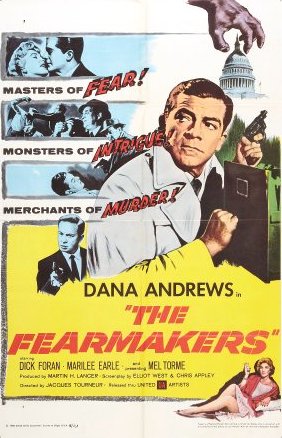
For instance, The Fearmakers was made in 1958 and it shows that not only has polling been around for a while but so has the fear of being manipulated by a fraudulent poll.
In The Fearmakers, Dana Andrews plays Alan Eaton. Before the start of the Korean War, Alan owned one of the best and most respected polling firms in Washington D.C. However, while serving in the army during the war, Alan was captured and held prisoner by the Chinese. After years of being tortured and perhaps brainwashed, Alan is finally released.
He returns to an America that is far different from the country that he left. For instance, while on a flight to Washington, D.C., he finds himself sitting next to a shifty scientist (Oliver Blake) who tries to convince Alan to support a group that believes in nuclear disarmament. Even worse, once the plane lands, Alan discovers that he’s been forced out of his polling firm and that his partner has died under mysterious circumstances.
The firm’s new owner, the outwardly friendly, inwardly cold-hearted Jim McGinnis (Dick Foran), offers to hire Alan as a special consultant. Alan is at first resistant but then he has a meeting with his old friend, Senator Walder (Roy Gordon). Walder explains that he suspects that Alan’s old polling firm has been infiltrated by outside forces and that it might be using its polling to try to push communist propaganda on the American people. Alan agrees to work for Jim and to help track down any and all subversives….
The Fearmakers is better than it sounds. Beyond the fact that the story remains relevant in our poll-driven times, it was directed by Jacques Tourneur, who directed several atmospheric and intelligent horror films in the 30s and 40s. He brings a similar atmosphere of doom to The Fearmakers. Perhaps the film’s best scenes are the ones where Tourneur just focuses his camera on Andrews’s face while Alan struggles to understand the country to which he has returned. As played by Andrews, Alan is troubled and hardly your typical hero. You’re never quite sure how much of the film’s danger is real and how much of it is just the result of Alan’s own paranoia.
I first saw The Fearmakers on Netflix. The next time you’ve got 84 minutes to kill, check it out.

 Through the Shattered Lens