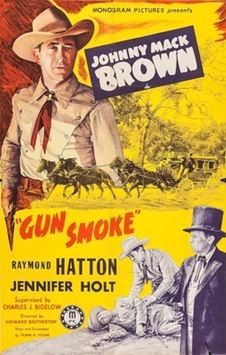
Gun Smoke (1945, directed by Howard Bretherton)


On the frontier, a stagecoach has been overturned and both the passenger and the driver have been killed by outlaws.  The passenger was Hinkley, an archeologist.  Who would want to kill a harmless archeologist?  That’s what Marshals Nevada Jack McKenzie (Johnny Mack Brown) and Sandy Hopkins (Raymond Hatton) set out to discover.  While Nevada Jack asks questions in the nearby town, Sandy disguises himself as a medicine man.

It all links back to an old Indian site that is said to be full of gold relics.  Jane (Jennifer Holt), the daughter of Hinkley’s partner, reveals that the only other person who knows the location of the site is an old Indian named Shag (Dimas Sotello).  Jack and Sandy have to try to track down Shag before he’s found the gang that killed Hinkley.

Yes, it’s another Johnny Mack Brown western.  Despite the title, this has nothing to do with the television series that featured James Arness and Amanda Blake.  Gun Smoke is still a solid western, featuring a determined performance from Johnny Mack Brown and some memorable villains from the usual poverty row western stock company.  Once again, Frank Ellis shows up as a henchman, though the identity of the main villain is actually a little more interesting than was typical for these films.  Johnny Mack Brown is a little more serious than usual, throwing punches with authority.  For fans of B-westerns, Gun Smoke is an above average entry in Johnny Mack Brown’s seemingly endless filmography.
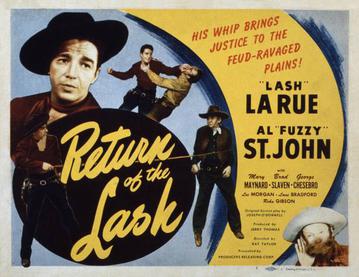
Return of the Lash (1947, directed by Ray Taylor)


There’s another range war brewing on the frontier.  Big Jim Kirby (George Chesebro) knows there’s plans for a new railroad so he wants to steal the land from the ranchers so he can make a fortune off a selling it.  Kirby calls in everyone’s mortgage, knowing they’ll never be able to pay.  Rancher Tom Grant (Buster Slaven) reaches out to Cheyenne Davis (Lash LaRue, a look alike for Humphrey Bogart)) and Fuzzy Q. Jones (Al St. John) for help.  Cheyenne raises the money but then he makes the mistake of trusting Fuzzy to deliver it.  Fuzzy takes a knock to the noggin and now, he’s got amnesia.  Where’s the money?

This is a standard B-western and you know the drill.  Big Jim’s henchmen don’t want that money to get paid.  Cheyenne is on the side of the angels.  Fuzzy provides comic relief.  Lash LaRue appeared in several B-westerns.  He never became as big a star as some of his contemporaries but he did have a gimmick that made him memorable.  Most westerns stars used guns.  LaRue had a bullwhip.  When LaRue was first offered the role of Cheyenne, he lied and said he could crack a whip.  After he struggled to teach himself, tiny production company PRC hired a professional trainer.  That was a huge expense for a poverty row studio but it paid off because LaRue became proficient with the whip and he had a surprisingly long career.  He was born Alfred LaRue.  The studio came up with the Lash nickname.  Many western stars, like Johnny Mack Brown, played characters who shared their name.  Lash almost always played Cheyenne Davis.

Lash LaRue’s movies were cheap and never that memorable.  In this one, Lash barely appears and most of the action is carried out by Al St. John as Fuzzy.  But Lash LaRue did play an important part in Hollywood history when he briefly came out of retirement to teach Harrison Ford how to crack a whip for a little film called Raiders of the Lost Ark.

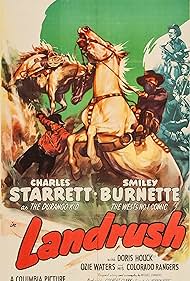
Landrush (1946, directed by Vernon Keays)


Steve Harmon (Charles Starrett) rides again!  This time, he’s investigating the murder of a Pony Express rider.  The murderer is outlaw leader Claw Hawkins (Bud Geary), who is working with rancher Kirby Garvey (Steve Barclay) to cheat the local homesteaders out of their land.

When local newspaper editor Jake Parker (Emmett Lynn) is attacked for trying to expose Claw Hawkins, Steve puts on a mask and dark clothing and, as the Durango Kid, he moves Jake to the carpentry shop owned by Durango’s old friend, Smiley Burnette.  While Jake continues to spread the word to the homesteaders, Durango works to prevent Claw and Kirby from taking all of the land for themselves.

This is a typical Durango Kid film.  This is not the first time that I’ve seen the Durango Kid protect the rights of homesteaders and, as usual, the main villain is not the outlaw that everyone fears but the respectable citizen who is controlling him.  Along with the usual gunfights and horse chases, Landrush has an exciting sequence where Durango and the homesteaders have to deal with a series of fires that have been set by Claw to keep the homesteaders from reaching their land.  Charles Starrett is as authentic a cowboy as ever.  Unfortunately, Bud Geary and Steve Barclay aren’t very interesting as the villains.  People who have watched several Durango Kid films will regret that series regulars Frank Fenton and Jock Mahoney weren’t cast in the roles.

As usual, Smiley Burnette provides comedy relief and sings two songs.  This time, he’s accompanied by Ozie Waters and His Colorado Rangers.

The Stranger From Ponca City (1947, directed by Derwin Abrahams)


After spending the past few years cleaning up the west, Steve Leary (Charles Starrett) rides into the town of Red Mound and says that he is ready to buy a ranch and settle down.  What Steve finds is an unfriendly town that is divided between law-abiding citizens on one side and cattle rustlers on the other.  The cattle rustlers want to prevent Steve from purchasing the old Atkins ranch and they’ll do anything to keep the deed from being signed over.  It’s a good thing that Steve also happens to be the legendary Durango Kid.

This is a standard entry in the Durango Kid series.  To me, it’s interesting to see that, even though Steve seems like he wants to settle down and live a peaceful, ranching life, he still can’t bring himself to give up his secret identity.  It is also interesting that Steve cannot escape Smiley Burnette.  This time, Smiley is the owner of Red Mound’s restaurant and he’s accompanied by Texas Jim Lewis and the Lone Star Cowboys.  It seems like Smiley sings even more than usual in this entry.

I liked the opening of The Stranger From Ponca City, in which Steve rides into town and all of the townspeople demand to know which side of Red Mound he supports.  Smiley even explains that food made on one side of the town cannot be taken to the other without it leading to violence.  After the opening sequence, The Stranger From Ponca City focuses on all of the usual horse chases and gunfights that showed up in all of the Durango Kid films.  Most of the Durango Kid stock company shows up as well.  Keep an eye out for Jock Mahoney, playing a bad guy with Kermit Maynard.

Director Derwin Abrahams keeps things moving, even if his direction is not up the level of the work of Durango’s usual directors, Ray Navarro and Fred F. Sears.  This isn’t the best of the Durango Kid films but fans of the genre should enjoy it.

Deputy Marshal (1948, directed by William Berke)


Deputy Marshal Ed Garry (Jon Hall) is pursuing two bank robbers in Wyoming when he comes across a wounded man.  Harley Masters (Wheaton Chambers) has been shot in the gut but his main concern is holding onto his hat.  Ed takes Harley into town.  They go into the local saloon, where Harley reveals a map hidden in his hat.  He slips the map to Ed before an unseen gunman shoots him a second time.  This time, Harley does not survive.

With the current sheriff “laid up,” Ed decides to stay in town and not only catch the bank robbers but also solve Harley’s murder.  Ed soon finds himself in the middle of a conflict between two rival women (Frances Langford and Julie Bishop) who own ranches and stand to make a lot of money when the railroad comes through.

Deputy Marshal is one of the B-westerns that was produced by Robert Lippert and directed by William Berke in the 40s and 50s.  This one is a step above the usual Lippert production because it combines a murder mystery with the standard western action and there are enough suspects to keep the story interesting.  Jon Hall was best-known for appearing in exotic adventure films, often playing islanders.  His career was in decline when he starred in Deputy Marshal but he makes for a surprisingly believable western hero.  It helps that Hall was older than the typical B-western hero.  His weathered looks make him convincing as an experienced lawman who understood the ways of the west.

Frances Langford, who plays the nicer of the two ranchers, was married to Jon Hall when she appeared in this film.  She gets to sing two songs because this is a Lippert production and Robert Lippert believed that every western should open with a horse chase and should feature at least one song.

While it obviously never won any awards for originality, Deputy Marshal is a better-than-average B-western with an interesting mystery story and a convincing hero.