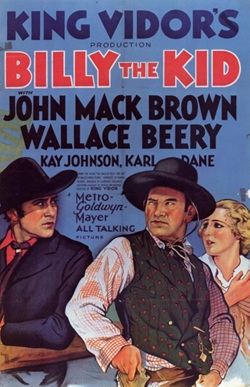
Billy The Kid (1930, directed by King Vidor)


In a frontier town, land baron William P. Donavon (James A. Marcus) finds his control challenged by the arrival of a English cattleman named John W. Tunston (Wyndham Standing).  Donavon orders his henchmen to gun down Tunston on the same day that Tunston was to marry the lovely Claire (Kay Johnson).  Tunston’s employee, an earnest young man named Billy The Kid (Johnny Mack Brown), sets out to avenge Tunston’s murder.  When Billy starts killing Donavon’s henchmen, it falls to Deputy Sheriff Pat Garrett (Wallace Beery) to arrest him.  When Billy escape from jail and rides off to be with Claire, Garrett pursues him.  Garrett is a friend of Billy’s and he knows that Billy’s killings were justified.  But he’s also a man of the law.  Will he be able to arrest or, if he has to be, even kill Billy?  Or will Garrett let his friend escape?

There were two silent biopics made about Billy the Kid but neither of them are around anymore.  This sound movie, directed by King Vidor, appears to the earliest surviving Billy the Kid film.  It’s a loose retelling of Billy’s life and his friendship with Pat Garrett and it doesn’t bother with sticking close to the established facts but that’s to be expected.  It’s an early sound film and, seen today, the action and some of the acting feels creaky.  Wallace Beery was miscast as Pat Garrett but I did like Johnny Mack Brown’s performance as the callow Billy.  The movie goes out of its way to justify Billy’s murders and it helps that Billy is played by the fresh-faced Brown.  King Vidor shows a good eye for western landscapes, a skill that would come in handy when he directed Duel In The Sun seventeen years later.

There are better westerns but, for fans of the genre, this film is important as the earliest surviving film  about one of the most iconic outlaws not named Jesse James.  It’s interesting to see Brown, usually cast as the clean-cut hero, playing a killer here.  The film’s ending is pure fantasy but I bet audiences loved it.

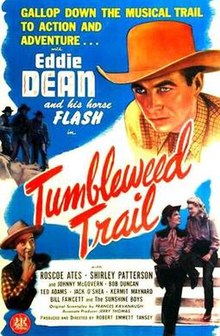
Tumbleweed Trail (1946, directed by Robert Emmett Transey)


I know that I said yesterday that I was done with Eddie Dean westerns but I decided to watch one more, just because it was short and, based on the other Eddie Dean films I had seen, I assumed that it would be undemanding. 

(I was right.)

Tumbleweed Trail opens with Brad Barton (Bob Duncan) and his group of colorfully named henchmen (one is named Dead-Eye) ambushing and apparently killing a rancher named Bill Ryan (Kermit Ryan), who also happens to be Barton’s half-brother.  Barton wants to take control of Ryan’s ranch and he’s even forged a will to to convince the land office to give it to him instead of Ryan’s children.  If this plot sounds familiar, it’s because much of it was recycled for Black Hills.

What Barton did not count on was the arrival of singing cowboy Eddie Dean (played by real-life singing cowboy Eddie Dean) and his sideick, Soapy (Roscoe Ates).  Eddie and Soapy get jobs working on Ryan’s ranch.  Eddie finds time to sing a few songs and to fall for Bill’s daughter, Robin (Shirley Patterson).  Everyone loves Eddie’s singing but he’s not make much progress when it comes to proving that Barton’s will is a fake.  Just when it seems like not even Eddie and Soapy will be able to stop Barton, there’s a “surprise” ending that you’ll see coming from a mile away.

This one is uninspired, though some of my reaction could be due to having already seen Eddie Dean go through a similar plot in Black Hills.  Eddie sings a lot but that’s about all he does in this routine poverty row western.  Bob Duncan is a generic villain.  Of the three Eddie Dean films that I’ve watched, Tumbleweed Trail was the most forgettable.  It’s for fans of the genre only.

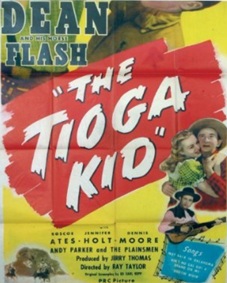
Eddie’s horse in Tumbleweed Trail is played by Flash.  Flash gets second billing, above Roscoe Ates.

This, I’m pretty sure, was my final Eddie Dean movie.

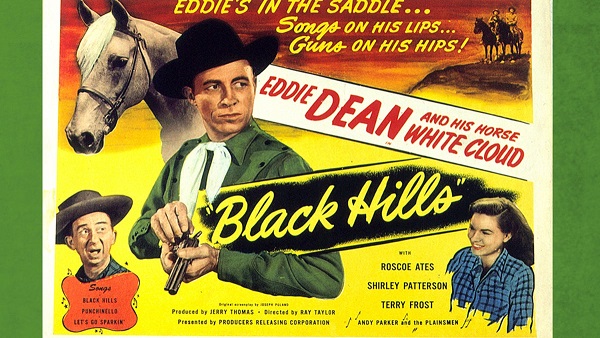
Black Hills (1947, directed by Ray Taylor)


Times are hard and rancher John Hadley (Steve Clark) is running the risk of losing his ranch. When Hadley finds gold on his property, he think that all of his problems have been solved. He makes the mistake of revealing the existence of the gold to his friend, Terry Frost (Dan Kirby). Terry’s not much of a friend because he shoots and kills Hadley and then, working with a corrupt county clerk (William Fawcett), he tries to steal Hadley’s property away from the rancher’s children and rightful heirs.

Luckily, singing cowboy Eddie Dean (played by real-life singing cowboy Eddie Dean) rides up and, with the help of his comic relief sidekick (Roscoe Ates), helps to get things sorted out. Even with Terry trying to frame Eddie for a murder he didn’t commit, Eddie still finds time to sing a few songs.

This was Eddie Dean’s final feature film before he moved into television. Black Hills is better than Romance of the West, the Eddie Dean movie that I reviewed yesterday. The plot actually has a few interesting twists and, though it doesn’t appear that he was ever much of an actor, Eddie Dean appears to be more comfortable with his role here than he was in Romance of the West. Black Hills emphasizes that Eddie could throw a punch just as well as he could sing and veteran western actor Dan Kirby is a credible villain. It makes Black Hills into an entertaining if not exactly memorable western diversion.

One final note about Black Hills: Eddie’s horse, White Cloud, gets second billing in the credits.

Lisa Reviews An Oscar Winner: Cimarron (dir by Wesley Ruggles)


(With the Oscars scheduled to be awarded on March 4th, I have decided to review at least one Oscar-nominated film a day.  These films could be nominees or they could be winners.  They could be from this year’s Oscars or they could be a previous year’s nominee!  We’ll see how things play out.  Today, I take a look at the 1931 best picture winner, Cimarron!)

“Be careful, Hank!  Alabaster may be a little dude but he’ll mess you up.”

“No offense … but he’s from Oklahoma.”

— King of the Hill Episode 5.13 “Ho Yeah”

Some best picture winners are better remembered than others.  Some, like The Godfather, are films that will be watched and rewatched until the end of time.  Others, like Crash, seems to be destined to be continually cited as proof that the Academy often picks the wrong movie.  And then you have other films that were apparently a big deal when they were first released but which, in the decades to follow, have fallen into obscurity.

1931’s Cimarron would appear to be a perfect example of the third type of best picture winner.

Based on a novel by Edna Ferber (who would later write another book, Giant, that would be adapted into an Oscar-nominated film), Cimarron is an epic about Oklahoma.  The film opens in 1889 with the Oklahoma land rush.  Settlers from all across America rush into Oklahoma, searching for a new beginning.  Among them is Yancey Cravat (Richard Dix) and his wife, Sabra (Irene Dunne).  Yancey is hoping to become a rancher but, upon arriving at the settlement of Osage, he discovers that the land he wanted has already been claimed by Dixie Lee (Estelle Taylor).

So, Yancey gives up on becoming a rancher.  Instead, he becomes a newspaper publisher and an occasional outlaw killer.  Soon, Yancey and Sabra are two of the most prominent citizens in Osage.  Under the guidance of Yancey, Osage goes from being a wild outpost to being a respectable community.  It’s not always easy, of course.  Criminals like The Kid (William Collier, Jr.) still prey on the weak.  As the town grows more respectable, some citizens try to force out people like Dixie Lee.  Struck by a combination of personal tragedy and wanderlust, Yancey occasionally leaves Osage but he always seems to return in time to make sure that people do the right thing.  When even his wife reveals that she’s prejudiced against Native Americans, Yancey writes a vehement editorial demanding that they be granted full American citizenship.

The film follows Sabra and Yancey all the way to the late 1920s.  Oklahoma becomes a state.  Sabra becomes a congresswoman.  Oil is discovered.  Throughout it all, Yancey remains a firm voice in support of always doing the right thing.  In fact, he’s such a firm voice that you actually start to get tired of listening to him.  Yancey may be a great man but he’s not a particularly interesting one.

By today’s standards, Cimarron is a painfully slow movie.  The opening land rush is handled well but once Yancey and Sabra settle down in Osage, the film becomes a bit of a chore to sit through.  Richard Dix is a dull lead and the old age makeup that’s put on Dix and Dunne towards the end of the movie is notably unconvincing.  Considering some of the other films that were eligible for Best Picture that year — The Front Page, The Public Enemy, Little Caesar, Frankenstein — Cimarron seems even more out-of-place as an Oscar winner.

And yet, back in 1931, it would appear the Cimarron was a really big deal.  Consider this:

Cimarron was not only well-reviewed but also a considerable box office success.

Cimarron was the first film to ever receive more than 6 Academy Award nominations.  (It received seven and won 3 — Picture, Screenplay, and Art Direction.)

Cimarron was the first film to be nominated in all of the Big Five categories (Picture, Actor, Actress, Director, and Screenplay).

Cimarron was the first film to be nominated in every category for which it was eligible.

Cimarron was the first RKO film to win Best Picture. The second and last RKO film to win would be The Best Years of Our Lives, a film that has held up considerably better than Cimarron.

Cimarron was the first Western to win Best Picture.  In fact, it would be 59 years before another western took the top award.

Though Cimarron may now be best known to those of us who watch TCM, it’s apparent that it was a pretty big deal when it was first released.  Though it seems pretty creaky by today’s standards, they loved it in 1931.
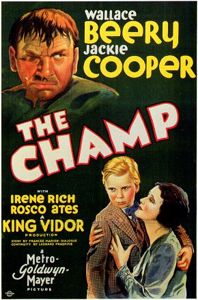
Lisa Reviews An Oscar Nominee: The Champ (dir by King Vidor)


the_champ_poster

“I want the Champ!  I want the Champ!”

Oh good God, shut up you little brat.

Now, nobody actually tells 8 year-old Dink (Jackie Cooper) to shut up at the end of 1931’s The Champ.  I’d like to think that I probably would have said those words if I had been sitting in the audience but, in all honestly, I probably would have been crying along with everyone else.  I’m sure that a lot of people probably cried when The Champ was first released.

And really, it’s probably unfair to criticize Jackie Cooper for repeatedly wailing, “I want the Champ!” during the film’s final five minutes.  It’s actually probably one of the few authentic moments in the film.  It’s just unfortunate that Cooper’s voice was a bit shrill and, as a result, I found myself covering my ears.

As for what The Champ is about, it’s the story of a boy and his alcoholic father.  Andy Purcell (played with loutish charm by the never particularly subtle Wallace Beery) is a boxer.  He used to be the world champion and people still call him The Champ.  Of course, it’s been a while since he’s been in the ring.  Now, Andy just drinks and gambles and continually lets down his son.  However, Dink is always willing to forgive Andy and Andy does truly love his son.  He even buys him a horse, which gets named Little Champ.

It’s while at the stables that Dink meets an upper class woman named Linda (Irene Rich).  What Dink does not realize is that Linda is … his mother!  She was once married to the Champ but his drinking led to divorce.  Linda wants to adopt Dink and perhaps she should because The Champ really is not a very good father.  He even loses Little Champ in a card game.

Fortunately, the Champ has a chance to win the money needed to buy back the horse.  All he has to do is reenter the ring and beat the Mexican heavyweight…

It all leads to “I want the champ!” being screamed several hundred times in a handful of minutes, enough times to make me fear that I would be deaf before the film ended…

The Champ is an old-fashioned and rather creaky melodrama, one that hasn’t aged particularly well.  Director King Vidor specialized in films about the “common man” and The Champ often feels like it was adapted from the first draft of an unproduced Clifford Odets play.  It’s all very sentimental and so thoroughly lacking in snark or cynicism that, for modern audiences, it’s difficult to relate to.  I’ll leave it to you to decide whether that’s a good or a bad thing.

The Champ does hold a place in Oscar history.  Wallace Beery won the Oscar for Best Actor but, for the first time in the history of the awards, there was a tie and Beery shared the Oscar with Fredric March, who won for Dr. Jekyll and Mr. Hyde.

The Champ was also nominated for best picture but it lost to Grand Hotel, which also features Wallace Beery.

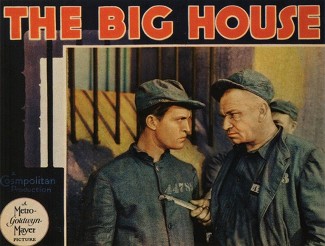
Embracing the Melodrama Part II #3: The Big House (dir by George Hill)


The_Big_House_film_poster

The 1930 Best Picture nominee The Big House opens with a black Model T car slowly pulling up to the front of a large and imposing prison.  Handcuffed in the back seat of the car is a handsome, nervous-looking young man named Kent (Robert Montgomery).  Kent is led into the prison where he is forced to hand over all of his possessions to a grim-looking guard.  We find out that Kent has been convicted of manslaughter, the result of hitting someone while driving drunk.  For the next ten years, this prison (which, we’re told, was designed to house 1,800 but actually holds 3,000) will be Kent’s home.

Kent finds himself sharing a cell with two lifers.  Butch (Wallace Beery) is a coolly manipulative sociopath who alternatively counsels and abuses Kent.  Meanwhile, Morgan (Chester Morris) tries to protect Kent and even helps him get his cigarettes back from Butch.  These three prisoners represent the three faces of prison: Butch is the unrepentant criminal who is actually more at home in prison than in the “real” world.  Morgan is the former criminal who has changed his ways but who is apparently destined to spend the rest of his life paying for his poor decisions.  And Kent is the young man who has to decide if he’s going to be like Butch or if he’s going to be like Morgan.  The Big House makes the still-relevant argument that the American prison system is more likely to turn Kents into Butches than into Morgans.

When the film began, I assumed that Kent would be the main character but actually, he’s secondary to most of the action.  From the moment he first shows up, Kent is not particularly sympathetic and he becomes steadily less likable as the film progresses.  Instead, the film is more focused on the always-scheming Butch and the regretful Morgan.  While Morgan makes plans to escape from captivity and ends up falling in love with Kent’s sister (Leila Hyams), Butch spends his time plotting ways to take over the prison.  For his performance as Butch, Wallace Beery won an Oscar but, seen today, it’s obvious that the film’s heart and soul belongs to Chester Morris’s Morgan.

Like a lot of films from the period, The Big House feels undeniably creaky when viewed through modern eyes.  The Big House was made at a time when Hollywood was still trying to make the transition from silent to sound films.  As such, the film’s pacing is slower than what contemporary audiences are used to and a few of the performances are undeniably theatrical.  I can honestly say that I’m never been more aware of how much I take for granted nonstop background music than when I watch a movie from the early 30s.

That said, once you’ve adapted to the different aesthetic, The Big House holds up fairly well.  Director George Hill films the prison like a town in a German expressionist horror film and Chester Morris’s performance remains sympathetic and compelling.  If the plot seems familiar, it’s important to remember that The Big House is the film first introduced a lot of the clichés that we now take for granted.

The film’s best moments are the ones that deal not with Kent, Butch, and Morgan but instead just the ones that show hordes of prisoners — all anonymous and forgotten men — going about their daily life.  It’s during those scenes that you realize just how many people have been crammed into one tiny space and why that makes it impossible for prison to reform the Kents of the world.

Gandhi once said that the true value of any society can be determined by how that society treats its prisoners and The Big House certainly makes that case.

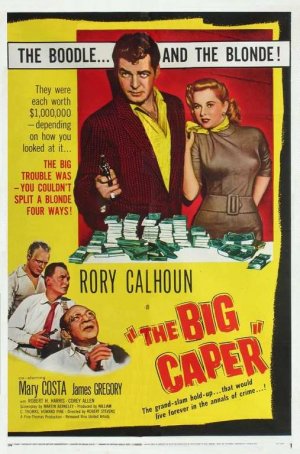
Netflix Noir #2: The Big Caper (dir by Robert Stevens)


The Big Caper Poster

For our next Netflix Noir, we take a look at a heist film from 1957, The Big Caper.

Frank (Rory Calhoun) is a small time criminal with a plan.  He knows that there’s a Marine base near the small town of San Felipe, California and he also knows that, during the weekend before payday, the San Felipe bank will be holding a million dollar payroll for those Marines.  He proposes  to Flood (James Gregory), a wealthy crime boss whom Frank idolizes, that they should find a way rob that bank over the weekend.  Flood agrees to the plan.

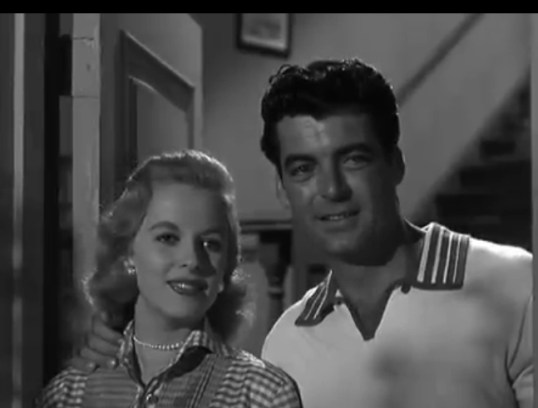
While Flood recruits some help for the robbery, Frank and Flood’s girlfriend, Kay (Mary Costa), move into the town and set themselves up as a part of the community.  Using Flood’s money, Frank buys a gas station and he and Kay move into a nice suburban house.  At first, Frank resents being forced to live like a “square.”  He bitterly complains that the local San Felipe newspaper doesn’t even tell him “how the horses did.”

But then something odd happens.  Frank starts to enjoy being a member of the community.  Soon, the gas station is making a profit and Frank is even thinking about buying a second one.  Oddly enough, his becomes best friends with the local cop.

As for Kay, she transitions to respectability even before Frank does.  As she eventually confesses to Frank, she’s tired of being treated like Flood’s property.  She wants to stay in San Felipe and make a life for herself.  Wearily, Frank tells her that she better hope that Flood doesn’t find out…

Meanwhile, Flood has recruited together his gang and they’re not exactly the most impressive bunch of criminal masterminds.  There’s Roy (Corey Allen), a physical fitness fanatic who is almost childlike in his devotion to Flood.  There’s Harry (Paul Picerni), who demands that his girlfriend Doll (Roxanne Arlen) be a part of the scheme.

And then there’s Zimmer (Robert H. Harris), a bald, sweating pyromaniac who spends most of his time begging for alcohol and lighting matches.  Zimmer arrives at Frank’s house unannounced and Frank is forced to pretend that Zimmer is his uncle.

Once Flood and the rest of the gang arrive, Frank starts to prepare for the robbery but he soon discovers that he’d rather be barbecuing with the neighbors.

The Big Caper is a clever little film, one that features excellent performances (especially from Gregory, Calhoun, Allen, and Harris) and tons of hard-boiled dialogue.  What makes this film especially memorable is the way that it contrasts the fake respectability of the wealthy Flood with the newfound, but genuine, respectability of Frank and Kay.

If The Big Caper was made today, it would probably be directed by the Coen Brothers and Ben Affleck and Ray Liotta would play Frank and Flood respectively.  However, the film works just as well with Rory Calhoun and James Gregory and is totally worth seeing.

The Big Caper