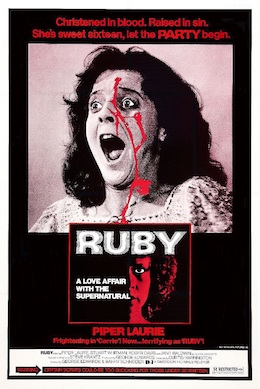
The TSL Horror Grindhouse: Ruby (dir by Curtis Harrington)


The 1977 film, Ruby, opens with a scene set in 1935.  The Great Depression is still raging and the only people making money are industrialists like Joseph P. Kennedy and gangsters like Lucky Luciano and Frank Costello.  In the Florida swamps, gangster Nicky Rocco (Sal Vecchio) is betrayed by both his gang and his pregnant girlfriend, Ruby (Piper Laurie).  As Nicky’s bullet-ridden body sinks into the bayou, Ruby goes into labor and gives birth to Leslie.

16 years later, Ruby owns her own drive-in.  The theater employs several members of the old gang and Ruby is herself married to one of Nicky’s former partners, the crippled and blinded Jake Miller (Fred Kohler, Jr.).  Ruby’s lover is another former member of the gang, Vince Kemper (Stuart Whitman).  Leslie, meanwhile, is now 16 years old and has never spoken a word in her life.  Ruby laments that she never made it as a lounge singer but she does a good job running the theater and it seems to be a popular place to see movies.  She’s even able to show Attack of the 50 Feet Woman, even though that film came out in 1958 and Ruby is set in 1951.  That’s the power of having mob-connections, I guess.

When strange things start to happen at the theater, it could just be a case of Ruby having bad luck and the former gangsters that she’s hired not being particularly good at their jobs.  Or maybe it has something to do with the fact that Nicky swore to get revenge on everyone with his dying breath.  One employee is found hanging in a projection booth.  Another is found hanging from a tree.  Another is left in a cold drink machine and the lady who puts in a quarter to get a cup of tea instead gets a cup of blood.  While Ruby might be in denial about the fact that her business is obviously cursed, Vince realizes that something has to be done so he brings a psychic/exorcist named Paul Keller (Roger Davis, who also provides some narration at the start of the film).

Of course, it’s not just ghosts that Ruby and the gang have to worry about.  Leslie is acting strange as well!  At one point, Leslie even speaks but it’s not with her voice.  It’s with Nicky’s voice!  Leslie has been possessed and soon, Nicky himself is appearing on the drive-in’s screens and repeating, “I love you, I love you.”

Ruby is a real mess of a film, one that attempts to rip-off The Exorcist while tossing a bit of Carrie in as well.  Director Curtis Harrington plays up the campier aspects of the story and Piper Laurie gives a scenery-chewing performance that suggests that she realized it was pointless to try to take anything about Ruby seriously.  Stuart Whitman plays Vince as being the most well-meaning but also the most clueless man in Florida while poor Roger Davis is stuck with the most earnest role in the film and, as such, gets the unenviable task of trying to explain what’s going on in a rational manner.  There’s nothing rational about Ruby, which goes from being a film about gangsters to being a film about ghosts to being a film about possession without even stopping to catch its breath.  It’s a deeply silly film but one gets the feeling that it was made to be silly.  Ruby works as long as you just accept the weirdness of what you’re watching while you’re watching it and you don’t give it too much thought afterwards.
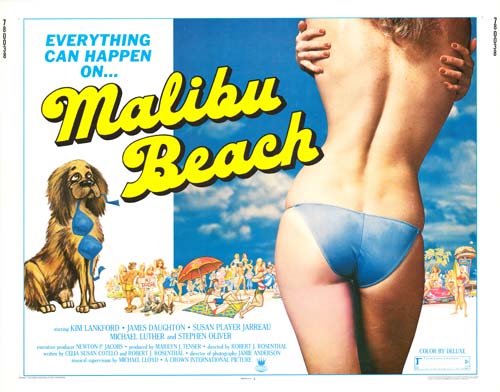
Life is a Beach #2: Malibu Beach (dir Robert J. Rosenthal)


MALIBU-BEACH

Yesterday, I started my 2-week miniseries of reviews on beach movies by taking a look at 1963’s Beach Party.  For my next review, I will be jumping forward 15 years and taking a look at 1978’s Malibu Beach.  

Just by comparing the two films, you can tell that a lot changed during those 15 years.  As opposed to the euphemism-spouting surfers of Beach Party, the teenagers that hang out on Malibu Beach know exactly what they want and they’re not ashamed to say it.  What Beach Party could only hint at, Malibu Beach has the freedom to make explicit.  The film’s poster claims that “everything can happen on Malibu Beach” and, in theory, that’s certainly true.

And yet, at the same time, Malibu Beach has more in common with Beach Party than you might think.  Ultimately, they’re both about the same thing: celebrating the idea of being young and having freedom.  Both films are a bit of a chore to try to watch today but are interesting as cultural time capsules.  Beach Party had no plot.  Malibu Beach has no plot.  Beach Party featured some oddly generic music.  Malibu Beach features the same three generic songs being played over and over and over again.  Beach Party features Erich Von Zipper and his motorcycle gang.  Malibu Beach features a muscle-bound bully named Dugan (Steve Oliver).  Beach Party featured a cameo appearance from Vincent Price.  Malibu Beach features a dog that steals bikini tops.  Beach Party was produced by American International Pictures.  Malibu Beach was produced by Crown International Pictures.

That’s right!  Malibu Beach is a Crown International Picture and anyone who loves 70s exploitation knows what that means.  Malibu Beach is a cheaply produced film that was made to exploit then-current trends and bring in a lot of money.  Like a lot of Crown International Films, it’s technically a pretty bad film but it’s so sincere and honest about what it is that it almost feels petty to be too critical of it.

CIP_Logo

Oddly enough, Malibu Beach pretty much feels like a remake of a previous Crown International Picture, The Pom Pom Girlsthe main difference being that, while the visual style of The Pom Pom Girls was almost oppressively ugly, Malibu Beach at least features some pretty beach scenery.

Much like in the Pom Pom Girls, the heroes of Malibu Beach are two high school jocks, one of whom, Bobby (played by James Daughton, who, that same year, also played the evil Greg in National Lampoon’s Animal House), is dark and brooding while the other, Paul (Michael Luther), is skinny and dorky.

Much as in The Pom Pom Girls, one of the heroes has a nemesis for no particular reason.  Seriously, I never could figure out why Bobby and Dugan hated each other but they certainly did.  What’s odd is that, whenever there’s a confrontation between the two of them, Malibu Beach suddenly gets extremely serious.  Bobby and Dugan glare at each other and speak through clenched teeth.  Suddenly, there’s no music on the soundtrack and all we can hear are seagulls above and the tide rolling in and it all feels very ominous.  I sat through Malibu Beach expecting either Dugan and Bobby to be dead at the end of the film, that’s how seriously their conflict is portrayed.

Also, much like The Pom Pom Girls, Bobby and Paul each have girlfriends.  Paul is dating the spacey Sally (Susan Player).  Bobby, meanwhile, is romancing the new lifeguard, Dina (Kim Lankford).  Dina has a big scene where she tells Bobby that she can’t handle being caught in the middle of his increasingly intense rivalry with Dugan.  Again, it’s a deadly serious scene and it’s just so strange to see it there, awkwardly dropped in between scenes of a bumbling cop smoking weed and a dog stealing bikini tops.

Finally, the main similarity between The Pom Pom Girls and Malibu Beach is that the exact same three songs appear in both films!  Obviously, somebody at Crown International, really loved those three songs.

Malibu Beach is one of those films that was obviously made to appeal to hormonal teens at a drive-in but, by today’s standards, it’s rather tame.  It’s currently playing on Hulu and it’s also available in several of those Mill Creek box sets that we all know and love.  Is the film any good?  No.  Do I recommend it?  Not really.  But, much like Beach Party, it is a portal into the past.

http://www.youtube.com/watch?v=gp9NtaOzd1k