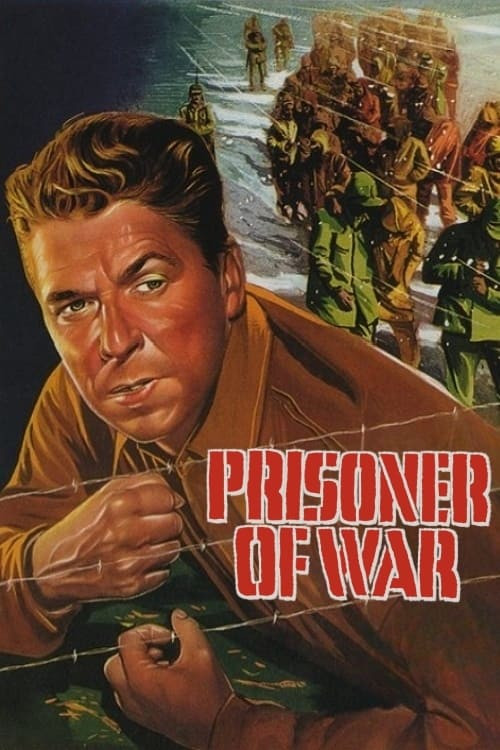
Prisoner of War (1954, directed by Andrew Marton)


The setting is the Korean War.  After getting information that American POWs are being tortured and brainwashed in North Korean prisoner-of-war camps, Major Hale (Harry Morgan) assigns Webb Sloane (Ronald Reagan) to go undercover.  After parachuting behind enemy lines, Webb spots a group of POWs being marched through the snow and joins the group.  From the minute that Webb joins the march, he begins to observe war crimes.  The death march itself, with the POWs being forced to move in freezing weather, is itself a war crime.  At the POW camp, Webb discovers the presence of an arrogant Soviet interrogator (Oscar Homolka) and a routine designed to break the POWs down until their ready to betray their native country.  Some POWS, like Captain Stanton (Steve Forrest), refuse to break.  Others, like cowardly Jesse Treadman (Dewey Martin), break all too quickly.  Webb sends the information back to Hale and eventually tries to make his escape.

It’s not terrible.  That the North Koreans and, later, the North Vietnamese tortured their POWs and forced some of them to denounce America is a matter of the historical record and, for a 1954 film, Prisoner of War doesn’t shy away from the brutality of the torture that POWs were often subjected too.  Of all of Reagan’s film, Prisoner of War had the strongest anti-communist message, though Reagan himself feels miscast as a hard-boiled secret agent.  (Reagan’s affability comes through even in a film set in a POW camp.)  Sending someone undercover into a prisoner of war camp and then hoping that they’ll find a way to escape doesn’t sound like the most efficient way to determine if the Geneva Convention is being violated.

The film features a dog who is found by one of the POWs.  Don’t get attached.

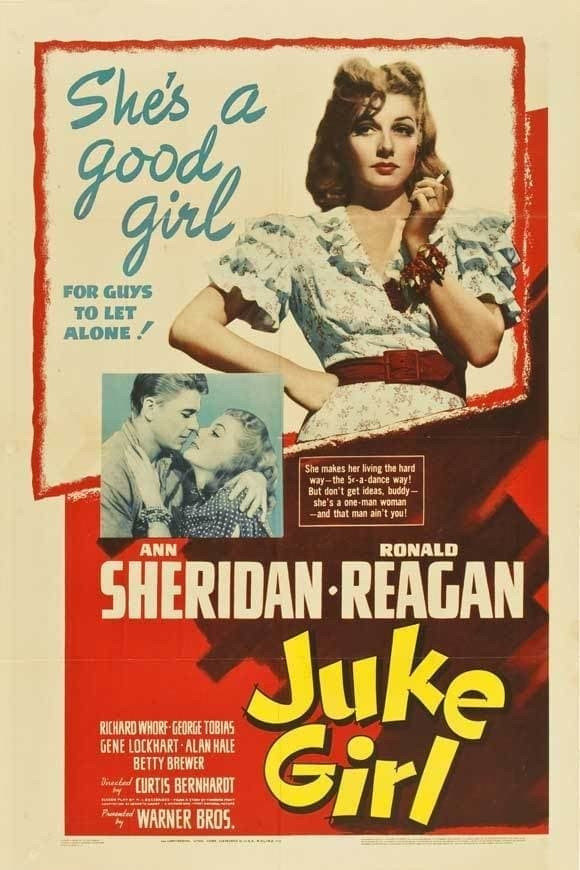
Juke Girl (1942, directed by Curtis Bernhardt)


Farm workers Steve (Ronald Reagan) and Danny (Richard Whorf) arrives in Florida, looking for work.  The whole town is controlled by the corrupt Henry Madden (Gene Lockhart) but the honest Steve would rather work for Nick (George Tobias), who treats his workers fairly.  While Steve romances Lola Mears (Ann Sheridan), who works at a “juke joint,” he also tries to organize the other workers into demanding better conditions.  When Madden frames Steve and Lola for a murder, the entire town turns against them.

This is not a bad Warner Bros. melodrama.  As with a lot of Warner Bros. films, the heroes are the poor workers who have found themselves exploited by wealthy men like Madden.  As played by Ronald Reagan, Steve is no radical firebrand.  He is just someone who wants the workers to get a fair shake and who wants to help decent bosses like Nick make a living despite the efforts of Madden to put them out of business.  As was so often the case with his movies, Reagan is an affable hero without ever actually being compelling.  Gene Lockhart is the dependably hateful villain and the cast is full of dependable character actors, including Faye Emerson, Alan Hale, Howard Da Silva, and Fuzzy Knight.

Ann Sheridan is really the main reason to Juke Girl and she’s as sexy and tough as ever.  There’s a reason why this movie was named for her character’s profession, even though its really only a minor part of the film.  Sheridan is the main attraction here and she gives a strong performance as a bad girl who is actually good underneath it all.  Her character worries that settling down with Steve will mean a lifetime of struggling to make ends meet but she sees that Steve is worth it by the end of the movie.  The town may not be worthy of either of them but Steve and Lola are meant to be together.

Girls On Probation (1938, directed by William C. McGann)


Eager to get away from her abusive father (Sig Ruman), Connie Heath (Jane Bryan) keeps making the mistake of hanging out with the ultimate bad friend, Hilda Engstrom (Sheila Bromley).  Hilda steals a dress from where they work and when the dress is torn, Hilda lets Connie take the blame.  When the dress’s owner (Susan Hayward, making her film debut) insists on pressing charges, insurance investigator Neil Dillon (Ronald Reagan) helps Connie get off the hook and out of jail.

Having not learned her lesson, Connie continues to hang out with Hilda and her new boyfriend, Tony Rand (Anthony Averill).  This time, Connie gets caught up in a bank robbery.  Will Neil be able to get her out of another jam?

63-minutes long, Girl on Probation is a Warner Bros. B-movie.  Ronald Reagan is surprisingly mellow as someone falling in love with a woman who keeps getting framed for his crimes she didn’t commit.  Sheila Bromley steals the show as the out-of-control dangerous blonde who tells a priest, “I’m about to meet your boss.”  The main problem with the film is that Connie is incredibly stupid.  How many times can one person be framed?  Jane Bryan, who played Connie, ended her acting career when she got married but she and her millionaire husband later helped to bankroll Reagan’s first political campaign and both of them were members of his unofficial “kitchen cabinet” when he was governor of California.

The movie has never been released on DVD and is hard to find.  It plays on TCM occasionally, which is where I saw it.  Online, the only place it appears to be streaming, ironically enough, is on a Russian site.

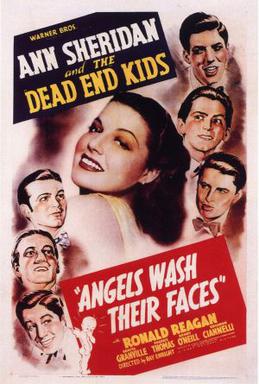
Angels Wash Their Faces (1939, directed by Ray Enright)


Gangster William Kroner (Bernard Nedell) and his henchman Martino (Eduardo Ciannelli) frame teenager Gabe Ryan (Frankie Thomas) for setting several buildings on fire.  Because Gabe has just gotten out of reform school and is a member of a local neighborhood gang, they know that no one will believe him or his sister, Joy (Ann Sheridan).

What Kroner and Martino did not count on were the Dead End Kids (Billy Halop, Bobby Jordan, Leo Gorcey, Gabriel Dell, Huntz Hall, and Benard Punsley).  They’re not going to sit by while the adults send their friend to jail.  Plus, one of their friends was killed in one of the fires.  The kids are out for revenge and sympathetic district attorney Pat Remsen (Ronald Reagan) is on their side.

As a publicity stunt, the city is holding an election for “Kid Mayor.”  The Kid Mayor gets to run the city for a week.  What could go wrong?  Billy Halop decides to run for Kid Mayor so that he can order the arrest of Kroner and then beat a confession out of him.

Angels Wash Their Faces was one of the last of the studio-made Dead End Kid films.  After this one, they would be sent down to Poverty Row and their films would be more obviously comedic.  Angels Wash Their Faces starts out as a juvenile delinquent drama, with Gabe struggling to rebuild his life and keep on the right track.  Then it becomes a goofy comedy, with Billy Halop running for mayor and unleashing vigilante justice on the bad guys.  I’m not sure that any city would actually give the “kid mayor” the power to lock people up.  Whoever came up with the idea of a kid mayor should be run out of politics.

On the positive side, Ann Sheridan is beautiful.  Future president Reagan is his usual friendly self.  On the negative side, the movie, overall, lacks the edge that made the first few Dead End Kids films memorable and the Dead End Kids themselves seem to be pretty much interchangeable.  Huntz Hall would have made a better mayor.
 

The Girl From Jones Beach (1949, directed by Peter Godfrey)


Painter Bob Randolph is famous for painting a beautiful woman who is known as “the Randolph Girl.”  Everyone wants to meet the model but they can’t because there is no one model.  Instead, there are a dozen models, each with a perfect feature that Bob uses in his paintings.  In need of money, Bob and his business partner, Chuck Donavon (Eddie Bracken) search for a woman who can be the real-life Randolph Girl.  Chuck thinks that he’s found her when he spots school teacher Ruth Wilson (Virginia Mayo) but Ruth has no interest in being a model.  She wants to be known for how she thinks and not how she looks.  Hoping to change her mind, Randolph pretends to be Czech immigrant and enrolls in Ruth’s citizenship class.

When a photograph of Ruth in a swimsuit is published without her prior knowledge, the school board decides that Ruth is not a good role model and they fire her.  With the support of Bob and Chuck, Ruth sues for reinstatement.  Bob ends up posing in the courtroom in his own swimsuit, the better to prove that there’s nothing wrong with  appearing in public in a swimsuit.

The role of Ruth was originally offered to Lauren Bacall, who turned it down because she didn’t think she could play a pin-up.  Not to knock Bacall but Virginia Mayo does seem like a better choice for the role of Ruth and she does a good job of bringing the role to life.  She proves to be a good match for Ronald Reagan, whose amiable nature allows him to get away with taking her class under a false pretext and speaking in a mangled approximation of a foreign accent.  The comedy is light and it fits well with Reagan’s affable screen presence.  The film is pleasant but ultimately lightweight and forgettable.  I can understand why, by this point in his career, Reagan was getting frustrated with the quality of scripts he was being sent.  The Girl From Jones Beach would be forgotten today if it didn’t star the future president of the United States.

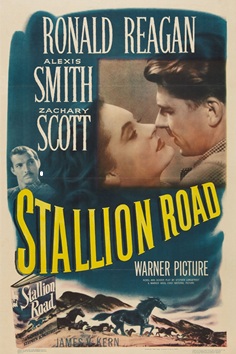
Stallion Road (1947, directed by James V. Kern)


Writer Stephen Purcell comes out to the country to visit an old school friend, veterinarian Larry Hanrahan (Ronald Reagan).  Larry is great at taking care of horses but a little clueless when it comes to women.  Both rancher Rory Teller (Alexis Smith) and Rory’s neighbor, Daisy Otis (Peggy Knudsen), have a thing for Larry but Larry is kept pretty busy taking care of all the horses in the community.  Stephen decides that he likes Rory but, deep down, he knows there’s no way he can compete with Larry.  When Larry gets busy tending to an anthrax outbreak, Rory finds herself tempted to give Stephen a shot.

When Stallion Road originally went into production, Humphrey Bogart was cast as Stephen and Lauren Bacall was cast as Rory.  Both of the stars refused to do the movie, feeling it was too lightweight.  Audiences were cheated out of a chance to see Reagan and Bogart, who were friends despite their differing styles of acting, co-starring opposite each other.  (They were both in Dark Victory but they didn’t share any scenes.)  Speaking of Bogart and Reagan, it’s a Hollywood legend that Reagan was originally offered the role of Rick in Casablanca though I’ve also read that Reagan was actually offered the role of Victor Laszlo.

Bogart and Bacall were right.  Stallion Road is the epitome of lightweight entertainment, with Reagan giving a pleasant but bland performance as Larry and the film never really allowing any doubt as to who Rory belongs with.  It’s the type of movie that would be a Hallmark film today so if you’re actually looking for a realistic drama about ranching and taking care of horses, it’s best to look elsewhere.  This film does show why Reagan was such a successful politician.  Even though his character isn’t exactly exciting, he’s innately likable and, from the minute he first appears, he’s dependable.  He’s someone who any rancher would trust to take care of their horses.


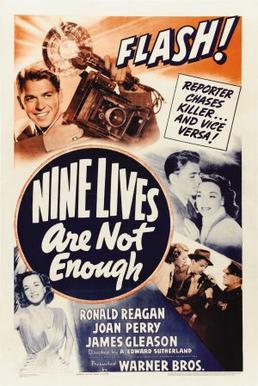
Nine Lives Are Not Enough (1941, directed by A. Edward Sutherland)


Matt Sawyer (Ronald Reagan) is a junior reporter whose enthusiasm for breaking the big news is always getting him in trouble.  Sometimes, he runs with a story before getting all of his facts straight and the newspaper gets sued.  If not for his enthusiasm and his affability, Matt would have been fired a long time ago.  Instead of losing his job, Matt just finds himself demoted to riding in a squad car with Sgt. Daniels (James Gleason) and the slow-witted Officer Slattery (Edward Brophy).  Matt still manages to find a story when he and the cops discover a dead man in a flophouse.

The man turns out to have been a millionaire.  The coroner rules his death a suicide but Matt is convinced that it was murder.  How could the man have shot himself if he died with his hands in his pockets?  Over the objections of the police and his editors, Matt investigates the man’s death.  Helping him out is the man’s daughter, Jane Abbott (Joan Perry).

Nine Lives Are Not Enough is one the many B-pictures that Ronald Regan made for Warner Bros.  It’s only 63 minutes long and, despite the murder mystery, the emphasis is more on comedy than drama.  For all of his reputation for being a stiff actor, Reagan proves himself to be surprisingly adroit when it comes to exchanging snappy dialogue with his editor.  This film showcases the innate likability that made Reagan a success as both an actor and a politician.  What he lacks in range, he makes up for in sheer affability.  Watching Reagan in movies like this, it is easy to see the limitations that kept him from being a major star while also revealing why he later had so much success asking people to vote for him.

Considering how the press felt and still feels about Ronald Reagan, it’s entertaining to see him cast as a reporter who has a reputation for getting the story wrong.  When it’s really important, though, Matt Sawyer gets it right.

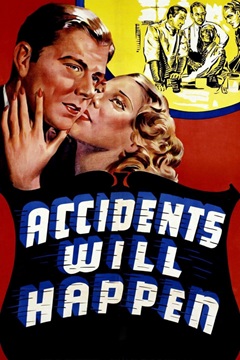
Accidents Will Happen (1938, directed by William Clemens)


Eric Gregg (Ronald Reagan) is an insurance claims adjuster who works hard, always has a cheerful attitude, and is inexplicably married to a greedy, dishonest woman named Nona (Sheila Gregg).  When Nona, sick of not being able to afford to live like a rich person, starts claiming to be a witness to accidents that didn’t really happen, it leads to Eric losing his job.  Eric is also dumped by Nona, who heads off to Reno.  Luckily, Patricia (Gloria Blondell), who works as the candy counter clerk at Eric’s office building, is just as eager to hook up with Eric and he is with her.

But what’s this?  Soon, Eric and Patricia are running insurance scams of their own and Eric is being recruited into a gang of fraudsters that’s led by Blair Thurston (Addison Richards).  Has Eric gone bad or does he have something else up his sleeve?

Accident Will Happen is one of the many B-movies that Ronald Reagan made before he briefly became a star as the result of Knute Rockne — All American and Kings Row.  It’s only 62 minutes long and the story moves quickly. The plot features a pretty obvious twist and it ends with some courtroom theatrics that I doubt anyone could have gotten away with in real life.  As with most of his B-performances, Reagan is likable even if there’s not much depth to his character.  Watching him hit bottom and then climb back up is satisfying because Reagan is so affable in the role.  Accidents Will Happen also stands out for its portrayal of an unhappy marriage, with Eric not realizing how miserable and greedy Nona is until she leaves him when he needs her the most.  Luckily, Gloria Blondell (who was the sister of Joan Blondell) is cute and perky and a far better match for our Reagan.  In the end, Ronald Reagan defeats insurance fraud as surely as he defeated the Soviets in the Cold War.

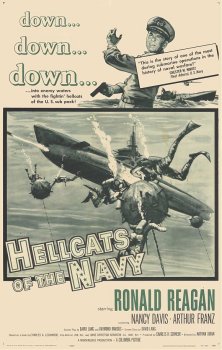
Hellcats of the Navy (1957, directed by Nathan Juran)


At the height of World War II, Commander Casey Abbott (Ronald Reagan) breaks up with nurse Helen Blair (Nancy Davis, the future first lady) and takes command of a submarine that has been tasked with mapping out Japanese mine fields.  Abbott struggles at first with commanding his submarine.  After a popular diver — and Helen’s new boyfriend — is killed during a mission, much of the crew holds Abbott responsible.  While Abbott is able to win back the respect of the crew, he still struggles with his second-in-command, Don Landon (Arthur Franz).  Landon wants to command his own submarine but when Abbott gives him a negative recommendation, Landon is forced to consider his past actions.  Landon eventually discovers just how difficult it is to be in charge.

Full of stock footage and chintzy special effects, Hellcats of the Navy was the movie that Ronald Reagan considered to be so bad that it led to him retiring from feature films and devoting himself to mastering the emerging medium of television.  Gene Hackman had his Welcome To Mooseport.  Ronald Reagan had his Hellcats of the Navy.  It’s definitely on the cheap and predictable side but, when I watched it earlier today, I discovered it wasn’t as bad as I had heard.  Reagan actually gives a pretty good performance as Abbott and the film does show that even a good commander will make mistakes.  The main problem is that it’s just not a very exciting film and a good deal of the undersea footage was clumsily lifted from other movies.

Hellcats of the Navy was the one movie that co-starred both Ronnie and Nancy and it’s worth watching for curiosity’s sake.  Nancy isn’t in much of the movie and it’s really a role that anyone could have played.  There’s not a lot of romantic chemistry between Ronnie and Nancy, they’re both too reserved for that.  This film still shows the likability and the natural authority that led to Ronald Reagan launching a second career in politics.

Just think, if Hellcats of the Navy had been a better movie, the past 45 years might have been very different.

Knute Rockne, All American (1940, directed by Lloyd Bacon)


The son of a Norwegian carriage builder who immigrated to the United States in 1892, Knute Rockne (Pat O’Brien) attends Notre Dame, revolutionizes football as both a player and a coach, and leads Notre Dame to upset victory after upset victory.  Other coaches look to Rockne and see how to build and inspire a team and learn the importance of taking chances when the game is on the line.

This rah-rah biopic of real-life coach Knute Rockne elevates the character to near sainthood.  I was surprised that he didn’t heal any sick children or single-handedly end World War I.  Pat O’Brien is just the right age to play Rockne as an aging, veteran coach but the movie also has him playing Rockne as a college student.  It’s strange to see Rockne telling his father that he’s decided to go into coaching and that he hopes he won’t be a disappointment to his family when both the father and the son appear to be the same age.

If there is one thing about this movie that really works, it’s the performance of future President Ronald Reagan as George Gipp, a college baseball player who is recruited to the football team after Rockne sees how far and how high he can kick the ball.  Gipp becomes a surrogate son to Rockne and Ronald Reagan’s innate likability is put to good use.  As an actor in forgettable B-movie, Reagan could seem stiff and uncomfortable but, as George Gipp, he seems surprisingly relaxed and natural.  It’s easy to see why this film temporarily made him a star.  The scene when George Gipp, on his death bed, tells Knute to tell the team to “win one for the Gipper” is a classic tear-jerker moment and Reagan’s image as being the selfless Gipper, the man who was all about inspiring the team at even the worst of moments, served him well when he went into politics.

(It also served the makers of Airplane! well when Leslie Nielsen needed to give Robert Hays an inspiring speech to get Hays back into the cockpit of that plane.  Win one for the Zipper!)

Ronald Reagan’s performance is the only thing about Knute Rockne, All American that has aged well.  The movie made me want to win one for the Gipper.