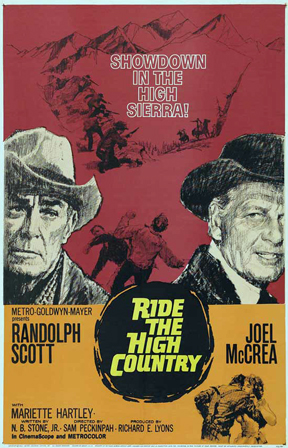
 It’s the turn of the 20th century and the Old West is fading into legend. When they were younger, Steve Judd (Joel McCrea) and Gil Westrum (Randolph Scott) were tough and respect lawmen but now, time has passed them by. Judd now provides security for shady mining companies while Gil performs at county fairs under the name The Oregon Kid. When Judd is hired to guard a shipment of gold, he enlists his former partner, Gil, to help. Gil brings along his current protegé, Heck Longtree (Ron Starr).
On their way to the mining camp, they spend the night at the farm of Joshua Knudsen (R.G. Armstrong) and his daughter, Elsa (Mariette Hartley). Elsa is eager to escape her domineering father and flirts with Heck. When they leave the next morning, Elsa accompanies them, planning on meeting her fiancée, Billy Hammond (James Drury), at the mining camp.
When they reach the camp, they meet Bill and his four brothers (John Anderson, L.Q. Jones, John Davis Chandler, and the great Warren Oates). Billy is a drunk who is planning on “sharing” Elsa with his brothers. Gil, Judd, and Heck rescue Elsa and prepare for a final confrontation with the Hammond Brothers. At the same time, Gil and Heck are planning on stealing the gold, with or without Judd’s help.
Ride the High Country was actually Sam Peckinpah’s second film but it’s the first of his films to truly feel like a Sam Peckinpah film. (For his first film, The Deadly Companions, Peckinpah was largely a director-for-hire and had no say over the script or the final edit.) Peckinpah rewrote N.B. Stone’s original script and reportedly based the noble Steve Judd on his own father. All of Peckinpah’s usual themes are present in Ride the High Country, with Judd and, eventually, Gil representing the dying nobility of the old west and the Hammond brothers and the greedy mining companies representing the coming of the “modern” age. Ride The High Country‘s final shoot-out and bittersweet ending even serve as a template for Peckinpah’s later work in The Wild Bunch.
Much like the characters they were playing, Randolph Scott and Joel McCrea were two aging veterans on the verge of retirement. For these two aging stars, who had starred in countless westerns before this one, Ride The High Country would provide both fitting farewell and moving tribute. This would be the last chance that either of them would have to appear in a great movie and both of them obviously relish the opportunity. The best moments in the film are the ones where Judd and Gil just talk with the majestic mountains of California in the background.
Among the supporting cast, Ron Starr and Mariette Hartley are well-cast as the young lovers but are never as compelling as Gil or Judd. Future Peckinpah regulars R.G. Armstrong, L.Q. Jones, and Warren Oates all make early appearances. Seven years after playing brothers in Ride the High Country, L.Q. Jones and Warren Oates would both appear in Peckinpah’s most celebrated film, The Wild Bunch.
The elegiac and beautifully-shot Ride The High Country was Sam Peckinpah’s first great film and it might be his best.
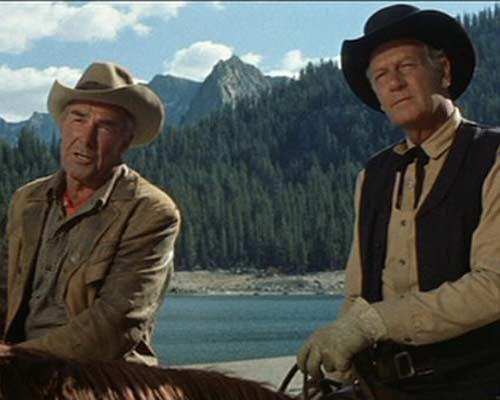
Randolph Scott and Joel McCrea in Ride The High Country


 Through the Shattered Lens