October True Crime: Into Thin Air (dir by Roger Young)


Originally broadcast in 1985, Into Thin Air is a made-for-TV movie that is based on a true story.  It’s film that brings to life the horror of every family’s nightmare.  Brian Walker (Tate Donavon) is an intelligent, soft-spoken, and somewhat naive college student in Ottawa.  He’s been accepted into a summer writing program in Colorado.  As he gets in the van that he will be driving to Colorado, he promises his mother, Joan (Ellen Burstyn), that he’ll call her when he reaches Nebraska and again when he reaches Colorado.

Brian drives away and that’s the last time that Joan ever sees her son.  Brian calls from Nebraska and talks to his brother, Stephen (Sam Robards).  Joan arrives home just as Stephen is saying goodbye.  Brian never calls from Colorado.  He has vanished, seemingly into thin air.

Joan, Stephen, and Joan’s ex-husband, Larry (played the great character actor Nicholas Pryor) travel to America to search for him.  At one point, Stephen thinks that he’s spotted Brian’s van on the road and chase after it, just to discover that it’s a different van.  Joan talks to cops in Nebraska and Colorado and discovers that different jurisdictions don’t work together or share information.  As the days pass, Joan keeps hoping that Brian is somehow still alive….

I was about ten minutes into this film when I started sobbing.  I pretty much cried through the entire film.  Some of that was because I knew that they were never going to see Brian again.  Some of that was because of the powerful, heartfelt performances of Ellen Burstyn, Nicholas Pryor, and Sam Robards.  Most of it was because this film did such a good job of capturing the feeling of hopelessness and the dread that comes with not knowing what has happened to someone who you love.  I found myself crying for Brian’s lost potential.  He was a writer and he was engaging in a time-honored writing tradition.  He was taking a road trip and he was discovering the world.  He deserved better than whatever happened to him.  He deserved see his novel sitting in a bookstore.  Instead, he ran into the wrong people.

It’s the little details that really got to me.  Stephen flies into a rage when he sees his younger brother wearing one of Brain’s sweaters.  Joan momentarily gets her hopes up when she discovers that Brian reported some lost traveler’s checks, just to have that hope shot down when she’s told that the bank can’t reveal where Brian called them from unless Brian himself gives permission.  When the van eventually turn up in Maine, it’s been totally trashed by whoever took it from Brian.

Eventually, Joan hires a private detective and Robert Prosky is well-cast as Jim Conway, a seemingly cynical ex-cop who dedicates himself to trying to provide closure for the Walkers.  The scene where he finally discovers what happened to Brian is one of the strongest in the film and one of the most upsetting.  So many people could have saved Brian if they only had the courage to speak up.

Into Thin Air is a powerful film.  No one should ever be forgotten.

October True Crime: Getting Gotti (dir by Roger Young)


In this 1994 made-in-Canada movie, Anthony Denison plays John Gotti.  We watch as he goes from being a street boss to Paul Castellano to assassinating Castellano so that he can take over the Gambino crime family.  Gotti thinks that he’s the king of New York and he’s convinced that no one will ever bring him down.  U.S. Attorney Diana Giacalone (Lorraine Bracco) is determined to prove him wrong.  She becomes the first of many prosecutors to try to get Gotti and Gotti reacts by having his attorney launch a series of outrageously misogynistic attacks against her.  Gotti doesn’t just want to defeat Diana.  He also wants to humiliate her.  Diane may have the evidence but Gotti’s got the money.  Who will get Gotti?

Now, I guess I could argue here that the horror aspect of this film comes from the crimes that Gotti commits.  And it is true that we see Gotti kill a number of people.  He’s a sadistic killer, the type who will shoot someone twenty more times than he needs to.  As the last of the truly flamboyant gangsters, Gotti would go on to become something of a pop cultural institution.  But one should not overlook the fact that, for all of his charisma and bravado, John Gotti was not a nice guy.  Of course, I should also point out that none of that charisma is really present in Anthony Denison’s performance as Gotti.  As played by Denison, John Gotti — the so-called Teflon Don whose greatest strength was his shamelessness — comes across as being a little boring.

Actually, the scariest thing about this film is Lorraine Bracco’s performance as Diana Giacalone.  Bracco does a lot of yelling as Giacalone.  Sometimes, it’s understandable.  Giacalone is portrayed as being someone who grew up on the same tough streets as Gotti and who resents people like Gotti and the Mafia giving a bad name to Italians in general.  The problem is that Bracco yells her lines even when there’s no reason to be yelling.  At one point, she discovers that someone screwed up her lunch order and she screams about it as if the world is ending.  Visiting her mother (Ellen Burstyn) for the holidays, Giacalone yells at her family.  When the verdict comes in, Giacalone yells some more.  The yelling is pretty much nonstop and, as a result, one starts to feel that the other U.S. attorneys might have a point when they say that Giacalone is a loose cannon.  The film tries to present her as being a strong, no-bullshit woman who is going up against an army of misogynists but there’s more to being strong than just yelling.  It would be such a big deal if the film had given her a personality beyond yelling but it doesn’t.  I blame the script more than I blame Lorraine Bracco, who can be a very good actress when cast in the right role.

Getting Gotti pretty much hits every Mafia cliche.  Whenever anyone drives around the old neighborhood, Italian string music plays.  There’s a moment where Giacalone yells that her goal is to make sure that people understand that the Mafia isn’t “Al Pacino looking soulful” in The Godfather.  I had to wonder if Giacalone had ever actually watched The Godfather.  Seriously, an Italian attacking The Godfather?  Who does she think she is, Joe Columbo?

Gotti remains the Gotti film to watch.

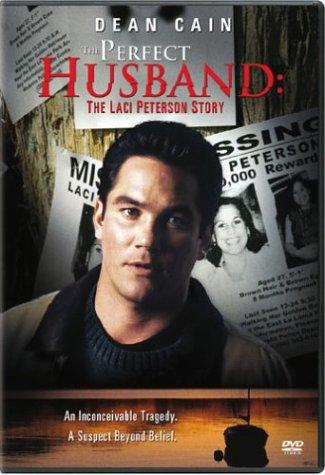
October True Crime: The Perfect Husband: The Laci Peterson Story (dir by Roger Young)


In December of 2002, most likely on Christmas Eve, Laci Peterson was murdered in Modesto, California.  At the time, she was eight months pregnant and, by all account, looking forward to the birth of her first child, Connor.  Suspicion immediately fell on her husband Scott Peterson, who seemed reluctant to contact police when Laci first disappeared and who was later revealed to be cheating on his wife, both before and after his disappearance.  Though Scott and Laci’s friends and family may have thought of Scott Peterson as being the perfect husband, the truth was far different.

After the bodies of both Laci and unborn Connor were discovered, Scott was arrested and charged with murder.  Scott insisted that his wife had been kidnapped and murdered by a gang of meth-dealing Satanists.  The jury disagreed and Scott was found guilty.  Originally sentenced to death, Scott is now serving a life sentence.

The disappearance and subsequent murder of Laci Peterson was national news and Scott Peterson, with his cold demeanor and his history of infidelity, was a perfect villain.  (The case would serve as one of the inspiration for the novel and film, Gone Girl.)  Today, unfortunately, the case has received renewed attention due to a docuseries called The Murder of Laci Peterson.  Though the documentary may have Laci’s name in the title, she’s treated largely as an afterthought.  Instead, the documentary focuses on making excuses for all of Scott’s incriminating behavior and, in the final episode, it goes as far as to include cheesy reenactments of Satanists stalking the streets of Modesto.  This heavy-handed work of propaganda, which was produced by a friend of Scott Peterson’s family, can be found on Hulu and is regularly re-aired on stations like A&E.  Whenever it airs, one can be sure that the dumbest people on twitter will start tweeting stuff like, “I lowkey think Scott Peterson might be innocent!”  The documentary ends with Scott’s creepy sister-in-law delivering an unconvincing monologue about how she often goes to the beach where Laci was found and thinks about her and Connor.  It’s one of the few times that anyone in the documentary mentions anything about Laci.

The 2004 made-for-TV movie, The Perfect Husband: The Laci Peterson Story, also keeps Laci off-screen but it still feels like a more honest look at the Peterson case than the documentary.  Because the movie was put into production before Scott’s trial had actually begun, the film does maintain a sense of ambiguity as to whether or not Scott is actually guilty but, unlike the docuseries, it also doesn’t deny just how suspicious Scott’s behavior was in the days following Laci’s disappearance.  While his friends and his family frantically look for Laci, Scott calls his mistress and flirts over the phone.  (As shown in the film, Scott’s girlfriend did not know that Scott was married and was shocked to see Scott on television, talking about his missing wife.)  When his friends and family beg Scott to help get the word out about his missing wife, Scott retreats into his own shell.  And when Laci’s body is discovered, Scott puts on a fake beard, dyes his hair, and heads to San Diego with a bag full of money.  In the docuseries, Scott’s condescending father claimed that Scott was just trying to get away from the media.  The film leaves little doubt that he was trying to get away from his crimes.

Dean Cain does a good job in the role of Scott Peterson.  Because Scott’s trial had yet to begin, Cain couldn’t play him as being an outright murderer so, instead, he focused on playing Scott as being petulant, insecure, and self-centered, the type of guy who seems to be annoyed that Laci’s disappearance is inconveniencing him.  Dee Wallace and G.W. Bailey have a few good scenes as, respectively, Laci’s mother and the detective investigating the case.  David Denman (who is probably best-known for playing Roy, Pam’s lunkhead fiancé on The Office) gives the film’s strongest performance as a friend of Scott’s who desperately wants to believe that he’s innocent even though the evidence keeps piling up against him.

The Perfect Husband probably gets closer to the truth of the case than any of the documentaries that have followed.  Scott’s a killer.  RIP, Laci and Connor.

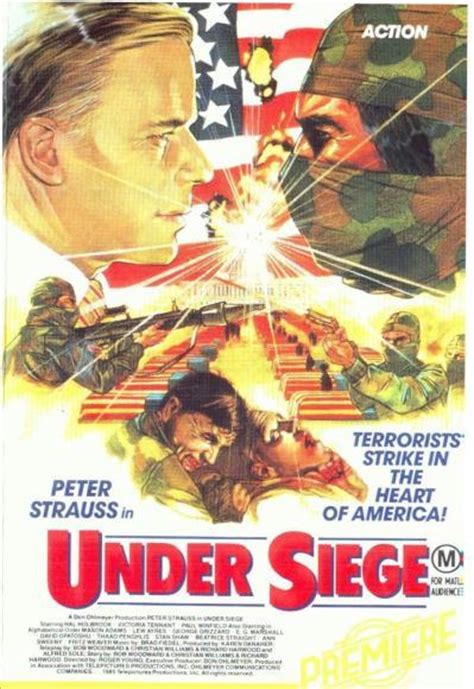
Under Siege (1986, directed by Roger Young)


Let’s say that you are the governor of Arkansas and, once again, your state is running out of money and will soon not be able to afford to pay its bills.  What do you do?

That was the problem facing Governor Bill Clinton in 1986.  His solution was to allow a big Hollywood production to come down to Little Rock and film someone throwing explosive devices at the state capitol.  The capitol building at Little Rock looks like a smaller version of the capitol building in Washington D.C.  The producers of Under Siege needed to shoot a scene where terrorists attempt to blow up Congress.  Even though the state capitol wasn’t actually blown up in the film, the dome did end up with extensive burn marks that were visible for years afterwards.  Many people in Arkansas were not amused that they had to allow a film crew to set their capitol on fire just to pay the bills.  Still, if Bill Clinton hadn’t agreed to blow up the state capitol building, Arkansas could have gone bankrupt and then he probably would have lost his reelection bid in 1986.  If Bill Clinton wasn’t reelected, he never would have been elected to the presidency in 1992, Hillary Clinton would never have been elected to the Senate in 2000 and, in 2016, the Democrats wouldn’t have been stuck with the only possible nominee who could have actually lost to Donald Trump.  When you look at it that way, Under Siege is one of the most significant films ever made.

As for the film, it’s a 3-hour, made-for-TV movie about what happens when Islamic extremism hits home.  Notorious terrorist Abu Ladeen (Thaao Penghlis) has managed to sneak into the United States and is hiding out in Detroit.  He directs a series of attacks on beloved American institutions.  Not only is the Capitol Building bombed but a mall is also attacked.  While President Maxwell Monroe (Hal Holbrook, who was born to play presidents) tries to keep America from falling apart, his hawkish advisers tell him that now is the time to launch a strike against Iran, despite Iran claiming to have nothing to do with the attacks.  Only the director of the FBI, John Garry (Peter Strauss), and the Secretary of Defense, Andrew Simon (Paul Winfield), argue that the president should exercise caution.  Garry is convinced that the attacks are the result of homegrown, domestic extremism and not an international conspiracy.  Garry is a very hands-on FBI director.  He’s the type of FBI director who will chase a terrorist down a street in Washington D.C.  Let’s see James Comey do that shit.

Under Siege probably seemed outlandish in 1986 but it seems prophetic today.  The film’s depiction of both terrorism and the government’s shady response to it turned out to be accurate.  That doesn’t mean that it’s a very good movie.  It was co-written by Bob Woodward of Watergate and Washington Post fame, so of course John Garry is righteous beyond belief and the solution to all of America’s problem begin with contacting a newspaper editor and blowing the whistle.  America may be under siege but a strongly-worded editorial is here to save the day.

Under Siege used to regularly show up on late night television and the DVD was popular overseas.  (In France, it was called Au Revoir, America.)  Not surprisingly, after 9-11, it vanished from circulation.  If you can find a copy, watch it and ask yourself, “Would I blow up my state capitol just to pay the bills?”