Welcome to Retro Television Reviews, a feature where we review some of our favorite and least favorite shows of the past! On Tuesdays, I will be reviewing the original Fantasy Island, which ran on ABC from 1977 to 1986. Almost entire show is currently streaming is on Youtube!

This week, Leslie Nielsen returns to Fantasy Island!
Episode 3.17 “Playgirl/Smith’s Valhalla”
(Dir by Michael Vejar, originally aired on January 26th, 1980)
This week, Tattoo is super excited because one of the guests is Erica Clark (Barbie Benton), a famous centerfold for Rooster Magazine! Erica, however, no longer models. As she explains to Mr. Roarke, she grew tired of men treating her as just being a sex object. Indeed, her fantasy is to be able to treat men the same way! (Today, of course, Erica could save however much money she spent for the fantasy by simply watching clips of Magic Mike on YouTube.)
In perhaps the simplest fantasy that Mr. Roarke has ever put together, he sends Erica to the Island’s famed Jackrabbit Club, where men dance while women watch. Again, to be clear, all Mr. Roarke had to do was send her to the island’s version of Chippendales. I mean, Erica could have just done that on her own. Anyway, Erica witnesses one of the dancers, Walter Wilde (Fabian Forte), getting fired for refusing to go along with being sexually harassed by one of the women in the audience. Relating to Walter, his desire to go to medical school, and his life as a single father to Dinah (Heather McAdam), Erica agrees to come out of retirement and pose (in a bikini with a big rooster tail hooked on the back) for the club’s owner, Big Earl Sanderson (Denny Miller). However, when Big Earl demands that Erica do more than just pose, Walter is there to punch him out.
Anyway, it turns out that Dinah’s fantasy was for Walter to fall in love and Roarke combined her fantasy with Erica’s, presumably to save some money. So, Erica, Walter, and Dinah leave the island together and I guess Erica learns that …. well, I’m not sure anyone learned anything. This was a pretty weak fantasy that claimed to be about treating men as sex objects but spent the majority of time looking for excuses to put Barbi Benton in a bikini. Seriously, Jackrabbit was the tamest male strip club I’ve ever seen.
Meanwhile, the Island finds itself in what should be an international incident after a group of dirty commies hijack a plane and make it land at an abandoned Fantasy Island airport. The communists say that they are doing this because they have to get people to pay attention to their cause but it’s hard not to notice that there’s next to no media coverage of the events, there are no soldiers or police surrounding the airport, and Mr. Roarke merely shrugs it off.
The only person who does care is Jason Smith (Hugh O’Brian), whose fantasy is to lead a combat mission. The fantasy becomes personal for Jason when he discovers that his wife (Emily Banks) is one of the hostages! Mr. Roarke arranges to Jason to work with three combat experts.
Buck Tanner (Sean Garrison) is an explosives expert who suffers from war flashbacks.
“Weasel” Forbes (Charlies Dierkop) is a wild sniper.
And French soldier of fortune Emile Bouvier is …. LESLIE NIELSEN!
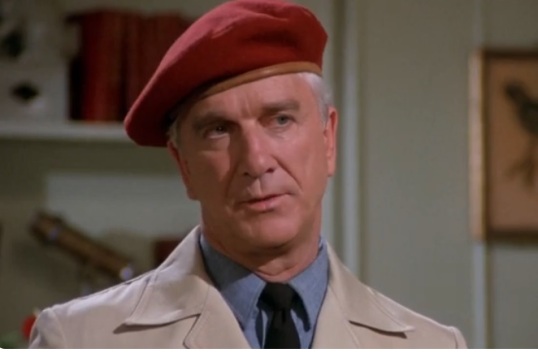
Yes, this episode of Fantasy Island features Leslie Nielsen is one of the last of his “serious” roles, playing a French mercenary by wearing a red beret and not even attempting an accent. Bouver is tough and no-nonsense, as we learn when he catches Buck drinking on the job.
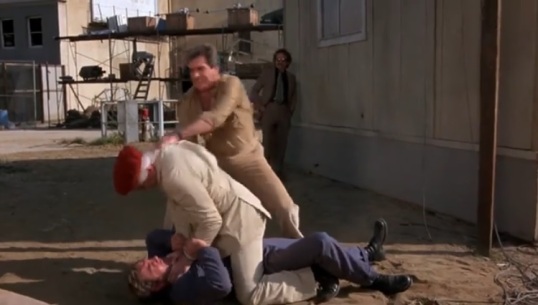
Anyway, Jason is able to rescue his wife and the other hostages and the communists are all arrested and hopefully sacrificed to the Fantasy Island mermaid. Bouvier sacrifices his life to save Jason’s but Mr. Roark explains that it was no big deal because Bouvier was dying anyways and his fantasy was to end his life doing something heroic. Once again, it appears that Mr. Roarke saved some money by combining fantasies. Was Fantasy Island feeling the effects of the Carter recession? Perhaps.
Other than Leslie Nielsen playing a serious role, probably the most interesting thing about this episode is that Mr. Roarke and Tattoo barely spoke to each other over the course of it. There was none of the usual comedic banter or anything like that. Indeed, even in the scenes greeting and saying goodbye to their guests, Ricardo Montalban and Herve Villechaize refused to every look at each other. Obviously, it wasn’t all happy days on Fantasy Island.


 Through the Shattered Lens