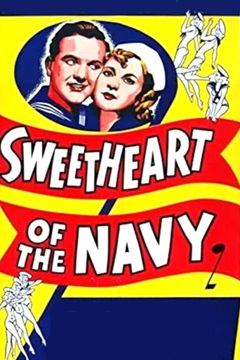
I was looking for Sweetheart of Sigma Chi, an obscure Buster Crabbe film that is nearly impossible to find. I was happy to see that someone had uploaded it to YouTube but then I watched and discovered that, even though the video was entitled SweetheartofSigmaChi, they had actually uploaded a movie called Sweetheart of the Navy. I was disappointed but I went ahead and watched because the movie was only 61 minutes long and I needed something to post for today’s review.
In other words, I’ve got no one to blame but myself.
Cecilia Parker plays Joan Whitney, who co-owns a cafe on the harbor. When her business partner runs off, he takes all the money and leaves her with all the bills. Joan has to raise the money to keep her bar open. Her friends, Andy (Cully Richards) and Pete (Don Barclay), decide to stage a fight against the boxing champion of the Navy, Bumper (Jason Robards, Sr., father of the more famous Jason Robards). They recruit the overmatched Eddie Harris (Eric Linden) to fight Bumper and then get all of their friends in the Navy to bet on the fight. Commander Lodge (Roger Imhof) views Eddie has being his protege and tries to change his mind about fighting. Joan tries to convince Eddie to get in the ring.
I may be biased because I was already annoyed that Buster Crabbe wasn’t in this movie but SweetheartoftheNavy was instantly forgettable, creaky, and corny. Forgettable songs, stagey directing, and boxing action that won’t exactly put Rocky to shame, SweetheartoftheNavy took 61 minutes of my life under false pretenses.
(With the Oscars scheduled to be awarded on March 4th, I have decided to review at least one Oscar-nominated film a day. These films could be nominees or they could be winners. They could be from this year’s Oscars or they could be a previous year’s nominee! We’ll see how things play out. Today, I take a look at the 1940 best picture nominee, The Grapes of Wrath!)
How dark can one mainstream Hollywood film from 1940 possibly be?
Watch The Grapes of Wrath to find out.
Based on the novel by John Steinbeck and directed by John Ford, The Grapes of Wrath tells the story of the Joad family and their efforts to neither get sent to prison nor starve to death during the Great Depression. When they lose their farm in Oklahoma, they head for California. Pa Joad (Russell Simpson) has a flyer that says someone is looking for men and women to work as pickers out west. The 12 members of the Joad Family load all of their possessions into a dilapidated old truck and they hit the road. It quickly becomes apparent that they’re not the only family basing all of their hopes on the vague promises offered up by that flyer. No matter how much Pa may claim different, it’s obvious that California is not going to be the promised land and that not all the members of the family are going to survive the trip.
Tom Joad (Henry Fonda) is the oldest of the Joad sons. He’s just been released from prison and he’s killed in the past. Having been in prison during the start of the Great Depression, Tom doesn’t realize how bad things truly are until he arrives home and sees someone he grew up with using a tractor to knock down a house. (It’s just business, of course. The owners of the house can’t pay their bills so the house gets destroyed.) The film’s story is largely told through Tom’s eyes and Henry Fonda gives a sympathetic performance, one the gets the audience to empathize with and relate to a character who is a total outsider.
As for the rest of the Joad Family, Ma (Jane Darwell) is the glue who holds them together and who refuses to allow them to surrender to despair. (And yet even Ma is forced to make some tough choices when the starving children of one work camp ask her to share her family’s meal with them.) Rosasharan (Dorris Bowdon) is pregnant while Grandpa (Charley Grapewin) is too sickly for the trip but doesn’t have anywhere else to go. And then there’s Casy (John Carradine), the former preacher turned labor organizer. Casy is not blood-related but he soon becomes a member of the family.
The Joads have a healthy distrust of the police and other authority figures and that turns out to be a good thing because there aren’t many good cops to be found between Oklahoma and California. Instead, the police merely serve to protect the rich from the poor. Whenever the workers talk about forming a union and demanding more than 5 cents per box for their hard work, the police are there to break heads and arrest any troublemakers on trumped up charges. Whenever a town decides that they don’t want any “Okies” entering the town and “stealing” jobs, the police are there to block the roads.
The Grapes of Wrath provides a portrait of the rough edges of America, the places and the people who were being ignored in 1940 and who are still too often ignored today. John Ford may not be the first director that comes to mind when you think of “film noir” but that’s exactly what The Grapes of Wrath feels like. During the night scenes, desperate faces emerge from the darkness while menacing figures lurk in the shadows. When the sun does rise, the black-and-white images are so harsh that you almost wish the moon would return. The same western landscape that Ford celebrated in his westerns emerges as a wasteland in The Grapes of Wrath. The American frontier is full of distrust, anger, greed, and ultimately starvation. (Reportedly, the film was often shown in the Soviet Union as a portrait of the failure of America and capitalism. However, it was discovered that Soviet citizens were amazed that, in America, even a family as poor as the Joads could still afford a car. The Grapes of Wrath was promptly banned after that.) John Ford is often thought of as being a sentimental director but there’s little beauty or hope to be found in the images of The Grapes of Wrath. (Just compare the way The Grapes of Wrath treats poverty to the way Ford portrayed it in How Green Was My Valley.) Instead, the film’s only hint of optimism comes from the unbreakable familial bond that holds the Joads together.
As dark as it may be, the film is nowhere near as pessimistic as the original novel. The novel ends with a stillborn baby and a stranger starving to death in a barn. The film doesn’t go quite that far and, in fact, offers up some deus ex machina in the form of a sympathetic government bureaucrat. (Apparently, authority figures weren’t bad as long as they worked for the federal government.) That the book is darker than the movie is not surprising. John Steinbeck was a socialist while John Ford was a Republican with a weakness for FDR. That said, even though the film does end on a more hopeful note than the novel, you still never quite buy that things are ever going to get better for anyone in the movie. You want things to get better but, deep down, you know it’s not going to happen. Tom says that he’s going to fight for a better world and Fonda’s delivers the line with such passion that you want him to succeed even if you know he probably won’t. Ma Joad says the people will never be defeated and, again, you briefly believe her even if there’s not much evidence to back her up.
Even when viewed today, The Grapes of Wrath is still a powerful film and I can only guess what it must have been like to see the film in 1940, when the Great Depression was still going on and people like the Joads were still making the journey to California. Not surprisingly, it was nominated for best picture of 1940, though it lost to Alfred Hitchcock’s Rebecca.
As I sit here writing this, I’m snowed in, my asthma’s acting up, and our cat is quickly losing patience with me. On the plus side, however, this weather has given me an opportunity to watch some more of the old best picture nominees that I had saved up on my DVR.
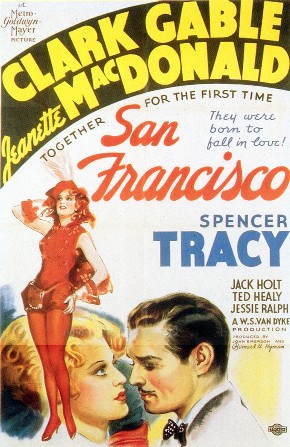
For instance, I just finished watching the 1936 best picture nominee, San Francisco.
San Francisco was one of the first disaster films, a film that follows a group of characters as they attempt to survive the 1906 earthquake that destroyed the town of San Francisco. And it has to be said that, nearly 80 years after the film was first released, the climatic earthquake remains effective and scary. San Francisco, of course, was made long before there was any such thing as CGI. Many of the film’s sets were built on special platforms that were designed to shake back and forth, just like in an actual earthquake. When you see walls and buildings collapsing in San Francisco, you know that those walls are breaking apart and collapsing for real and the extras running for their life are literally doing just that. After the earthquake, Clark Gable, as the film’s hero, walks through the ruins of San Francisco with the haunted look of a true survivor. Gable was such a confident actor that it’s still jarring to see him looking overwhelmed.
Unfortunately, before you get to that spectacular earthquake, you have to sit through the rest of the film. It’s a massive understatement to say that the pre-earthquake portion of San Francisco drags. Clark Gable is Blackie Norton, a notorious gambler and saloon keeper. Blackie may be a rogue but he’s a rogue with a heart of gold. His childhood friend, Father Tim (Spencer Tracy), wants Blackie to run for the board of supervisors. Blackie, however, is more interested in Mary Blake (Jeanette MacDonald), the newest singer at his club.
OH MY GOD, IS THIS WHOLE MOVIE JUST GOING TO BE JEANETTE MacDONALD SINGING!? WHERE'S THE EARTHQUAKE!? #SanFrancisco
— Lisa Marie Bowman (@LisaMarieBowman) March 5, 2015
From the minute she first appears to the very end of the film, Jeanette MacDonald is singing. Even when she’s not at the center of the scene, you can often hear her singing in the background. And, after a little while, you just want her to stop singing. But, whenever that happens, she tries to act and you realize that the only thing more boring than Jeanette MacDonald singing is Jeanette MacDonald acting.
Anyway, the film goes through all of the expected melodrama. Blackie wants to reform. Blackie decides not to reform. Father Tim believes that there’s good in Blackie. Father Tim gives up on Blackie. Father Tim decides to give Blackie another chance. Mary loves Blackie. Mary fears Blackie. Mary leaves Blackie. Mary comes back to Blackie. Mary leaves Blackie again. Mary sings. And sings and sings and sings…
But then, just when you’re about to fall asleep, the city starts to shake and all is forgotten in the wake of a natural disaster. Even earthquakes serve a purpose…
San Francisco was a huge box office success. It was nominated for best picture. Somehow, Spencer Tracy received a nomination for best actor, despite the fact that he’s really not that impressive in the film. (His role is primarily a supporting one and he’s consistently overshadowed by Gable.) The only Oscar that San Francisco won was for best sound recording and it must be said that, after all these years, the earthquake still sounds terrifying.
As for the film itself, I’d suggest skipping ahead to the earthquake. That, after all, is the main reason anyone would be watching the film and, by skipping ahead, you’re spared having to sit through an hour and a half of Jeanette MacDonald singing.
 I watched this movie by accident.
 Through the Shattered Lens