The TSL Horror Grindhouse: Night of the Cobra Woman (dir by Andrew Meyer)


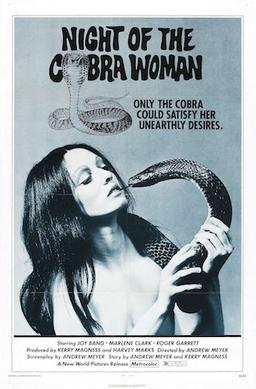
The 1972 film, Night of the Cobra Woman, tells the story of Lena (Marlene Clark).

During World War II, Lena was a nurse assigned to the Philippines.  When she and a friend were attacked in the jungle by a Japanese soldier, Lena’s friend was raped while Lena was bitten by a cobra named Movini.  As the result of being raised by a snake cult, Movini’s super-powered venom conferred eternal youth, beauty, and sexual energy.  It also gave Lena the power to turn into a snake.  After subduing the Japanese soldier and turning him into her slave, Lena made a life for herself in the jungle.  Worshipped by the locals, Lena became known for never aging.

Years later, a young UNICEF worker named Joanna (Joy Bang) is working at a laboratory in the Philippines.  Having heard about Lena’s special snake venom, Joanna heads out to Lena’s compound to ask her how the venom works.  However, Joanna is chased off by Lena’s mute man-servant (Vic Diaz).  Later, Joanna’s boyfriend, Duff (Roger Garrett), decides to head out to the compound himself and see what’s going on.

When Duff doesn’t return, Joanna heads out to the compound a second time.  This time, she brings along Duff’s pet eagle.  Joanna is confronted by Lena, who claims that Duff has been bitten by a cobra and has been recovering at the compound.  After Movini hisses at Joanna, Joanna released the eagle.  The eagle promptly kills Movini.

Now, this sets up a bit of a problem.  Lena needed Movini because it was Movini’s venom that was keeping her young and preventing her from turning into a snake and then not being able to change back.  Now that Movini is dead, Lena has to head into Manila and find men to seduce so that she can live off of their life force.  Helping her out is Duff, who has apparently been brainwashed by Lena and will now do anything to help her, including setting her up with an American serviceman (who is played by an actor named, I kid you not, Slash Marks.)  Duff himself starts to rapidly age and turn into a snake.  Can Joanna save him and, more importantly, why would she want to?  Seriously, Duff left her for another woman.  Joanna doesn’t owe him anything!

Night of the Cobra Woman is a thoroughly incoherent movie, one that feels as if it was made up on the spot while filming was taking place.  Duff’s decision to go to Lena’s compound on his own never makes sense, nor does it really make much sense that Joanna doesn’t seem to be that upset by the fact that he basically just abandoned her to live with the Cobra Woman.  That said, Night of the Cobra Woman does have a cult following because it’s one of the eight films that Joy Bang made during her career.  Bang (and that was her real name, as her husband was named Paul Bang) specialized in playing flighty hippies and, as a result, she’s not exactly believable as an expert in snake venom.  But the fact that she is so miscast adds to the film’s charm.  She has pretty much the same freaked-out reaction to seeing a cobra that I would have, making her a character to whom I could at least relate.

Anyway, Night of the Cobra Woman is not that good but Joy Bang completists will definitely want to check it out.
Embracing the Melodrama Part III #4: The Grasshopper (dir by Jerry Paris)


“It’s very simple what I want to be: totally happy; totally different; and totally in love.”

— Christine Adams (Jacqueline Bisset) in The Grasshopper (1970)

Seriously, is Christine asking for too much?

Total happiness?  That may sound like a lot but trust me, it can be done.

Totally different?  That’s a little bit more challenging because, to be honest, you’re either different or you’re not.  If you have to make the effort to be different, then you definitely are not.

Totally in love?  Well, it depends on how you define love…

At the start of The Grasshopper, Christine thinks that she’s heading to America to find love.  While an oh-so late 60s/early 70s theme song plays in the background, Christine leaves her small hometown in Canada and she heads down to California.  She’s planning on meeting up with her boyfriend Eddie (Tim O’Kelly) and taking a job as a bank teller.

Of course, it soon turns out that working in a bank isn’t as exciting as Christine originally assumed.  Eddie expects Christine to just be a conventional girlfriend and that’s not what Christine is looking for. As well, it’s possible that Christine may have seen Targets, in which O’Kelly played an all-American boy who picks up a rifle and goes on a killing spree.

And so, Christine abandons Eddie and heads to Las Vegas.  Since this movie was made in 1970 and Uber didn’t exist back then, Christine’s preferred method of traveling is hitchhiking.  This gives her a chance to meet the usual collection of late 60s weirdos who always populate movies like this.  One driver crosses herself when Christine says that she plans to have a baby before getting married.  Another is a hacky Las Vegas comic.

In Vegas, Christine applies for a job as a showgirl.  As she explains to sleazy casino owner Jack Benton (Ed Flanders), she “once did Little Women in school.”

“Did you do it nude?” Jack replies.

Yep, that’s Vegas for you!  It’s the city of Showgirls, Casino, and Saved By The Bell: Wedding in Vegas, after all!

Anyway, thing do get better once Christine meets and falls in love with Tommy Marcott (Jim Brown), a former football player who is now working as a door greeter in Jack’s casino.  Everyone tells Christine not to get involved with Tommy.  One of Jack’s men, a menacing hitman who looks just like Johnny from Night of the Living Death (he even wears glasses), warns Christine to watch herself.

Through a long series of events, Christine ends up on her own again.  The usual collection of 70s events occur: murder, drugs, prostitution, and ultimately a stint as the mistress of a rich man played by Joseph Cotten.  The important thing is that it all eventually leads to Christine and a skywriter getting stoned, stealing a plane, and deciding to write a message in the sky.

That’s when this happens:

Yes, it’s all very 1970!

Anyway, The Grasshopper is one of those films that tries to have it both ways.  Establishment audiences could watch it and think, “Wow, those kids are really messed up.”  Counterculture audiences could watch it and say, “Old people are such hypocrites.”  Oddly enough, The Grasshopper was written by future director Garry Marshall and it’s an incredibly overwrought film.  There’s not a subtle moment to be found in the entire film and the film’s direction is flashy but empty.  However, for those of us who love history, it’s as close to 1970 as we’re going to get without hopping into a time machine.