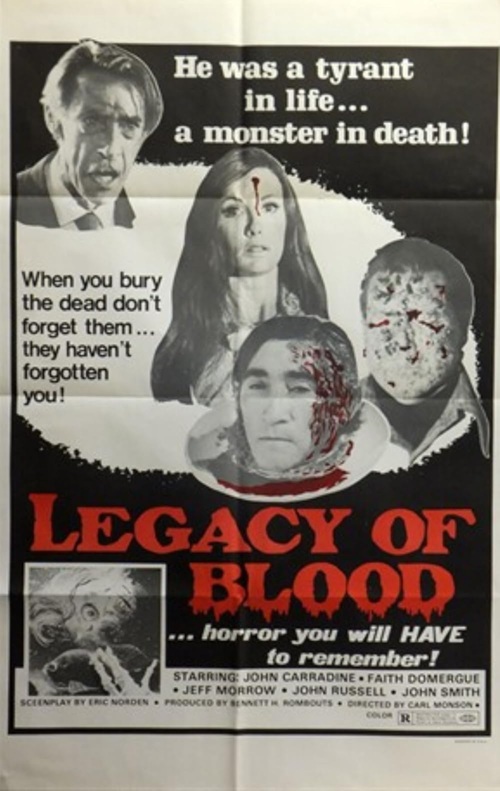
October Hacks: Blood Legacy (dir by Carl Monson)


a.k.a. Blood Legacy

In this 1971 film, John Carradine briefly plays Christopher Dean, a wealthy man who hated his family and his servants.  He dies before the film actually begins but we do get to see him in flashbacks and we also hear his voice at the reading of his will.  Dean leaves a fortune to his children and his servants, but he does so only on the condition that they spend a week at Dean’s estate.  If anyone dies or leaves the estate, they will lose their inheritance and the money will be split amongst those who stayed and/or survived.  You can see where this is leading, right?

This is actually a promising premise and it’s easy to imagine how it could have inspired an American version of Mario Bava’s Bay of Blood, where one person is killed by another just for that killer to then be killed by someone else until eventually, there’s no one left.  Unfortunately, while the characters are all unpleasant and greedy, none of them are as memorable as anyone in Bava’s classic shocker.  They’re all generic jerks and, as such, it’s hard to have much of a reaction when they start dying.  The film does feature several familiar B-movie stars.  Jeff Morrow and Faith Domergue (both of whom were in This Island Earth) appear as brother and sister.  Richard Davalos (who played James Dean’s brother in East of Eden) has an eccentric role.  Western character actor Rodolfo Acosta plays the sheriff who eventually takes an axe to the forehead.  B-movie veteran Buck Kartalian plays Igor, the butler.  (His name is actually Igor!)  Some of the members of the cast were good actors but few of them are particularly good in this film.  I did appreciate the weird energy of Buck Kartalian.  John Carradine doesn’t do much but he does deliver his lines with the proper amount of contempt.

The film does have a few vaguely interesting kills.  Bees are used as a weapon at one point.  A head is found in a refrigerator and Richard Davlos says, “This is just like a horror movie.”  Wow, Richard, thanks for sharing!  There’s a big twist ending but it really not that impressive of a twist.

Probably the most interesting thing about Blood Legacy is that it’s essentially a remake of Andy Milligan’s The Ghastly Ones. (Director Carl Monson had a habit of ripping off other films.  In 1973, he remade Roger Corman’s Little Shop of Horrors.  Monson called his remake Please Don’t Eat My Mother.  The film starred Buck Kartalian.)  Blood Legacy was originally released under the title Legacy of Blood but Milligan was so annoyed at being ripped-off that he later made his own remake of The Ghastly Ones and decided to give it the same title as Carl Monson’s rip-off.  Monson changed his film’s title and distributed it under the names Will To Die and Blood Legacy so that it wouldn’t be confused with Andy Milligan’s Legacy of Blood.  It makes sense.  Why would anyone want their Andy Milligan rip-off to be confused with an actual Andy Milligan film?
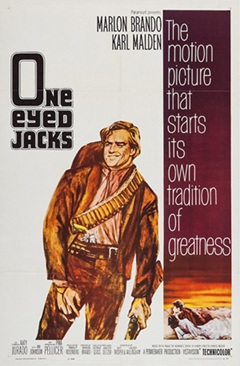
One-Eyed Jacks (1961, directed by Marlon Brando)


Rio (Marlon Brando), a young outlaw in the Old West, is betrayed by his partner and mentor Dad Longworth (Karl Malden) and ends up spending five years in a Mexican prison.  When Rio escapes, he gets together a new gang and heads for Monterey, California.  He wants to both get his revenge on Longworth and also rob the local bank.  Things get complicated when Rio actually confronts Longworth and suddenly realizes that he can’t bring himself just to gun the man down in cold blood.  Rio is not as ruthless of an outlaw as he thought he was.

However, Rio then meets and falls in love with Louisa (Pina Pellicer), Longworth’s stepdaughter  Longworth is willing to do whatever he has to keep Rio away from Louisa and, when Rio starts to think about going straight in an effort to win Louisa’s love, his new gang turn out to be even less trustworthy than his old partners.

A teenage rebellion film disguised as a western (and it’s not a coincidence that the main bad guy is named Dad), One-Eyed Jacks was Marlon Brando’s only film as a director.  The film was originally meant to be directed by Stanley Kubrick, who was working from a script written by a once-in-a-lifetime combination of Rod Serling and Sam Peckinpah.  Kubrick and Brando worked together to develop the film, with Brando insisting on Karl Malden as Dad.  (Kubrick wanted to cast Spencer Tracy.)  Ultimately realizing that working on One-Eyed Jacks would mean essentially taking orders from his star, Kubrick stepped down from directing so he could focus on Lolita and Brando took over as director.  The film finally went into production in 1958 and would not be released until 1961.  Brando’s perfectionism was blamed for the film going massively overbudget and, when it was finally released, One-Eyed Jacks was the first of Brando’s films to lose money.  The combined box office failures of One-Eyed Jacks and the remake of Mutiny on the Bounty left Brando in the cinematic wilderness for much of the 60s.

As for the film itself, One-Eyed Jacks takes what should have been a simple story and attempts to turn into an epic.  Rio spends a good deal of time brooding and the film seems to brood right along with him.  What starts out as a western becomes a forbidden love story as Rio and Louisa fall for each other.  Dad Longworth may be an outlaw-turned-sheriff but Malden plays him more as a possessive father who can’t handle that his two stepchildren — Rio and Louisa — are both turning against him and his strict rules.  Brando obviously viewed the film as being something bigger than a standard western.  Sometimes, his direction works and he does manage to get the epic feel that he was going for.  Other times, the film itself seems to be unsure what direction it wants to go in telling its story.  This is method directing.

Ultimately, One-Eyed Jacks is an interesting experiment, one that doesn’t really work but which still features Charles Lang’s outstanding cinematography and one of Karl Malden’s best performances.  As Brando’s only directorial effort, the film is a curiosity piece, one that will be best enjoyed by western fans who have the patience for something a little different.  And, for what it’s worth, based on the film’s visual beauty and the performances that he gets from the cat, I think Brando could have developed into a fine director with a little more experience.  However, it was not to be.


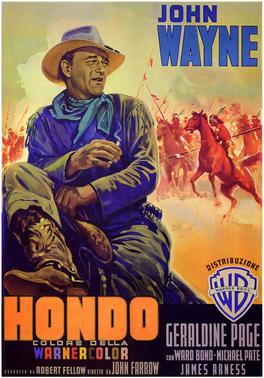
HONDO – John Wayne takes on Apaches!


John Wayne is just one of those actors I love. He’s made so many great movies. My personal favorites are RIO BRAVO, TRUE GRIT, BIG JAKE, THE SONS OF KATIE ELDER, THE MAN WHO SHOT LIBERTY VALANCE, THE SEARCHERS, THE QUIET MAN, RED RIVER, THE SHEPHERD OF THE HILLS and STAGECOACH. But hell, there are so many great ones not listed above. He just knew how to play tough, honorable, flawed men in his uniquely John Wayne way. When I hit play on a John Wayne film, I know I’m in for a good time. 

The 1953 John Wayne movie HONDO starts with a man and his dog walking through a dusty, rocky landscape on their way towards a pond and a rough looking farmhouse. He’s greeted by a woman and her young son. The man, Hondo Lane (Oscar winner John Wayne), is a scout for the U.S. Cavalry who’s just escaped from Apaches but lost his horse in the process. The woman, Angie Lowe (Oscar winner Geraldine Page), allows Hondo to stay at her ranch to rest and get something to eat. She tells him that her husband is away in the hills chasing wildcats for the day, and he asks her if he can buy a horse to get back to his cavalry post. Hondo ends up having to stay a few days at the ranch in order to break a wild, rambunctious horse before it can be ridden. While there, Hondo learns that Angie doesn’t really know where her husband is, as he left months ago and has never returned. Hondo and Angie share some nice conversation and even a kiss. Before he leaves, he tells her that she’s not safe at her remote ranch. It seems that the U.S. government has broken their treaty with the Apaches and no one is safe in the area. Angie refuses to leave her farm as the Apaches have always treated her well, using her spring for water. Hondo heads back to his post and is barely out of sight when the Apaches show up. Will they scalp Angie and her son, Johnny? Will Angie’s husband ever show back up? Will Hondo come back to the ranch and kiss her again in the moonlight? Will Hondo teach Johnny how to swim by throwing him into the pond? Will Hondo have to save a regiment of pony soldiers and settlers from marauding Apaches? It’s my guess that you probably know the answers to these questions, and that’s part of the fun of watching John Wayne movies. 

It should come as no surprise that I enjoyed HONDO. John Wayne plays a variation of his normal tough, honorable, honest character, and I like that character. Geraldine Page was nominated for her first Oscar for her performance as Angie Lowe. It was the first of eight nominations she would receive in her career. She’s an interesting actress. She’s not conventional at all in this role yet she absolutely nails it. I haven’t watched much of her work so I need to check some more of her stuff out. Ward Bond shows up as fellow cavalry scout Buffalo Baker. It’s always fun to see Wayne and Bond work together. They go together like peas and carrots. Leo Gordon is effectively slimy as the deserter Ed Lowe, and James Arness shows up as cocky young man who’s humbled and then redeems himself through battle. It’s a fine cast that helps in the fun factor. 

It’s not a perfect film, especially by the social standards of 2024, but it’s a fun and entertaining western. I liked it.