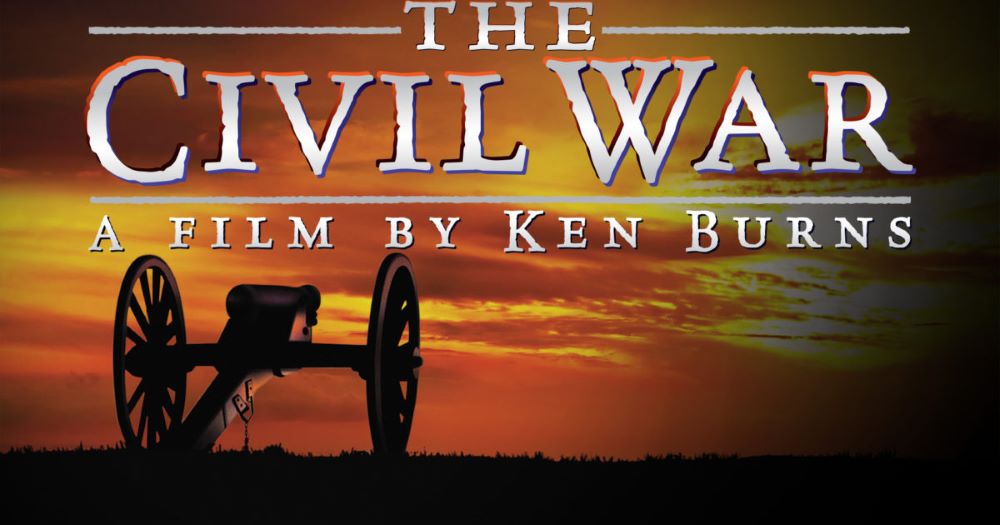
Review: The Civil War (dir. by Ken Burns)


“We are not enemies, but friends. We must not be enemies. Though passion may have strained, it must not break our bonds of affection.” — Abraham Lincoln

Ken Burns’ The Civil War stands as one of those rare documentaries that completely reshapes how people think about both history and the craft of documentary filmmaking. Released in 1990, it’s been over three decades since it first aired, yet it still feels monumental in its reach and emotional resonance. Instead of serving as a dry classroom recounting of battles and dates, it’s an experience that makes you feel the war’s human dimension—the people who fought it, lived through it, and were changed forever by its violence and ideals. Burns manages to take America’s bloodiest conflict and give it a pulse, telling the story not only through historians and statistics but through letters, diaries, and voices that make you feel connected to the 1860s as if it all just happened yesterday.

One of the most defining parts of The Civil War is its look and rhythm. Burns’ now-famous visual style—those slow pans and zooms across black-and-white photographs—became such a signature technique that it’s now built into editing software as “the Ken Burns effect.” It might sound simple, but the way he moves those still images feels like breathing life into ghosts. Every slow zoom on a soldier’s uncertain face, every fade over an empty battlefield, has meaning. Before Burns, most historical documentaries presented facts through re-enactments or stiff academic interviews. Burns dared to make photographs speak on their own. The pacing he uses is hypnotic—deliberate, unwavering, and emotionally tuned to each shot. It’s a visual rhythm that invites reflection instead of speed. The whole thing feels like time itself has slowed down so history can whisper its fullest story.

The narration, provided by David McCullough, ties the sprawling story together with a sense of calm authority. His voice is warm, measured, and almost timeless, acting less like a narrator and more like an old friend who knows the past intimately but never overstates it. McCullough’s presence builds trust—no hype, no theatrics, just thoughtful storytelling. Burns pairs that voice with readings from letters, diaries, and contemporary accounts, delivered by a lineup of talented voice actors like Jason Robards, Sam Waterston, and Morgan Freeman. Their readings never feel like performances; they feel lived in, restrained, and sincere. This combination of voice and image creates a tone that is both haunting and beautiful, one that makes history feel alive but not romanticized.

A huge part of why the series feels so moving is Jay Ungar’s “Ashokan Farewell.” Oddly enough, it’s not a Civil War-era tune at all—it was written in the 1980s—but it fits so organically with the documentary’s mood that it’s impossible to think about the series without hearing it. The plaintive fiddle melody has a mournful warmth, evoking the loss and longing that defines the entire project. Burns and his team used it in just the right measure: when the music plays, it deepens emotion rather than dictating it. Combined with other period-appropriate folk songs, banjo pieces, and hymns, the soundtrack acts as the emotional current guiding the story through landscapes of death, courage, and change.

The structure of The Civil War is deceptively simple but brilliantly executed. Spanning nine episodes and over eleven hours in total, it charts the war from its earliest, uneasy beginnings in the political debates over slavery and statehood through to its catastrophic conclusion and fragile aftermath. Burns understood that history isn’t static; it’s emotional and cumulative. The early episodes almost feel optimistic—the tone of youthful bravado and national pride fills the air as both sides believe the conflict will end quickly. As the series progresses, though, the optimism curdles into fatigue, despair, and grief. By the time the war drags into its later years, the imagery, narration, and music all carry the weight of shared tragedy. You begin to see how idealism eroded into acceptance of horror. The careful pacing of each episode allows viewers to feel that arc not just intellectually but emotionally.

Among the many creative decisions Burns made, choosing to anchor the series around personal letters was perhaps the most effective. Through these letters, anonymous soldiers, wives, and family members speak across time. Their words carry more power than any historian’s commentary could. One of the most unforgettable moments comes from Union officer Sullivan Ballou’s letter to his wife, written shortly before he was killed. His words are devastating in their tenderness and resignation, summing up both love and mortality in a way that feels timeless. Burns threads similar letters throughout the series—from soldiers on both sides, from civilians caught in the middle, and from the enslaved people whose freedom hung in the balance. Their voices form the emotional backbone of the documentary, constantly reminding us that this was not just a war of strategy but a catastrophe of human consequence.

Alongside these voices, there’s a chorus of historians offering perspective and context. Shelby Foote, with his Southern drawl and gift for anecdote, became one of the documentary’s most recognizable figures. His storytelling bridges the gap between scholarship and folklore, even if some critics later accused him of romanticizing the Confederate perspective. Counterbalancing that, historian Barbara Fields provides some of the series’ most profound reflections, particularly regarding race and memory. Her insistence that the war’s legacy continues to shape American identity feels just as relevant now as it did in 1990. Their alternating viewpoints give the documentary balance—emotion on one side, intellect and conscience on the other.

Burns’ handling of tone is one of the most striking things on a rewatch. It’s both deeply romantic in its love of storytelling and brutally realistic in its depiction of suffering. It doesn’t sanitize the war, but it doesn’t exploit it either. You’re never shown battle reenactments, explosions, or gore. Instead, Burns conveys the violence and despair through letters, photos, and silence. He trusts the audience to fill in the horror. That’s uncommon in modern documentary work, where there’s often pressure to explain or dramatize everything. In The Civil War, silence becomes a storytelling device. The pauses between sentences, the long holds on a tattered flag or a battlefield grave, carry meaning. The documentary refuses to rush toward catharsis; it lingers in grief.

In today’s media landscape—where documentaries tend to move fast and fight for attention—Burns’ slower, more contemplative approach stands out. Back in 1990, it riveted viewers. An estimated 40 million people watched it on PBS, an unbelievable number for a historical series on public television. For many Americans, it became their most vivid introduction to their own national history. It made people talk about Gettysburg, Lincoln, emancipation, and the moral aftermath of the war in living rooms across the country. It even sparked renewed interest in Civil War books, memorials, and battlefield preservation. Burns had tapped into something rare: a collective need to understand who Americans are by understanding what nearly destroyed them.

Even decades later, The Civil War holds up both artistically and historically. Watching it now, its moral clarity about slavery as the war’s central cause feels vital, especially in a time when debates over monuments and racial politics remain heated. Burns never let the series fall into the “states’ rights” trap that muddied so many earlier narratives. He continually foregrounded the human cost of defending or destroying the institution of slavery. Still, modern viewers might wish for even more emphasis on the experiences of Black Americans, beyond the selected diaries and Douglass excerpts. The documentary touched these stories with respect but within the limits of its early-1990s format. Later historians have expanded upon what Burns began, but his foundation remains solid.

Technically, the documentary’s aged well. Restored versions bring new clarity to the old photographs, and the audio’s crisp enough to make the letters feel freshly read. The storytelling, slow-moving as it is, rewards patience. It’s not content to skim across major events; it expects you to sit with sorrow, fatigue, and loss. Watching all eleven hours feels like reading an epic novel: it’s best done gradually, letting each episode resonate before starting the next. The cumulative effect isn’t just historical understanding—it’s emotional exhaustion tempered by awe.

The Civil War remains one of the greatest nonfiction works ever broadcast. It’s not simply about battles or leaders but about the psychology of a country divided by ideals and identity. It asks questions rather than delivering verdicts—questions about sacrifice, belief, morality, and what it means to be American. Few documentaries manage to tell old stories in ways that still feel alive, but Burns achieved that through patience, empathy, and an unshakable faith in the power of storytelling. Even now, it’s hard to watch without feeling the echo of those voices—some hopeful, some broken—that seem to reach out from still photographs and faded ink. Burns didn’t just document history; he let history speak for itself. That’s why The Civil War endures.

Perhaps it’s even more important now than when it first aired. In a time when historical revisionism has begun to creep from the fringes into mainstream discourse and when the nation feels dangerously forgetful of its own moral and political lessons, Burns’ documentary serves as both a warning and a reminder. It shows what happens when ideology overtakes humanity and when a country forgets the cost of its own divisions. Watching The Civil War today feels less like revisiting the past and more like confronting the present—proof that the ghosts of that conflict remain, quietly urging us not to repeat what we once swore to never forget.

Film Review: All The King’s Men (dir by Steven Zaillian)


On September 10th, 1935, a Senator named Huey Long was shot and killed at the Louisiana State Capitol in Baton Rogue.

While it’s generally agreed that Carl Weiss, the son-in-law of a political opponent, approached Long, there’s still some debate as to whether or not Weiss was the one who shot Long. Did Weiss fire one shot at Long or was Long himself accidentally shot by his many bodyguards, all of whom opened fire on Weiss? (Weiss died at the scene, having been wounded at least 60 times.) There’s even some who argue that Weiss didn’t even have a gun on him when he approached Long and that Long’s bodyguards misinterpreted Weiss’s intentions. Or, as some more conspiracy-minded historians have suggested, perhaps Long’s bodyguards were themselves paid off by one of Long’s many enemies. With Huey Long, anything was possible.

Huey Long has been described as being an American dictator, a man who ran for office as a populist and who, as governor and then senator, ruled Louisiana with an iron fist. His slogan was “Every man a king,” and he promoted a platform that mixed Socialism with redneck resentment. (In modern terms, he mixed the vapid but crowd-pleasing rhetroic of AOC with the bombastic but calculated personal style of Donald Trump.) He often played the flamboyant buffoon but he also knew how to reward his friends and punish his enemies. At the time of his death, he was planning to run for President against FDR. It’s said that, in typical Long fashion, he planned to run as a third party candidate and draw away enough votes from Roosevelt to allow Republican Alf Landon to win. Then, in 1940, Long would run for the Democratic nomination and send President Landon back to Kansas.

Huey-Long-radio-3000-3x2gty-5c2934d246e0fb00012da4a1

Whether his plan was feasible or not, they came to an end with his death. However, his legacy continued as members of the Long family dominated Louisiana politics for decades to come. Huey’s brother, Earl, served as governor of Louisiana for several contentious terms. Huey’s son, Russell, spent nearly 40 years in the Senate and, as chairman of the Finance Committee, was one of the most powerful men in the country. As late at 2020, Huey’s third cousin was serving in the Louisiana Senate. In the past few years, both Donald Trump and Bernie Sanders have been compared to Huey Long. Of course, if Huey were alive today, he’d probably be very popular online. Political Twitter has never met an authoritarian that it couldn’t make excuses for.

Among those who were fascinated by the life and death of Huey Long was a Southern poet and novelist named Robert Penn Warren. Warren used Long as the basis for Willie Stark, the man at the center of the novel All The King’s Men. In the novel, Stark is a classic and tragic American archetype, the man of the people who loses his way after coming to power. Stark starts the book as an idealist who wants to make life better for the poor but who, as he works his way up the political ladder, loses sight of why he first entered politics in the first place. He goes from fighting for the people to fighting only for himself. The book was controversial but popular and won the 1947 Pulitzer Prize. In later interviews, Warren often said that All The King’s Men was never meant to be a book about politics but instead a book about two men, Willie Stark and reporter Jack Burden, losing their way during the tumult of the Great Depression.  Regardless of Warren’s intentions, most readers and critics have focused on the book as a cynical look at American politics and the authoritarian impulse.

All-the-Kings-Men-1949

Considering the book’s popularity, it’s not surprising that All The King’s Men was turned into a movie just three years after it was published.  Directed by Robert Rossen and starring a perfectly cast Broderick Crawford as Willie Stark, the film won the Oscar for Best Picture of 1949.  Just as with the book, the film was considered to be controversial.  Many claimed that the film’s cynical portrayal of American politics was the equivalent of supporting communism, despite the fact that both the novel and the original film present Stark as being the epitome of the hypocritical Marxist dictator.  Indeed, if any character would have inspired audiences in 1949 to distrust socialism, it would have been a faux populist like Willie Stark.  Still, John Wayne was so offended by the book and the script that he very publicly turned down the role of Willie Stark.  That was all the better for Broderick Crawford, who won an Oscar playing the role.  When seen today, the original All The King’s Men holds up surprisingly well, as does Crawford’s lead performance.  Filmed in harsh black-and-white and featuring a cast of cynical, tough-talking characters, it’s a political noir.

Those who found the 1949 version of All The King’s Men to be dangerously subversive obviously had no idea what was in store for them and the country over the next couple of decades.  There’s a reason why the best-known book about the downfall of Richard Nixon was called All The President’s Men.  By the start of the current century, with all of the political corruption that was happening in the real world, the flaws and crimes of Willie Stark seemed almost quaint by comparison.  In 2006, with George W. Bush serving his second term, America embroiled in two unpopular wars, and the economy looking shaky, it was decided that it was time for a new version of the story of Willie Stark.

This version was directed by Steven Zaillian, the screenwriter whose credits included Schindler’s List, Gangs of New York, Hannibal, and American Gangster.  The role of Willie Stark was played by Sean Penn, who was both an Academy Award winner and an outspoken critic of George Bush.  (And, make no mistake about it, the new version of Willie Stark would be as much based on Bush as he was on Huey Long.)  Jude Law played Jack Burden, the reporter who narrated the story of Stark’s rise and fall.  Kate Winslet, Anthony Hopkins, James Gandolfini, Patricia Clarkson, Mark Ruffalo, Jackie Earle Haley, and Kathy Baker all had supporting roles.  This was a cast full of Oscar nominees and, indeed, the film’s trailer had that portentous, “the movie is very important and award-worthy” feeling to it that studios go with whenever they’re trying to convince audiences that they have an obligation to see a film, regardless of how boring or annoying it may look.  Entertainment Weekly predicted that All The King’s Men would be an Academy Award contender. For nearly two months, one could not see a movie at the Dallas Angelika without also seeing thee trailer for All The King’s Men.  It was a movie that was due to arrive at any minute and it was coming with an awful lot of hype.

And then, the strangest thing happened.  The film itself kind of disappeared.  It arrived and then it promptly got lost.  The reviews were overwhelmingly negative.  Audiences did not turn out to see the film.  It was a box office bomb, one that pretty much ended Steven Zaillian’s career as a director.  The film played for a week in Dallas and then left the city’s movie screens.  Even if I had been planning on seeing the film when it was originally released, I wouldn’t have had the opportunity.  The Gods of cinema, politics, and Southern accents were conspiring to protect me from suffering through a bad movie and I guess I should be thankful.  There’s nothing that makes me cringe more than hearing a bad Southern accent in a movie and the trailer for All The King’s Men was full of them.

Way back in November of last year, I noticed that the 2006 version of All The King’s Men was available on Encore On Demand.  At the time, I had politics on my mind.  The Virginia and New Jersey gubernatorial elections had bee held earlier that week.  Biden’s huge infrastructure bill had passed the House on the very same night that I came across the film.  Hell, I figured, could watching Sean Penn as Willie Stark be any worse than watching Joe Biden try to give a speech from the Oval Office?  So, I decided to give the movie a chance and I quickly discovered that watching Sean Penn’s Willie Stark was a lot worse.

In All The King’s Men, Sean Penn gives the type of bad performance that can only be given by a good actor.  Penn yells and grimaces and barks out order like the villain in a badly dubbed Bollywood movie.  When he watches a dancer, he doesn’t just look at her.  Instead, he stares with all the intensity of a cartoon wolf who has just spotted Little Red Riding Hood.  There’s nothing subtle about Penn’s performance, least of all his overbaked accent.  The only thing wilder than Penn’s accent is his hair, which often seems to be standing up straight as if he’s just removed his fingers from an electrical socket.  It’s a performance that is heavy on technique but empty on substance.  In both the book and the original film, Willie Stark is flamboyant in public but cool and calculating in private.  In the remake, Penn yells and sweats and jumps around and comes across as being so desperate that it’s hard to buy into the idea that anyone would believe a word that he said.  Broderick Crawford’s Willie Stark was believable because Crawford, with his bulky build and his plain-spoken manner, came across as being a real human being.  One could imagine voters looking at Crawford and believing that he was just like them.  Sean Penn, on the other hand, comes across like a rich man’s version of a poor man.  Penn is too obviously condescending to be an effective populist.  Voters will forgive a lot but they’ll never forgive a politician who openly talks down to them.

As for the rest of the cast, they’re a very talented group but not one of them is convincingly cast.  In fact, many of them give career-worst performances.  Anthony Hopkins does his usual eccentric routine but it doesn’t add up too much because the audience never sees him as being anything other than Anthony Hopkins using a rather spotty Southern accent.  When Hopkins’s character dies, it’s not a tragedy because the character himself never feels real.  Instead, you’re juts happy that Hopkins collected a paycheck.  Kate Winslet seems to be bored with the role of Stark’s mistress.  Mark Ruffalo is dazed in the role of Winslet’s brother.  As Jack Burden, Jude Law seems as lost as anyone, which wouldn’t be problem if not for the fact that Jack is the one narrating the film.  When your narrator is lost, you’re in trouble.

There’s really only two members of the cast who escape the film unscathed.  Jackie Earle Haley is properly intimidating as Stark’s devoted bodyguard.  Haley doesn’t get many lines but one look at his disturbed eyes tells you all you need to know about how far he’ll go to protect his boss.  On the other hand, James Gandolfini gets several lines and he does such a good job of delivering them and he plays the role of a corrupt political boss with such a perfect combination of good humor and cold pragmatism that you have to wonder just how much All The King’s Men would have been improved if Gandolfini had played Willie Stark instead of Sean Penn.

Steve Zaillian’s direction involves a lot of soft-focused flashbacks and several visual references to the Nuremberg rallies.  Just as with Penn’s performance, there’s nothing subtle about Zaillian’s direction, despite the fact that the story itself is so melodramatic that it calls for the opposite of a heavy-handed approach.  One wonders what exactly Zaillian was trying to say with his version of All The King’s Men, which presents Willie Stark as being a monster but still as the audacity to end with a clip of him giving a rousing campaign speech.  Again, the problem is that we never buy into the idea that Willie Stark was ever sincere in his desire to help the common man.  Everything about both Penn’s performance and Zaillian’s direction serves to suggest that, from the start, Stark viewed them as just being a means to an end.  Ending the film with a flashback of Willie giving a campaign speech is about as moving as a friend from high school contacting you on Facebook and then trying to get you to take part in a pyramid scheme.  There’s no sincerity to be found in any of it.

In the end, it’s a film of overheated performances and meticulously shot scenes that all add up to very little.  There are a few moments where Sean Penn’s body language and his vocal inflections suggest that he’s trying to channel George W. Bush but there’s nothing particularly shocking or subversive about that.  In 2006, every movie and TV show had to find a way to take a swipe at Bush and Penn’s never been particularly reticent when it comes to broadcasting his politics.  Though All The King’s Men was executive produced by political consultant James Carville, there’s very few moment in the film that feel authentic.  It’s like a high school senior’s view of politics.

All The King’s Men came and went quickly.  Fortunately, everyone was able to move on.  Steven Zaillian has not directed another film but remains an in-demand scriptwriter.  Sean Penn, Anthony Hopkins, and Kate Winslet all won Oscars after appearing in this film (though, it should be noted, none of them won for this film).  Mark Ruffalo and Jude Law went on to join the Marvel Universe.  Jackie Earle Haley continues to be a much-respected character actor.  Tragically, James Gandolfini is no longer with us but his performance as Tony Soprano will never be forgotten.  The second version of All The King’s Men wasted a lot of talent but, fortunately, talent always finds a way to survive.