MAN WITH A CAMERA (TV Series) – starring Charles Bronson – S1, E2: The Warning


This episode opens with Mike Kovac (Charles Bronson) receiving an anonymous phone call to come to the corner of Myers St. and Brooklyn Ave., and he’s told to bring his camera! When he gets there, he’s forced at gunpoint by two masked man to take a picture as they kill another man. After the killers drive off, Kovac immediately calls the police. We meet Lt. Abrams (Robert Ellenstein), who tells Kovac that the dead man is a new merchant in town named Sam Bartlett (Bill Erwin) who has been refusing to pay the head of the local protection racket, Glenn Markey (Berry Kroeger). Lt. Abrams asks Kovac to let them plant a story in the paper that says they have an eyewitness to the murder, ace photographer Mike Kovac. Worried that he might be the next man to get killed, Kovac turns him down. Not feeling good about refusing to help the police, Kovac goes to see his dad Anton and tells him the story. Shocked to hear that his son has refused to help the police, especially since it could help put an end to Marky’s reign of terror, Anton asks his son if it’s because he’s afraid. Somewhat shamed into it, Kovac finally agrees and calls Lt. Abrams and tells him they can run the story saying he witnessed the murder. Wouldn’t you know it, the next night Glenn Markey and his funky bunch kidnap Anton in order to force Kovac’s hand. Will Kovac be able to save his dad, and his own skin in the process? Will the police be any help? 

“The Warning” seems to be built upon an irrational request from the police of Mike Kovac… let us plant a fake story and put your life in danger so we can hopefully catch the killer as he tries to kill you. When Kovac refuses to be used that way, as any other rational human being would, Lt. Abrams tells him he’d been told that “Mike Kovac doesn’t scare easily. Guess I heard wrong.” It’s bad enough when anyone implies you’re a coward, but when Mike’s own dad seems disappointed that he’s not helping the police out of fear, Mike is almost forced to help. This is not how it would go down if I found myself in this position, and my dad would be on my side! Even though the premise is somewhat flimsy, there are definitely some good moments in the episode. Once Markey has kidnapped his “Pop,” Kovac turns into the badass Bronson we’ve been waiting for. I enjoyed this tough guy exchange as Markey tries to force Kovac to come with him at gunpoint, not knowing Kovac has brought his own gun:

Markey – “This gun says you’re coming along with me.”

Kovac – “This gun says I’m not.”

Markey – “You’re bluffing, Kovak.”

Kovac – “You just think about that when these slugs start ripping into your body. Maybe it’ll be a comfort to you.”

I also like it when Anton admits he was wrong at the end. After somewhat shaming his son into helping the police, and then having to be rescued later, Anton says, “You were right Michael, these things are dangerous. The next time the police ask for your help, you say NO!” It’s a funny, and more realistic, conclusion to the episode! 

Overall, I enjoyed the episode very much, mainly because of Bronson’s strong central performance. I’m looking forward to seeing where the series goes from here! 
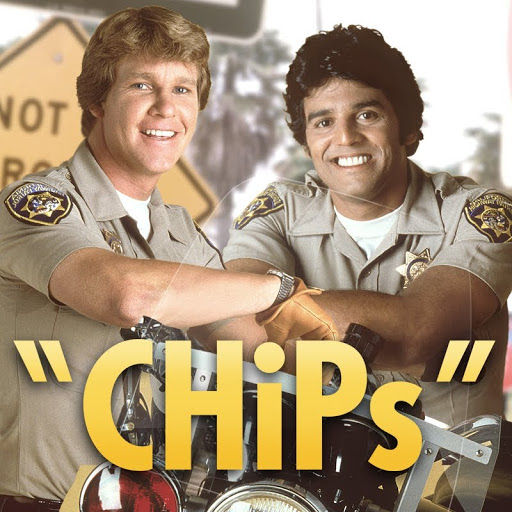
Late Night Retro Television Review: CHiPs 3.9 and 3.10 “Drive, Lady, Drive”


Welcome to Late Night Retro Television Reviews, a feature where we review some of our favorite and least favorite shows of the past!  On Mondays, I will be reviewing CHiPs, which ran on NBC from 1977 to 1983.  The entire show is currently streaming on Prime!

This week, it’s a special two-hour episode of CHiPs!

Episodes 3.9 and 3.10 “Drive, Lady, Drive”

(Dir by Don Weis, originally aired on November 10, 1979)

The police at nearby Palma Vista are on strike and the state of California has agreed to allow some members of the Highway Patrol to patrol the town until the strike is over.  Getraer assigns Baker, Ponch, Bear, and some new guy named Lenny (Leon Isaac Kennedy) to head over to the town,  Baker is named the OIC, which I eventually figured out stood for “Officer in Charge.”  Getraer knows better than to give the job to Ponch.

Ponch, by the way, is back!  After being absent for two episodes due to Erik Estrada actually injuring himself in a motorcycle crash, Ponch returns in this episode and he goes through the entire episode with this huge grin on his face as if he’s saying, “You know you missed me.”  Ponch’s return means that Baker is once again relegated to being the strong, silent partner who doesn’t really get to do anything.  In fact, Baker crashes his motorcycle early on in this episode, as if the show was trying to tell us, “See?  It could happen to anyone!”

The striking cops accuse Baker, Ponch, Bear, and Lenny of being scabs and strike breakers.  I’m not really a fan of public sector unions.  (When it comes to the police striking, my hero is Calvin Coolidge, who came to fame when he broke up a policeman’s strike in Massachusetts.)  Still, it felt strange to watch the show’s heroes cross that picket line.  That would definitely not happen on television today.

There’s a lot going on in Palma Vista.  There’s some rich kids who keep joyriding in a dune buggy and who think they can escape prosecution by crossing the city limits.  (Joke’s on them!  The Highway Patrol has jurisdiction everywhere!)  There’s some truck hijackers who are setting up a headquarters in town.  There’s an angry city councilman (Michael Conrad) who doesn’t feel his children should be held accountable for their actions.

That said, the majority of this two-hour episode centered on a stock car race and one of the racers, Candi Wright (Kelly Harmon).  Will Candi win the big race or will she lose to her friendly rival (and possible future romantic partner) Don Croyden (Jordan Clarke)?  Will Ponch be able to both date her and do his job?  And most importantly, will she be able to adopt a traumatized little girl (played by Tracey Gold) who Candi discovered outside of a burning house?  That’s a lot of storylines for someone who wasn’t even a regular cast member and a part of me wonders if maybe this episode was meant to be a secret pilot for a Candi Wright television series.  It would explain a lot.

This really was a basic episode of CHiPs, with the only real difference being that it was two-hours long for some reason.  A lot of what happened in the episode, especially the racing footage, felt like filler.  There was really no need for this to be a double-sized episode.  It also doesn’t help that, as opposed to the lovely Los Angeles scenery that we usually see, this episode took place in a rather ugly town.  There was some appropriately spectacular crashes but, in the end, this episode ran too long and felt a bit pointless.  Get the Highway Patrol back on the highways!

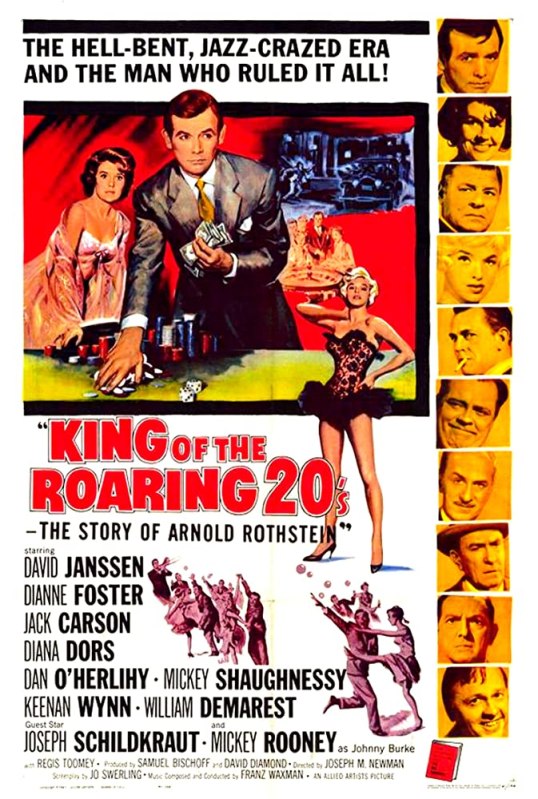
An Offer You Can’t Refuse #6: King of the Roaring 20s: The Story of Arnold Rothstein (dir by Joseph M. Newman)


The 1961 gangster biopic, King of the Roaring ’20s: The Story of Arnold Rothstein, tells the story of two men.

David Janssen is Arnold Rothstein, the gambler-turned-millionaire crime lord who, in the early years of the 20th Century, was one of the dominant figures in American organized crime.  Though he may be best-remembered for his alleged role in fixing the 1918 World Series, Rothstein also served as a mentor to men like Lucky Luciano, Meyer Lansky, and Bugsy Siegel.  Rothstein was perhaps the first gangster to to treat crime like a business.

Mickey Rooney is Johnny Burke, Arnold’s best friend from childhood who grows up to be a low-level hood and notoriously unsuccessful gambler.  Whereas Arnold is intelligent, cunning, and always calm, Johnny always seems to be a desperate.  Whereas Arnold’s success is due to his ability to keep a secret, Johnny simply can’t stop talking.

Together …. THEY SOLVE CRIMES!

No, actually, they don’t.  They both commit crimes, sometimes together and sometimes apart.  Perhaps not surprisingly, Arnold turns out to be a better criminal than Johnny.  In fact, Johnny is always in over his head.  He often has to go to his friend Arnold and beg him for his help.  Johnny does this even though Arnold continually tells him, “I only care about myself and money.”

The friendship between Arnold and Johnny is at the heart of King of the Roaring 20s, though it’s not much of a heart since every conversation they have begins with Johnny begging Arnold for help and ends with Arnold declaring that he only cares about money.  At a certain point, it’s hard not to feel that Johnny is bringing a lot of this trouble on himself by consistently seeking help from someone who brags about not helping anyone.  From the minute that the film begins, Arnold Rothstein’s mantra is that he only cares about money, gambling, and winning a poker game with a royal flush.  Everything else — from his friendship to Johnny to his marriage to former showgirl Carolyn Green (Dianne Foster) to even his violent rivalry with crooked cop Phil Butler (Dan O’Herlihy) — comes second to his own greed.  The film’s portrayal of Rothstein as being a single-minded and heartless sociopath may be a convincing portrait of the type of mindset necessary to be a successful crime lord but it hardly makes for a compelling protagonist.

Oddly enough, the film leaves out a lot of the things that the real-life Arnold Rothstein was best known for.  There’s no real mention of Rothstein fixing the World Series. His mentorship to Luciano, Lansky, and Seigel is not depicted.  The fact that Rothstein was reportedly the first gangster to realize how much money could be made off of bootlegging goes unacknowledged.  By most reports, Arnold Rothstein was a flamboyant figure.  (Meyer Wolfsheim, the uncouth gangster from The Great Gatsby, was reportedly based on him.)   There’s nothing flamboyant about David Janssen’s performance in this film.  He plays Rothstein as being a tightly-wound and rather unemotional businessman.  It’s not a bad performance as much as it just doesn’t feel right for a character who, according to the film’s title, was the King of the Roaring 20s.

That said, there are still enough pleasures to be found in this film to make it worth watching.  As if to make up for Janssen’s subdued performance, everyone else in the cast attacks the scenery with gusto.  Mickey Rooney does a good job acting desperate and Dan O’Herlihy is effectively villainous as the crooked cop.  Jack Carson has a few good scenes as a corrupt political fixer and Dianne Foster does the best that she can with the somewhat thankless role of Rothstein’s wife.  The film moves quickly and, even if it’s not as violent as the typical gangster film, it does make a relevant point about how organized crime became a big business.

It’s not a great gangster film by any stretch of the imagination and the lead role is miscast but there’s still enough about this film that works to make it worth a watch for gangster movie fans.

Previous Offers You Can’t (or Can) Refuse:

  1. The Public Enemy
  2. Scarface
  3. The Purple Gang
  4. The Gang That Could’t Shoot Straight
  5. The Happening