Horror Film Review: It! The Terror From Beyond Space (dir by Edward L. Cahn)


“Another name for Mars is …. DEATH!”

The 1958 sci-fi/horror hybrid, It!  The Terror From Beyond Space, opens with a NASA press conference.  The assembled reporters are reminded that, earlier in the year, America’s first manned mission to Mars was presumed to have been lost.  However, a second mission was sent to Mars and they discovered that the commander of the first mission, Edward L. Carruthers (Marshall Thompson), was still alive.

Unfortunately, all of Carruthers’s crewmates were dead.  Carruthers claimed that the murders were committed by a monster.  The commander of the second mission, Col. Van Heusen (Kim Spalding), instead suspected that Carruthers killed his crewmates when he realized they were stranded on Mars.  The ship had enough provisions to last the entire crew for one year or ten years for just one man.

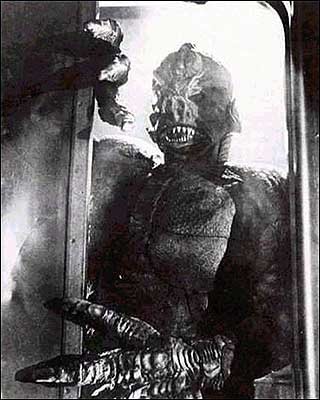
The second mission is now on their way back to Earth, with Carruthers under house arrest.  While one crewman does believe that Carruthers’s story could be true, the others are convinced that Carruthers is a murderer.  What they don’t know is that the monster from Carruthers’s story is not only real but that it also snuck onto their ship during lift-off.  Tall and scaly with huge claws and a permanently angry face, the Monster — It, for lack of a more formal name — is lurking in the lower levels of the ship and hunting for food.

To state what is probably already obvious, It! is not a film that worries much about being scientifically accurate.  While it does explain how living on the surface of Mars caused It to develop into the predator that it is, this is also a science fiction film from 1958.  It’s a film where, instead of going to the Moon, the first manned spaceflight is to Mars.  It’s also a film where there’s no weightlessness in space, the two women on the ship serve everyone coffee, and a nuclear reactor is casually unshielded at one point in an attempt to destroy It.  Bullets are fired on the spaceship.  Grenades are tossed.  Airlocks are rather casually opened.

Fortunately, none of that matters.  Clocking in at a mere 69 minutes, It! is a surprisingly suspenseful horror film, one that makes good use of its claustrophobic locations (a lot of the action takes place in an air duct) and which features a surprisingly convincing and, at times, even scary monster.  It may be a man in a rubber suit but that doesn’t make it any less shocking when its claw bursts out of an an open hatch and starts trying to grab everything nearby.  The cast of It! are all convincing in their roles.  Watching them, you really do believe that they are a crew who have seen a lot together and it makes the subsequent deaths all the more effective,

It! was a troubled production,  The monster was played by veteran stuntman Ray Corrigan, who reportedly showed up drunk a few times and also managed to damage the monster suit.  Many members of the cast were not happy about being cast in a B-movie.  (Fortunately, their resentment probably helped their performances as the similarly resentful crew of the second mission to Mars.)  Marshall Thompson, who played Carruthers, was one of the few cast members who enjoyed making It! and, perhaps not surprisingly, he also gives the best performance in the film.

Troubled production or not, It! was not only a box office success but, along with Mario Bava’s Planet of the Vampires, it was later cited as one of the inspiration for Alien.  At its best, It! has the same sort of claustrophobic feel as Alien.  The scene where one of the crewman is found in an air duct brings to mind the fate of Tom Skerritt’s character in Alien.

It! is still a very effective work of sci-fi horror.  Remember, another name for Mars is …. DEATH!
30 More Days Of Noir #1: Bunco Squad (dir by Herbert I. Leeds)


Welcome to Noirvember!

Yeah, yeah, I know.  That sounds kinda silly, doesn’t it?  However, November is traditionally the month that classic film bloggers tend to concentrate on writing about film noir.  It provides a bit of grit and cynicism in between the horror fun of October and the holiday schmaltz of December.

I have to admit that I’m a little bit torn when it comes to taking part in Noirvember.  On the one hand, I love a good film noir and there’s quite a few obscure and underrated ones available on YouTube right now.  On the other hand, as a natural-born contrarian, I don’t like the idea of hopping on any bandwagons.

In the end, my love of film noir won out.  So, welcome to my first entry in 30 More Days of Noir.

The 1950 film, Bunco Squad, tells the story of Tony Weldon (Ricardo Cortez), a con man who specializes in using a phony psychic routine to swindle rich people out of their money.  He runs a fake enlightenment center and he claims that he can speak to the dead.  His latest target is the wealthy Jessica Royce (Elisabeth Risdon).  After he finds out that her son was killed during the invasion of Normandy, he and his associates go out of their way to trick her into believing that Tony can contact her son and that her son wants her to leave all of her money to Tony’s organization.  It’s actually kind of interesting watching as Tony and his gang manage to track down information about Jessica and her son, asking the most mundane of questions to find out things that Jessica believes only her son would know.  Watching Tony operate, I was reminded of those documentaries and news reports that you see about phony faith healers and other people who claim they can speak to the dead but who actually just go on very vague fishing expeditions.  (“I’m sensing something about the letter L.  Does that mean anything to you?”)

Tony is not just a con artist.  He’s also a murderer, one who specializes in cutting brake lines on cars.  If you try to expose Tony, you’re probably going to end up driving off of a cliff.  I guess you can get away with that when you’re a con artist in California.  Myself, I live in North Texas where the land is totally flat.  Someone could cut my brake lines and I would probably just keep going forward until I eventually ran out of gas.  Once that happened, someone would probably pull over and offer to give me a lift to the nearest gas station.  That’s one reason why someone like Tony Weldon could never pull off any of his crimes in my home state.

Fortunately, the detective of the LAPD’s Bunco Squad know what Tony’s doing.  The only problem is that they have to get some proof that Tony is swindling Ms. Royce and they have to manage to do it before Tony gets a chance to tamper with all of their brakes.  Leading the Bunco Squad is Steve Johnson (Robert Sterling) and you better believe that there’s no way someone named Steve Johnson is going to be anything other than honest and upright.  Working with a real-life magician named Dante, Johnson attempts to expose all of Tony’s tricks.

It’s probably open for debate whether or not Bunco Squad is a true noir.  On the one hand, Tony and his schemes are very noirish.  On the other hand, Steve and the members of the Bunco Squad are so upright that there’s none of the ambiguous morality that you find in the best film noirs.  I guess I would call this a half-noir.

The best thing about Bunco Squad is that it’s only 67 minutes long, which is all the time that it needs to tell a compact and occasionally interesting story.  There’s no excessive padding to try to force the story out to an unwieldy 90 minutes.  Instead, Bunco Squad jumps right into its story and it doesn’t let up until things come to an end.  The other good thing about Bunco Squad is that you’ve got Ricardo Cortez, giving a charmingly evil performance as Tony Weldon.  The film’s heroes are a pretty dull bunch but Cortez brings a nice charge of danger to the proceedings.

Bunco Squad is an obscure film but it moves quickly and the story is interesting enough to hold your attention for an hour.  It can be found on YouTube.

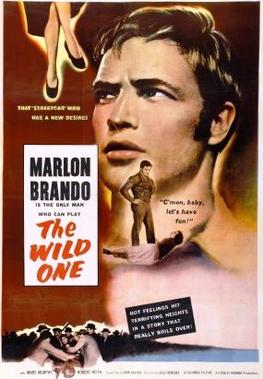
Film Review: The Wild One (dir by Laszlo Benedek)


Motorcycles have always been unbelievably sexy and, in 1953, so was Marlon Brando.

1953 was the year that Brando played Johnny Strabler in The Wild One.  Johnny’s the leader of the Black Rebels Motorcycle Club.  He wears a leather jacket and always has a cap tilted rakishly on his head.  When Johnny moves, he makes it a point to take his time.  He doesn’t run from anyone and, perhaps most importantly, he doesn’t run to anyone.  Johnny’s a rebel and he doesn’t care who knows it.  “What are you rebelling against?” Johnny is asked.  “Whaddya got?” Johnny replies and, when he says it, you not only believe him but you want to join him in his rebellion.

And yet, from the minute that we see Johnny, it’s obvious that there’s more to him than just his jacket and his attitude.  He speaks softly and when he smiles, there’s something almost shy about the expression.  You look into his brooding, soulful eyes and you know that Johnny isn’t just about making trouble.  He’s searching for something that society alone can’t deliver.  Johnny’s a bad boy, the type who you fool yourself into thinking that you — and only you — can reach and help heal.

At least, that’s the way that Kathie (Mary Murphy) feels about him, even though she’s way too smart to accept his invitation to go to a dance with him.  Kathie works at a diner in a small California town.  When Johnny and his gang ride into the town, all of the boring, responsible citizens want to force him to leave.  Kathie, alone, sees that Johnny’s not as bad as everyone assumes he is.  And if there’s any doubt about the fact that Johnny’s got a good soul despite his brooding nature, Chino (Lee Marvin) shows up to remind everyone of what a truly bad biker is like.

Chino and Johnny may both love their motorcycles but otherwise, they’re opposites.  If Johnny has the soul of a poet, Chino has no soul at all.  Johnny’s searching for freedom while Chino is merely searching for power.  Chino and Johnny were once friends, all part of the same gang.  However, Johnny eventually went off on his own and took the younger gang members with him.  Chino, in many ways, represents America’s destructive and wild path.  He’s an old west outlaw who rides a motorcycle instead of a horse.  Johnny, meanwhile, is a wanderer who represents the part of America that created Kerouac and Dylan.

(Interestingly enough, both Brando and Marvin were 29 years old when they made The Wild One.  However, Brando looked much younger and Marvin looked considerably older, which only added to the film’s theme of generational conflict.  Brando, himself, has never rode a motorcycle before making The Wild One and reportedly avoided the actual bikers who were hired to act as extras.  Lee Marvin, on the other hand, was an experienced rider and fit right in with the film’s cast.  To be honest, Lee Marvin is actually more convincing than Brando but Brando had the eyes and the wounded way of speaking whereas Marvin was every single guy who needlessly revs his motorcycle’s engine in the middle of the night.)

Anyway, needless to say, the townspeople are even less happy once Chino’s gang shows up.  Unfortunately, few of them understand the difference between Johnny and Chino.  In fact, the majority of the upright citizens prove themselves to be just as and, in some cases, more violent than the bikers that they’re trying to run out of town.  It all leads to violence, tragedy, and, ultimately, understanding.  This was a 50s film after all.  Director Laszlo Benedek may have played up the more sordid aspects of the story but the film was produced by the reliably and safely liberal Stanley Kramer and the film concludes on a very Krameresque note.

If you only know Marlon Brando from the latter half of his career, when he was best known for his weight, his eccentricities, and his personal tragedies, than watching The Wild One is quite a revelation.  It’s a well-directed film with a host of effective supporting turns but it’s Brando who makes the film unforgettable.  Watching the film, you understand why Brando became a star and you also see just how much he inspired so many of the actors who came after him.  James Dean’s performance in Rebel Without A Cause owes a huge debt to Brando’s work here.  In fact, every rebel owes a debt to The Wild One.  In the role of Johnny, Brando invites and inspires us all to ride down the road and see what we find.

The Wild One was a huge hit in 1953, leaving teenagers excited and parents concerned.  That same year, Brando also played Mark Anthony in Julius Caesar and received an Oscar nomination for the performance.  The Wild One was ignored at the Oscars but lives on whenever anyone hit the road and goes searching for America.

Film Review: Invasion U.S.A. (dir by Alfred Green)


Here’s how Invasion, U.S.A. opens:

A bunch of strangers sit in a bar.  On the television, a blandly handsome anchorman delivers the news.  He talks about foreign wars.  He talks about domestic conflicts.  One of the bar patrons asks the bartender to turn off the news.  Who cares about all of that stuff?  All he wants to do is have a nice drink before heading home to his cattle ranch.  Can’t he just do that in peace?  The bartender agrees and turns off the news…

That’s a scene that gets played out a lot nowadays.  No one wants to watch the news.  Certainly not me.  I guess we all know that we should because it’s important to know what’s going on in the world and blah blah blah.  But seriously, people who spend all of their time watching the news inevitably seem to end up going insane and ruining twitter.  I’ve got no interest in doing that.

Here’s the thing, though.  Invasion U.S.A. may open with a contemporary scene but it’s hardly a contemporary movie.  Instead, it was made in 1952 and it serves as proof that we’re not the first Americans to get sick of watching the news and that our current crop of politically minded filmmakers are not the first to try to change our mind with heavy-handed propaganda.

Everyone at the bar has a complaint.  The Arizona rancher resents having to pay high taxes just to support the defense department.  The Chicago industrialist is upset that the government wants to use his factories to build weapons.  Congressman Haroway (Wade Crosby) is a drunk.  Socialite Carla Sanford (Peggie Castle) worked in a factory during World War II but she no longer follows the news.  Newscaster Vince Potter (Gerald Mohr) is a cynic.  Tim the Bartender (Tom Kennedy) is too busy selling cocktails to worry about the communists.

Only the mysterious Mr. Ohman (Dan O’Herlihy, who would later play Conal Cochran in Halloween III) seems to care.  While holding a conspicuously oversized brandy glass, Mr. Ohman explains that he’s a forecaster.  What’s a forecaster?  A forecaster is … oh wait!  There’s no time to explain it because the communists have invaded!

Everyone sits in the bar and watches as the news reports on the invasion of the U.S.A.  (Everyone except for Mr. Ohman, who has mysteriously vanished.)  In the tradition of all low-budget B-movies, the invasion is represented through stock footage.  Lots and lots of stock footage.  Planes drop bombs.  Soldiers run out of a barracks.  Cities burn.

When everyone leaves the bar, they discover that America has been crippled by people like them, people who never thought it would happen.  Some of our bar patrons die heroically.  (Not Tim the Bartender, though.  He’s still making dumb jokes and cleaning beer mugs when the bomb drops.)  Some of our patrons regret that they didn’t care enough when it would have actually made a difference.  The industrialist discovers that, because he wouldn’t let the government take over his factory, he now has to take orders from sniveling little Marxist.  The rancher discovers that taxis get really crowded when everyone’s fleeing the Russians.  And others discover that better dead than red isn’t just a catch phrase.  It’s a way of life.

Of course, there’s a twist ending.  You’ll guess it as soon as you see Mr. Ohman with that brandy glass…

Invasion U.S.A. is often cited as one of the worst films ever made but I have to admit that I absolutely love it.  I have a soft spot for heavy-handed, over the top propaganda films and they don’t get more heavy-handed than Invasion, U.S.A.  There’s not a subtle moment to be found in the entire film.  You have to love any film that features character authoritatively declaring that something will never happen mere moments before it happens.  Best of all, you’ve got Dan O’Herlihy, playing Mr. Ohman with just a hint of a knowing smile, as if he’s as amused as we are.

Politically, this film is a mixed bag for me.  The film argues that you should trust the government and basically, shut up and follow orders.  I’m a libertarian so, as you can imagine, that’s not really my thing.  At the same time, the villains were all communists and most of the communists that I’ve met in my life have been pretty obnoxious so I enjoyed the part of the film that advocated blowing them up.  The only thing this film hates more than communists is indifference.

In the end, Invasion U.S.A. is a real time capsule of a film, one that shows how different things were in the past while also reminding us that times haven’t changed that much.  Though the film’s politics may be pure 1952, its paranoia and its condemnation of apathy feels very contemporary.

(For the record, apathy is underrated.)

Seen today, what makes Invasion U.S.A. memorable is its mix of sincerity, paranoia, and Dan O’Herlihy.  Unless the communists at YouTube take down the video, you can watch it below!