Film Review: Francis In The Navy (dir by Arthur Lubin)


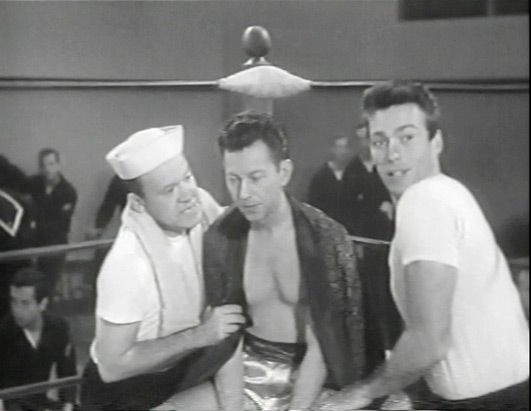
In 1955’s Francis In The Navy, Donald O’Connor plays Lt. Peter Sterling, an officer in the U.S. Army who gets word that his best friend, a talking mule named Francis (voice of Chill Wills), is about to be auctioned off by the U.S. Navy.  Sterling rushes to the Naval base but, along the way, his wallet gets stolen, he gets mistaken for an AWOL soldier, and Francis gets sold to a laboratory.

Hold on, I’m re-reading that last paragraph to make sure that I didn’t hallucinating typing all that…

Peter argues that he’s not the AWOL soldier, he’s just someone who looks just like him.  Peter gets tossed into the psychiatric ward.  Francis advices Peter …. yes, the mule that can talk gives Peter advice on how to get out of the mental ward …. to pretend to be the AWOL sailor.  Unfortunately, the sailor is a champion boxer so that means Peter will have to enter the ring.  Peter, needless to say, is not a boxer.  Peter also falls for a nurse (Martha Hyer) but — uh oh! — she’s the sister of the AWOL soldier.  Well, that’s kind of awkward.  I don’t have a brother but if I did, I doubt I would ever want to make out with anyone who looked like him.  Like seriously….

Hold on, I’m re-reading that last paragraph to see if there’s anything that I need to add.

Like, seriously, what the Hell?  This movie has a talking mule, an oddly incestuous subtext, and Donald O’Connor playing two roles.  Doing some research, I discovered that this was the sixth film to deal with the adventures of Peter Sterling and Francis.  This was the last one of them to star Donald O’Connor, who apparently resented getting upstaged by a mule.  There was one more Francis movie after this one and it starred Mickey Rooney.  It was called Francis In The Haunted House so who knows?  Maybe I’ll review it for our October horrorthon.  (Don’t count on it.)

As weird as this film is, it’s kind of likable.  Donald O’Connor is a favorite of mine and this one featured O’Connor in two roles, as both the hapless Peter and also the sailor who goes AWOL and repeatedly refuses to help Peter out.  And, while I’m not really sure why he’s talking, Francis was actually cute.  I enjoyed the boxing scene where he attempted to help Peter out.  Unfortunately, there’s only so much a mule can do.

As for why I’m reviewing this movie, it’s because Clint Eastwood is in the cast.  He plays Jonesy, a friend of the AWOL sailor who becomes a friend of Peter’s.  Now, to be clear, Clint doesn’t do a lot in the movie.  He works Peter’s corner during the boxing match.  Otherwise, he spends most of the time in the background and he has a few scenes where he hangs out with the rest of the AWOL sailor’s friends.  That said, Clint does make an impression.  Even in this very early role, he had an impressive screen presence.  He’s the tallest guy there and he’s got the best hair.  Once you spot him in a scene, it’s hard to look away.

Francis In The Navy is historically significant because it’s the first film for which Clint Eastwood received on-screen credit.  (Eastwood previously appeared in films like Revenge of the Creature and Tarantula but his name wasn’t included in the credits.)  It’s an odd film, one that’s likable if you’re in an undemanding mood and you enjoy goof — extremely goofy — humor.  It would be forgotten if not for Eastwood’s appearance.  Seen today, this film, like Eastwood’s other early appearances, reminds us that everyone started somewhere.
Spider-Man: The Dragon’s Challenge (1979, directed by Ron Satlof)


This, the final of the three Spider-Man “feature films” that were basically edited episodes of the Spider-Man TV series, finds Peter Parker (Nicholas Hammond) in Hong Kong.  Spider-Man having adventures in Hong Kong sounds like it should be fun and the 2nd half of this “movie” was filmed on location but, even with all those elements (and a young Ted Danson in a small role), Spider-Man: The Dragon’s Challenge is just dull.

Min (Benson Fong) is a rich Chinese businessman who stands to be appointed to a position in the Chinese government but only if he can prove that he didn’t sell secrets to the U.S. during World War II.  Min needs to find three Marines who can clear his name.  Because Min is an old friend, J. Jonah Jameson (Robert F. Simon) assigns photographer Peter Parker to help Min track the men down.  Why would Jameson give that responsibility to Pater Parker?  I don’t know.

Min’s granddaughter, Emily (Rosalind Chao), thinks that Peter is a coward because he always disappears whenever Min is attacked.  It’s a good thing that Spider-Man always mysteriously shows up whenever Peter isn’t around because otherwise, Min would be in a lot of trouble.  It turns out that a steel baron named Mr. Zeider (Richard Erdman) wants to stop Min from clearing his name because Min would stop Zeider from getting a big construction contract.

Eventually, Peter, Min, Emily, and a former marine who can clear Min all end up in Hong Kong, where Spider-Man gets to fight kung fu masters and hopefully save the day.

Spider-Man: The Dragon’s Challenge has all the elements to be an enjoyably cheesy 70s adventure film but it fails because it’s not really a movie.  It’s just two episodes of a TV show that have been edited together and, with the exception of a few of the fight scenes in Hong Kong, there’s nothing cinematic about it.  As opposed to the previous two Spider-Man “films,” Nicholas Hammond just seems bored in this outing and the scenes with Rosalind Chao scolding Peter for being a coward are too much like Lois Lane complaining about Clark Kent never being in the same place as Superman.

Spider-Man: The Dragon’s Challenge also misses the opportunity to bring in any members of Spider-Man’s gallery of wonderful villains.  How hard would it have been to replace Mr. Zeider with Wilson Fisk?  The Silver Samurai could have at least made an appearance.  Instead, Spider-Man’s just fighting another corporate villain.  It’s a wasted opportunity.

The two episodes that make up this film were also the final two episodes of the Spider-Man TV show.  Despite the fact that CBS was constantly moving the show around on the schedule and that the second season only featured 7 episodes, the series still got good ratings.  However, CBS apparently feared that, by airing not only Spider-Man but also The Incredible Hulk and Wonder Woman, it would run the risk of becoming known as a “comic book” network.  Since the Hulk and Wonder Woman both got good ratings and, unlike Spider-Man, had the support of the critics, they were allowed to remain while Spider-Man was given the boot and canceled in 1979.  That’s a strong contrast to today, when most exec would probably sell their first born to get a chance at some of the Marvel action.

After this, it would be another 23 years before Spider-Man again appeared on a movie screen, this time in the form of Tobey Maguire.  While Nicholas Hammond would never again play Spider-Man, one fan of his time on the show was director Quentin Tarantino, who later cast Hammond as director Sam Wanamaker in Once Upon A Time In Hollywood.