Phantom Ranger (1938, directed by Sam Newfield)


Treasury agent Pat Doyle (John St. Polis) is sent to investigate a counterfeiting ring in Wyoming but ends up getting kidnapped by gang leader Sharpe (Karl Hackett) instead.  With Doyle’s daughter, Joan (Suzanne Kaaren), demanding that the government rescue her father and generating all sorts of bad publicity for the Secret Service, the decision is made to send in Tim Hayes (Tim McCoy).  Hayes, who will be working undercover, is selected because he’s not a “city boy.”  He’s a cowboy, through and through.  If you want to tame the west, you have to send a cowboy.

Phantom Ranger is a low-budget, 56-minute western from Monogram Pictures.  The plot is nothing special but the film itself still interesting because it’s a western that takes place in the 1930s.  Tim Hayes may ride a horse and wear a cowboy hat but he also works in a Washington D.C. office building and he interacts with a woman dressed like a flapper.  In this movie, the frontier has not caught up with the modern world but the modern world has also forgotten what life is like away from civilization.

The movie has the usual collection of B-western stalwarts.  Karl Hackett, John Merton, Charles King, Frank Ellis, Herman Hack, and Horace B. Carpenter are all present and accounted for.  Tim McCoy, a former rodeo performer and army officer, plays the hero and brings a lot of natural authority to the role.  McCoy was not only one of the first western heroes but he was also one of the best.

There’s no phantoms to be found in Phantom Ranger.  It’s still a good western.
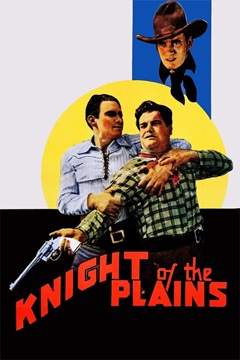
Knight of the Plains (1938, directed by Sam Newfield)


Clem Peterson (Richard Cramer) has a plot to force all of the ranchers in the valley to give up their land.  He gives a phony land claim to Carson (John Merton), who presents himself as being a Mexican nobleman.  In a situation like this, you need a singing cowboy and luckily, there’s one nearby.  Fred (Fred Scott) and Fuzzy (Al St. John) get involved after their cattle are stolen by Clem and his men.  Fred not only fights to save the ranchers but he also sings a song or two.

Singing cowboy films are always strange.  Cowboys who ride horses and pull guns and get into fistfights should not also be tenors.  Fred Scott looks convincing on a horse and he has one heck of a fistfight towards the end of the movie but he’ll also start singing at the drop of a hat and it just doesn’t feel right.  John Wayne did a few singing cowboy films early in his career and he could usually pull it off.  Fred Scott wasn’t much of an actor and had a forgettable screen presence.  He had a good voice, though.

This film was produced by Stan Laurel, of Laurel and Hardy fame.  Always read those credits.  You never know who you might find.

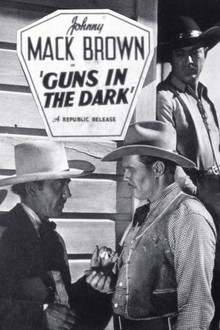
Guns In The Dark (1937, directed by Sam Newfield)


In Mexico, two American cowboys, Johnny Darrel (Johnny Mack Brown) and Dick Martin (Julian Madison) join a poker game to try to win some money and help out their buddy, Oscar (Sid Saylor).  When they discover that cantina owner Manuel Mendez (Ted Adams) has rigged the game, a fight breaks out.  The lights turn off.  In the darkness, several guns are fired.  When the lights come back up, Dick is dead.  Mendez convinces Johnny that he accidentally shot his friend in the fight.  Guilt-stricken, Johnny tosses aside his guns and returns to Texas.

Johnny has sworn that he will never shoot another gun but when he’s hired to work at a ranch owned by Joan Williams (Claire Rochelle), he finds himself in the middle of a range war between Joan and Brace Stevens (Dick Curtis), with Mendez also making an unwelcome return to Johnny’s life.  Even after Johnny discovers the truth about what happened that night at the cantina, he doesn’t pick up a gun.  Instead, Johnny fights the bad guys with lassos and plates.

Guns In The Dark is only 54 minutes long and it features actors who will be familiar to any fan of the old B-westerns.  Sidekcick Sid Saylor’s stuttering schtick gets old quickly but Johnny Mack Brown is as likable as always in Guns In The Dark and he comes across as being an authentic cowboy even when he’s not carrying a gun  Given that this film features even more horse chases than the typical Johnny Mack Brown b-western, it’s good that Brown is so convincing.  What isn’t convincing is how stupid Johnny Darrel is required to be in order for him to fall for Mendez’s lie in the first place.  I appreciated the change of pace from Brown just using a gun to stop the bad guys but I wish the reason behind it had been more convincing.  This isn’t one of Johnny Mack Brown’s more memorable westerns though, as always, it’s easy to see why he was one of the early stars of the genre.


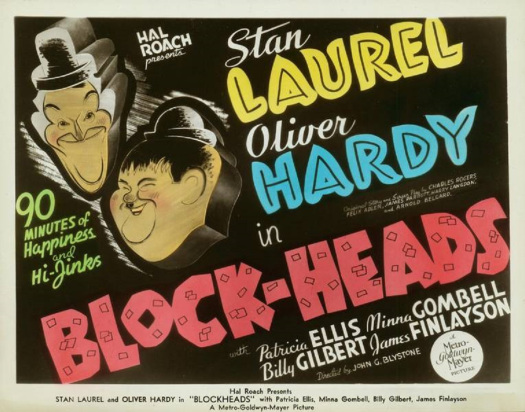
Double Your Fun: Laurel & Hardy in BLOCKHEADS (MGM 1938) and SAPS AT SEA (United Artists 1940)


gary loggins's avatarcracked rear viewer

Hal Roach first teamed Stan Laurel with Oliver Hardy in 1927, beginning a long and prosperous screen comedy collaboration. The pair became the movie’s most beloved, and funniest, screen team, a point  that’s hard to argue against after a recent rewatching of BLOCKHEADS and SAPS AT SEA, two films that each clock in at less than an hour, but pack more laughs than many longer, larger budgeted films of the era – or any era, for that matter!

In BLOCKHEADS, L&H are soldiers during WWI, and Stan is ordered to stand guard in the trench until the troop returns from battle. Twenty years later, he’s still there! Found by a pilot he shoots down, Stan is taken to an Old Soldiers’ Home, when Ollie (once again a henpecked husband) spots his picture in the newspaper. Ollie rushes to see his old pal, and finds him sitting in a wheelchair with…

View original post 780 more words