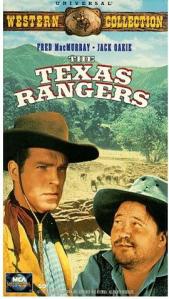
Sam (Lloyd Nolan), Jim (Fred MacMurray), and Wahoo (Jack Oakie) are three outlaws in the old west. Wahoo works as a stagecoach driver and always lets Sam and Jim know which coaches will be worth holding up. It’s a pretty good scam until the authorities get wise to their scheme and set out after the three of them. Sam abandons his two partners while Jim and Wahoo eventually end up in Texas. At first, Jim and Wahoo are planning to keep on robbing stagecoaches but then they realize that they can make even more money as Texas Rangers.
At first, Jim and Wahoo are just planning on sticking around long enough to make some cash and then split. However, both of them discover that they prefer to be on the right side of the law. After they save a boy named David from Indians, Jim and Wahoo decide to stay in Texas and protect its settlers.
The only problem is that their old friend Sam has returned and his still on the wrong side of the law.
Made to commemorate the Texas centenary (though it was filmed in New Mexico), The Texas Rangers is a good example of what’s known as an oater, a low-budget but entertaining portrayal of life on the frontier. King Vidor does a good job with the action scenes and Fred MacMuarry and Jack Oakie are a likable onscreen team. The best performance comes from Lloyd Nolan, as the ruthless and calculating Sam. Sam can be funny and even likable but when he’s bad, he’s really bad.
Jack Oakie was better known as a comedian and The Texas Rangers provides him with a rare dramatic role. Four years after appearing in The Texas Rangers, Oakie would appear in his most famous role, playing a parody of Benito Mussolini in Charlie Chaplin’s The Great Dictator.
The 35th film in Mill Creek’s Fabulous Forties box set was — wait a minute? I’m on my 35th Fabulous Forties review? Let’s see — there’s 50 films in the box set so that means that I only have 15 more of these to write and I’ll be done! And then I can move onto the Nifty Fifties, the Sensation Sixties, the Swinging Seventies, and the Excellent Eighties! YAY!
Anyway, where was I?
Oh yeah, the 35th film.
First released in 1941, That Uncertain Feeling is a movie about sophisticated people doing silly things. Socialite Jill Baker (Merle Oberon) gets the hiccups whenever she gets nervous or irritated. Her trendy friends suggest that she try the new big thing: seeing a psychoanalyst! At first, Jill is reluctant but eventually, she gives in to the pressures of high society and she goes to visit Dr. Vengard (Alan Mowbray). Dr. Vengard tells her that her hiccups are a result of her marriage to Larry (Melvyn Douglas) and suggests that the best way to cure them would be to get a divorce.
At first, Jill is horrified at the suggestion. Whatever will people think if she gets a divorce!? However, Larry is kind of a condescending jerk. (Or, at least, he comes across as being a jerk when viewed by 2016 standards. By 1941 standards, I imagine he’s supposed to be quite reasonable.) And Jill happens to meet another one of Vengard’s patients, an outspoken pianist named Alexander Sebastian (Burgess Meredith).
Soon, Jill is not only contemplating getting a divorce from Larry but perhaps marrying the eccentric Sebastian as well! When Larry realizes that Jill is dissatisfied with their marriage and that she is attracted to Sebastian, he gives her a divorce. He even pretends to be an abusive husband so that she can file for divorce on grounds of cruelty. (It’s funnier than it sounds.) Jill and Sebastian get engaged but, once Larry starts to date again, Jill realizes that she’s not quite over her ex…
I was really excited when I saw that The Uncertain Feeling was an Ernst Lubitsch film. Lubitsch directed some of my favorite Golden Age comedies, films like Ninotchka and Heaven Can Wait. But That Uncertain Feeling is not quite up to the standard of the other Lubitsch films that I’ve seen. As played by Burgess Meredith, Sebastian never comes across as being a realistic rival to Larry. The character is so cartoonishly eccentric that it becomes impossible to see what Jill sees in him. At the same time, Larry comes across as being such a chauvinist that it’s far easier to understand why Jill would divorce him than why she would ever want to take him back. The end result is a rare Lubitsch misfire.
However, as long as we’re talking about Lubitsch, make sure to see The Smiling Lieutenant if you get the chance. Now, that’s a good Lubitsch film…
(For those following at home, Lisa is attempting to clean out her DVR by watching and reviewing 38 films by the end of today!!!!! Will she make it? Keep following the site to find out!)
Oh my God, I love this movie!
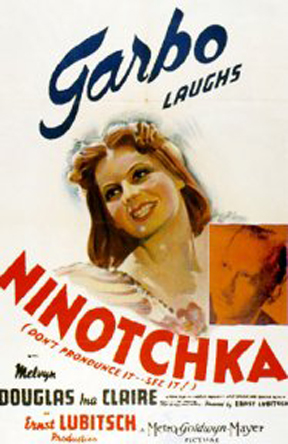
First released in 1939, Ninotchka is many things. It’s a love story. It’s a comedy. It’s a story of international intrigue. It’s a political satire. It’s a celebration of freedom. And, perhaps most importantly, it’s a showcase for one of the greatest actresses of all time, the one and only Greta Garbo!
But you know what? As great as Garbo is, she’s not the only worthy performer in this film. Melvyn Douglas plays Garbo’s love interest and his performance is full of charm and class. And guess who plays the main villain? BELA LUGOSI! That’s right — this was one of Lugosi’s few roles that did not require him to play a variation on his famous Dracula. And, even if he doesn’t have a lot of scenes, Lugosi does a pretty good job in Ninotchka. It’s interesting to see Lugosi playing an all-too real monster for once.
Ninotchka opens in Paris. Three Russians are in town and they’re trying to sell some jewelry that was confiscated by the government during the revolution of 1917. That’s right — they’re communists! When they first show up in Paris, they make a big deal about hating the decadence of capitalism. But then they meet Count Leon d’Algout (Melvyn Douglas), who proceeds to introduce them to the wonders of the free market. Soon, the three of them are holed up in their luxurious hotel, ordering room service and having a nonstop party.
(Leon, incidentally, is working for the original owner of the jewelry. The jewelry, as you’ve probably guessed, is what Hitchock would have called a macguffin.)
Once it becomes obvious that the first three Russians have been corrupted by western society, Ninotchka (Greta Garbo) is sent to bring them back to Moscow. Ninotchka is a “special envoy” and, from the minute that she meets Leon, it’s obvious that she’s going to be a lot more difficult to corrupt. For all of Leon’s charm, he cannot get Ninotchka to smile or drop her “all Marxist business” attitude.
Of course. from the minute that she first appears, we all know that Ninotchka is eventually going to loosen up and come to love both the west and Melvyn Douglas. But what makes Garbo’s performance truly special is that we like and sympathize with Ninotchka even before she embraces decadence. Even when Ninotchka is reciting Marxist-Leninist dogma, there’s a playfulness to the way Garbo delivers the lines.
That’s one reason why it’s so much fun to watch as Ninotchka (and Garbo) starts to actually relax and enjoy both Paris and life. Wisely, the film doesn’t suggest that Paris has changed Ninotchka. Instead, it merely shows that being in Paris and getting to know Leon has finally allowed her to act like the person that she was all along.
(Before her appearance in Ninotchka, Garbo was known for playing very dramatic roles. Not only is this film about Ninotchka learning to enjoy herself. It’s also about Garbo proving that she could play comedy just as well as she could play melodrama.)
Of course, eventually, Ninotchka and the three Russians are forced to return to Moscow and director Ernst Lubitsch does a wonderful job contrasting the glamour of freedom-loving Paris with the drabness of life under communism. Just when it looks like Ninotchka is going to be forced to spend the rest of her life in her depressing apartment and missing the luxury of being able to wear silk stockings, her boss (Lugosi) tells her that she is being assigned somewhere else. Ninotchka doesn’t want the assignment but, as Lugosi explains, the revolution doesn’t care what the individual wants.
Will Ninotchka and her friends ever find their way back to freedom and Leon? Or will she remain trapped in the bureaucracy? You’ll have to watch the film to find out!
I really liked Ninotchka. Even 77 years after it was first released, it remains a wonderfully romantic and sweet-natured little comedy. If you haven’t seen it, you definitely should!
Ninotchka was one of the many great films to be nominated for best picture of 1939. However, the Oscar went to another famously romantic film, Gone With The Wind.
 Sam (Lloyd Nolan), Jim (Fred MacMurray), and Wahoo (Jack Oakie) are three outlaws in the old west. Wahoo works as a stagecoach driver and always lets Sam and Jim know which coaches will be worth holding up. It’s a pretty good scam until the authorities get wise to their scheme and set out after the three of them. Sam abandons his two partners while Jim and Wahoo eventually end up in Texas. At first, Jim and Wahoo are planning to keep on robbing stagecoaches but then they realize that they can make even more money as Texas Rangers.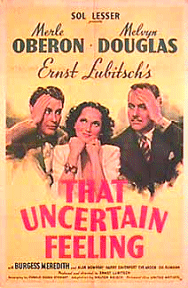
 Through the Shattered Lens