Every year, I set a few goals for myself. In 2012, for instance, my goal was to stop worrying so much about achieving unrealistic goals. For 2013, my goal is to post a film review a day, alternating between reviews of films that have been nominated for Academy Awards and films that most assuredly were not.
With that in mind, I’d like to get things started by taking a look at Les Miserables. Now, I’m not talking about the Tom Hooper-directed musical extravaganza that’s currently playing at a theater near you. Instead, I’m talking about the Les Miserables that was directed by Richard Boleslawski and which was nominated for best picture of 1935. (It lost to another literary adaptation that featured Charles Laughton as a classic villain, Mutiny On The Bounty.) As opposed to Hooper’s film, this version of Les Miserables is not based on a Broadway musical. Instead, it’s a condensed version of Victor Hugo’s original novel.
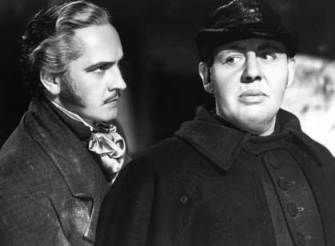
As opposed to the novel, Les Miserables takes a straight-forward chronological approach to telling the story of Jean Valjean. We start with Valjean (played here by Fredric March) being sentenced to prison and then follow him through his experiences in prison. We watch as the embittered Valjean first meets the kindly bishop (played here by Cedric Hardwicke) who turns his life around. Valjean becomes both a mayor and the protector of the young Cosette, who eventually ends up falling in love with the young revolutionary Marius. Thoughout all of this, Valjean is pursued by the obsessive Inspector Javert (Charles Laughton).
As a film, Les Miserables is more faithful to the spirit of Hugo’s original novel than to the exact details. For instance, in this film, Javert first encounters Valjean while the latter is in prison. While this is clearly different from the novel, it works perfectly from a cinematic point of view. As well, the film jettisons many of the book’s longer digressions and instead, it focuses on the characters of Valjean and Javert. As such, characters like Cosette and Marius are only important (and considered) in how they relate to the two main characters. Fortunately, Valjean and Javert are played by two of the best actors to ever appear on screen.
While Charles Laughton, in the role of Javert, gets to the give the showier performance, the film is rightfully dominated by Fredric March’s quietly determined performance as Jean Valjean. Valjean is a truly complex character who, over the course of the film, goes from being bitter and angry to kindly and strong and March perfectly captures each side of Valjean’s personality. As an actor, Fredric March is not as well-remembered as some of his contemporaries (like Charles Laughton, for instance). However, in this film, Fredric March proves himself to be the perfect Jean Valjean. He is the Jean Valjean that all other Valjeans must be judged against.
While director Richard Boleslaswki is hardly a household name (I have to admit that I had never heard of him before I saw this film), his work on Les Miserables is impressive. Interestingly, he directs the film almost as if it was a combination of a Warner Bros. gangster film and a Universal monster film. (It’s easy to imagine some alternative universe where his version of Les Miserables starred Edward G. Robinson as Valjean and Boris Karloff as Javert.) He’s at his strongest is the dream-like sequence where Valjean carries the wounded Marius through the sewers of Paris.
While Les Miserables may not be a perfect film, it is the perfect introduction to Hugo’s novel. Incidentally, the most faithful cinematic adaptation of Les Miserables actually came out a year before the Boleslawski version. It was a French film that had a running time of five hours. It occasionally turns up on TCM and, like the 1935 version, it’s well-worth watching.


 Through the Shattered Lens