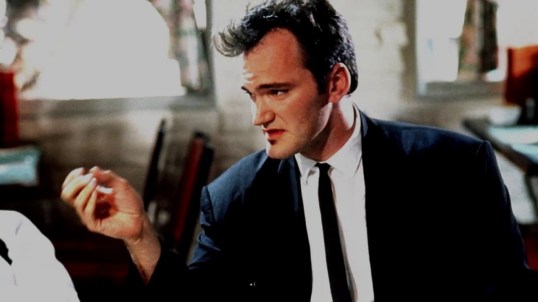
Ranking The Films of Quentin Tarantino


Since Today is Quentin Tarantino’s 57th birthday, I figured this would be a good time to rank the ten films that he’s directed so far!

Please note that I have not included things like Natural Born Killers, True Romance, Four Rooms, Sin City, or those episodes of CSI and ER on the list below.  These are just the feature films that Tarantino has directed.

So, without further ado, for worst to best, here are the ten film of Quentin Tarantino:
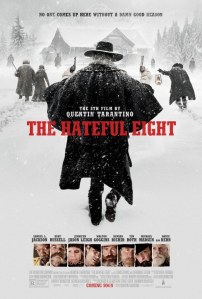
10) The Hateful Eight (2015)

The Hateful Eight is one of those films that people either seem to love or hate.  I personally think that it’s the one Tarantino film in which QT truly stepped over the line and became a parody of himself.  From the punishing run time to the lengthy “chapters” that went nowhere to the overwritten dialogue that read more like someone trying to write like Tarantino than Tarantino himself, The Hateful Eight is my least favorite of his films.  For me, the final straw was when — after already having forced audiences to endure two and half hours of this film — Tarantino stopped the action completely for a totally unnecessary flashback that apparently only existed so Tarantino could work in a Zoe Bell cameo.
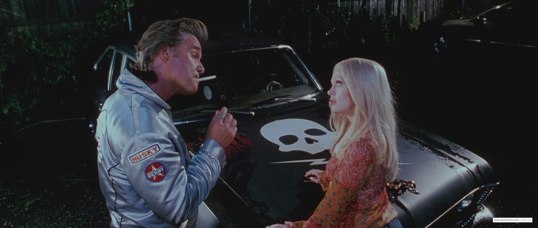
9) Death Proof (2007)

Oh, Death Proof.  I really liked Death Proof the first time that I saw it but whenever I’ve tried to rewatch it, it’s been a struggle to get through it.  Yes, Kurt Russell is great as Stuntman Mike and, unlike her previously mentioned cameo in The Hateful Eight, Zoe Bell is a welcome addition to Death Proof‘s ensemble.  But oh my God, why doesn’t the film just start in Tennessee?  Why do we have to suffer through all of that crap in Austin?
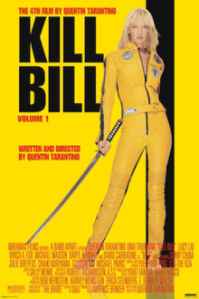
8) Kill Bill: Volume One (2003)

Now, it may seem like I’m ranking the first volume of Kill Bill fairly low on the list but you have to understand that, as far as I’m concerned, Tarantino has only made two bad films.  Kill Bill: Volume One is an exciting thriller and it not only features Uma Thurman at her best but it also has some of the best and most energetic fight scenes of all time.  If Kill Bill: Volume One seems ranked low, it’s just because it has some truly tough competition to deal with.
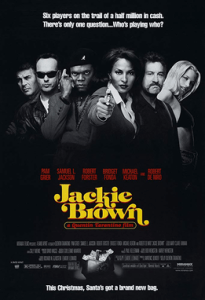
 

7) Jackie Brown (1997)

The first time I saw Jackie Brown, I thought it was a bit too slow and I guess I didn’t really “get” it.  As I’ve gotten older, I’ve come to better appreciate this surprisingly low-key and rather sad film.  Jackie Brown features Tarantino in the type of contemplative mood that he wouldn’t really return to until making Once Upon A Time In Hollywood.
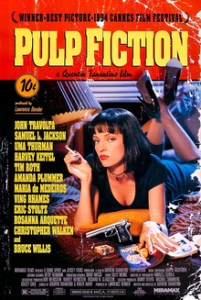
6) Pulp Fiction (1994)

One of the most influential films ever made, Pulp Fiction was not only the first of Tarantino’s first film to be nominated for an Oscar but it was also his first film to truly establish that his filmography takes place in its own separate, pop culture-centered universe.  If there’s anything that’s keeping Pulp Fiction from being listed higher, it’s the painfully self-indulgent taxi cab conversation between Bruce Willis and Angela Jones and Quentin Tarantino’s own terrible cameo as Jimmy, the casually racist homeowner.  That said, this is still one of the most — if not the most — essential film for the 90s.  If you want to understand that decade, you have to watch Pulp Fiction.
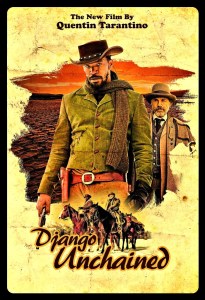
5) Django Unchained (2012)

Despite the fact that it features one of Leonardo Di Caprio’s worst performances (I know I’m the only one who thinks that), Django Unchained is still Tarantino at his most provocative and angry.  After decades of Hollywood films that attempts to explain away the history and legacy of slavery or that suggested that racism could easily be overcome, Tarantino and Django stepped up to say, “Fuck that.”  While the film received a lot of attention for its violence, I think it revealed that Tarantino is an artist with a conscience.  When Christoph Waltz speaks against the evils of slavery, it’s obvious that he’s speaking for Tarantino as well.  In much the same fashion of 12 Years A Slave (which would come out a year later), Django Unchained doesn’t flinch away from showing the horrors of slavery.
4) Inglourious Basterds (2009)

With Inglourious Basterds, Tarantino showed how art could be used to fix history’s mistakes.  In reality, many of the leaders of Nazi Germany escaped justice by committing suicide.  In Inglourious Basterds, they get blown away by a group of Jewish soldiers.  The film itself features some of Tarantino’s best set pieces and one of his best casts.  Despite the film’s length, this is also one of the few Tarantino films where there’s not a single scene that you can look at and say, “Well, that could have been cut.”  For once, every minute of the run time is needed to tell the film’s story.  Christoph Waltz became the first actor to win an Oscar for appearing in a Tarantino film.

3) Kill Bill: Volume Two (2004)

The Kill Bill saga concludes in grand fashion in Kill Bill: Volume Two.  For all of the fights and the violence, this film is more about accepting the consequences of your actions.  Uma Thurman and David Carradine give great performances but the heart of the film belongs to poor Michael Madsen, sitting in his trailer and waiting for justice to come and get him.  The scene where Thurman digs herself out of her grave is a justifiable classic and the final confrontation between Carradine and Thurman is Tarantino at his best.
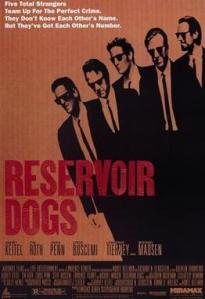
2) Reservoir Dogs (1992)

Tarantino’s debut film is still one of the most exciting and, in it’s way, funniest crime films ever made.  Every line is quotable.  Every performance is perfect.  Every song on the soundtrack is perfectly selected.  Who can forget Harvey Keitel’s incoherent scream of pain as he realizes that he’s been betrayed?  Personally, I just hope Mr. Pink escaped with the diamonds.


1) Once Upon A Time In Hollywood (2019)

Tarantino’s latest film is also his best, a love letter to the movies and the actors whose legacies live on in his own films.  For all the criticism that the film took for Margot Robbie’s lack of dialogue, her performance as Sharon Tate is the perfect epitome of everyone’s fantasy of what Hollywood was like in the years before the Manson murders made everyone lock their doors.  Leonardo Di Caprio and Brad Pitt are perfectly cast as Rick and Cliff and the film’s finale may be bloody but, at the same time, it corrected history in much the same way that Inglorious Basterds did.  By the end of the film, Rick Dalton knows that he’ll probably never be as big of a star as he could have been but at least he’s made some new friends.  He’s been accepted, in much the same way that a somewhat dorky former Hollywood video store clerk was eventually accepted by a film industry that, at first, wasn’t sure what to make of him.

Happy birthday, Quentin Tarantino!
Sundance Film Review: Reservoir Dogs (dir by Quentin Tarantino)


The Sundance Film Festival is currently taking place in Utah so, for this week, I’m reviewing films that either premiered, won awards at, or otherwise made a splash at Sundance!  Today, I take a look at 1992’s Reservoir Dogs, which premiered at that year’s Sundance Film Festival.

Technically, I guess I’m obligated to start this review with a spoiler alert.  Though, seriously, is there anyone out there who hasn’t seen Reservoir Dogs?  I guess that there may be.  But surely, even if you haven’t seen it, you know everything that happens in the movie.  You know about the Like A Virgin conversation at the start of the movie.  You know about the ear scene.  You’ve seen countless parodies of that scene where the cast walks down the street in slow motion.  I find it hard to believe that there are people who don’t know everything about this film but still, I guess it’s always a possibility.

Reservoir Dogs is a challenging film to review, though not because it’s overly complicated or difficult to follow.  Instead, the problem is that it’s hard to know what’s left to say about Reservoir Dogs.  Just about every crime film that has come out in my lifetime has owed an obvious debt to Reservoir Dogs.  It’s the film that launched the directorial career of Quentin Tarantino.  It’s also features one of the greatest acting ensembles in the history of American film: Harvey Keitel, Tim Roth, Michael Madsen, Steve Buscemi, Chris Penn, Kirk Baltz, and Lawrence Tierney.  Tierney’s presence was especially important.  By appearing in the film, the veteran tough guy actor passed on the torch of hard-boiled crime to a new generation.

At its most basic, Reservoir Dogs is a heist film.  It employs the type of jumbled timeline that has become a Tarantino trademark.  The film starts with a group of 8 criminals eating breakfast and preparing to rob a jewelry store.  Then it jumps forward to immediately after the crime, with Mr. Orange (Tim Roth) shot in the gut and Mr. White (Harvey Keitel) desperately trying to get them both to the safety of a warehouse.  That’s where they are joined by Mr. Pink (Steve Buscemi).  Mr. Pink is convinced that they were set up.  He rants about being a professional.  He asks if Mr. White had to shoot anyone during his escape.

“A few cops,” Mr. White says.

“No real people?” Mr. Pink replies.

Eventually, Mr. Blonde (Michael Madsen) shows up.  We already know, from the film’s first scene, that Mr. Blonde strongly feels that everyone should tip their waitress.  After he arrives at the warehouse, we discover that he also likes good music and torturing hostages.  Meanwhile, the robbery’s mastermind, Joe Cabot (Lawrence Tierney) and his son, Eddie (Chris Penn), are also on their way to the warehouse.  Neither one is happy about how things are going.

And while all this goes on, Mr. Orange continues to bleed in the background…

Reservoir Dogs is known for being a violent film and, even though the movie is 26 years old, some of the violence can still catch you off-guard and make you flinch.  The scene where Mr. Blonde chops off the cop’s ear is still not easy to watch.  However, the scene that always freaks me out is when Mr. White starts shooting at a police car and the windshield is suddenly smeared with blood.  Mr. White is one of the film’s more sympathetic characters but he doesn’t hesitate to kill.

Of course, I think it could also be argued that Reservoir Dogs is actually as close as Tarantino has come to making a film that condemns violence.  Not counting the flashbacks, the story largely plays out in real time, which means that we basically spend the entire movie watching and listening as Mr. Orange slowly bleeds to death in front of us.

I rewatched Reservoir Dogs for this review and I have to say that I was really surprised to see how well the film holds up.  I was honestly expecting to be a little bit bored with it, just because I’d already seen it multiple times and I knew who the cop would turn out to be.  I already had all of the film’s great lines memorized.  But, as soon as the film started with everyone arguing about Like A Virgin and whether or not to tip their waitress, I was sucked back into Tarantino’s world.  Once again, I found myself laughing at Steve Buscemi’s brilliant delivery of the line: “Why am I Mr. Pink?”  I was enthralled all over again by Tim Roth’s nervous intensity and Harvey Keitel’s weary integrity.  Even Michael Madsen’s psycho routine felt fresh, despite the fact that he’s played numerous cool-as-ice psychos over the course of his career.  Even the way Chris Penn told the story about Lady E still made me laugh.

(To be honest, the line that makes me laugh the most in Reservoir Dogs — and don’t ask me why because I’m not sure of the exact reason — is when the unseen cop who is heard to say, “Yeah, give me the bearclaw,” while following Eddie’s car.)

It’s just a cool movie.  How can you resist this?

What happen at the end of the film?  Well, we all know the basics.  (And here’s where that probably unnecessary spoiler alert comes into play.)  Mr. White kills Joe and Eddie, all to protect Mr. Orange.  Mr. Pink runs from the warehouse.  The seriously wounded Mr. White cradles the dying Orange in his arms.  Orange confesses to being a cop.  Mr. White lets out a wail of both physical and emotional pain.  The police enter the warehouse and order Mr. White to drop his gun.  Mr. White shoots Orange in the head and is then gunned down by the police.

But what happened to Mr. Pink?

That’s a serious question because Mr. Pink is my favorite member of this band of robbers.  (He gets all the best lines, probably because Tarantino was planning on playing the role himself before Steve Buscemi auditioned.)  A lot of people will tell you that they can hear Mr. Pink being arrested outside of the warehouse, shortly before the cops come in and kill Mr. White.  And yes, I realize that, in at least one draft of the script, that’s exactly what happened.

Well, I don’t care.  We don’t actually see Mr. Pink getting arrested.  We don’t hear him getting shot.  As far as I’m concerned, Mr. Pink made it out of there alive and managed to escape with the diamonds.  The police may have yelled at him to stop but, in the end, they were too busy killing Mr. White to keep an eye on him.  Mr. Pink escaped and is currently living on the beach somewhere.  As a result of selling the diamonds, he’s now financially comfortable but he still doesn’t tip his waitress.  That’s just the way Mr. Pink is.

Finally, one little bit of trivia: Reservoir Dogs may have premiered at the 1992 Sundance Film Festival but it didn’t win any awards at the end of it.  Instead, the big winner that year was a comedy called In The Soup.  The star of that film?  Steve Buscemi.

Previous Sundance Film Reviews:

  1. Blood Simple
  2. I Don’t Feel At Home In This World Anymore
  3. Circle of Power
  4. Old Enough
  5. Blue Caprice
  6. The Big Sick
  7. Alpha Dog
  8. Stranger Than Paradise
  9. sex, lies, and videotape