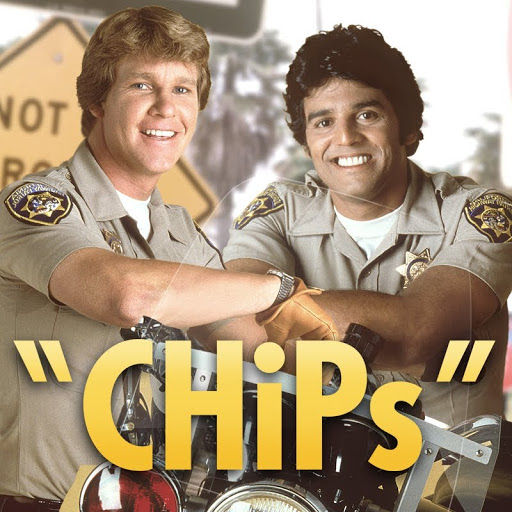
Late Night Retro Television Review: CHiPs 2.21 “CHP BMX”


Welcome to Late Night Retro Television Reviews, a feature where we review some of our favorite and least favorite shows of the past!  On Mondays, I will be reviewing CHiPs, which ran on NBC from 1977 to 1983.  The entire show is currently streaming on Freevee!

This week, Ponch saves us all.

Episode 2.21 “CHP BMX”

(Dir by John Florea, originally aired on March 3rd, 1979)

The California Highway Patrol is sponsoring a BMX racing team!  Sindy and Baker are the coaches while Ponch is …. well, Ponch is mostly just hanging out.  He does find time to flirt with Ms. Ramirez (Mina Vasquez), a teacher who hopes that joining the team could help out an at-risk student named Danny (Kirk Calloway).  Danny likes to vandalize things.  He’s on his way to juvie if Ponch can’t reach him …. hey, you know the drill.  By this point, we all know how this show works.  Of course, Ponch is going to reach the kid.  With that dazzling smile, Ponch can do anything.

It’s Getraer who has the most to deal with during this episode.  After his son is struck by a car, Getraer becomes so distracted on the job that he messes up the arrest of a drug dealer (Henry Olek).  Told by his superiors to take a week off while his son recovers, Getraer instead starts to tail the dealer on his own.  Getraer is determined to put the man in jail.  Fortunately, Ponch is there to help catch him.  Is there nothing that Ponch can’t do?

Seriously, when I watch an episode like this, I can understand why Larry Wilcox apparently did not enjoy working with Erik Estrada on this show.  While Baker humbly does his job without asking for any special recognition, Ponch is portrayed as being so perfect that you half-expect him to start walking on water.  The theme of this episode — and really, the theme of much of the second season — has been that Ponch can ultimately do no wrong.  Even when it looks like Ponch has screwed up, he ultimately turns out to be infallible.  He’s more than just a member of the California Highway Patrol.  He’s St. Ponch of Los Angeles, saving souls while riding his motorcycle amongst the heathens.

It probably sounds like I’m being critical of this episode but I actually enjoyed it, for much the same reason that I enjoy most episodes of CHiPs.  The car and motorcycle stunts were spectacularly filmed and the scenery was nice to look at.  Even though it rains through a good deal of this episode and Getraer, Baker, and Ponch aren’t exactly hanging out in the most glamorous sections of Los Angeles, this episode still manages to make L.A. look like the loveliest city in the world.

And really, even Erik Estrada is entertaining.  It’s easy to laugh at his big smile and his less-than-subtle acting technique but that’s just Estrada being Estrada and, in the world of CHiPs, it works.

The important thing is that everything works out.  Danny wins his race.  Getraer’s son gets out of the hospital.  And maybe Baker will get to do something more than smile at Ponch next week.  We’ll see!

Film Review: Brothers (dir by Arthur Barron)


First released in 1977 and based on the real-life story of prison activist George Jackson, Brothers opens with David Thomas (Bernie Casey) being charged with robbing a gas station.

Thomas explains that, while he was in the car with the people who robbed the station, he personally had nothing to do with the robbery and did not know that it was going to happen.  Thomas’s attorney tells Thomas that the smart thing to do would just be to plead guilty.  That way, Thomas will probably just spend a few months in jail as an accessory and then he’ll be a free man.  Instead, the judge sentences Thomas to a sentence of one year to life in prison.  Essentially, Thomas will be in prison until the State decides to let him out.

Thomas serves his sentence at Mendocino Prison, where he has to deal with threats from both the white prisoners and the guards.  Thomas’s cellmate is Walter Nance (Ron O’Neal), a political activist who tells David that he’s “letting your time do you.”  Nance educates David, teaching him about both chess and radical politics.  Soon, David is publishing an underground newsletter that is discreetly passed around amongst the black prisoners.

Meanwhile, on the outside, David’s younger brother, Josh (Owen Pace), is trying to free David from prison.  Josh approaches a radical professor named Paula Jones (Vonetta McGee) and asks for her help in publicizing David’s case.  Paula is at first skeptical but, after she reads David’s writings, she starts to correspond with him.  Soon, David and Paula have fallen in love.  However, when Walter is murdered by the racist guards and David starts to organize within the prison, both David and Paula find themselves being targeted by the government.

As I said at the start of this review, Brothers is based on a true story.  David Thomas is based on George Jackson, who was sentenced to a year to life for robbery and who, while serving time in Soledad Penitentiary, wrote two books that made him a cause celebre amongst political radicals in the early 70s.  Paula Jones is based on Angela Davis, who was placed on the FBI’s Most Wanted list after a gun registered in her name was used by Jackson’s younger brother during a shoot-out at a courthouse.  (The shoot-out, which is depicted in the film, led to the murder of Judge Harold Haley and the deaths of Jonathan Jackson and two prisoners.)  George Jackson was later shot and killed while attempting to escape San Quentin.  In the film, the fate of David Thomas is just as violent but slightly more poetic.

There’s still a considerable amount of controversy as to whether or not George Jackson was a hardened criminal or an innocent man who was targeted for his activism.  Brothers is firmly on the side of George Jackson and Angela Davis, portraying them both as activists who are fighting back against an unjust system that is determined to hold them down and destroy them if necessary.  Bernie Casey and Vonetta McGree both give good performances as David Thomas and Paula Jones.  Casey, in particular, smolders with an intensity that makes him instantly believable as someone who could organize a rebellion.  Unfortunately, the film itself moves a bit too slowly for its own good and it ends on a false note, suggesting that David’s sacrifice has managed to unify both the white and the black prisoners against the guards.  Considering that, up until that point, the film had been honest about racism in prison, the ending feels like an attempt to provide some hope to an otherwise downbeat story.  Unfortunately, the hope doesn’t feel earned.  Still, Brothers is an interesting historical document, one that deals with issues that are still being fought over to this day.

Cleaning Out The DVR Yet Again #40: Melinda (dir by Hugh A. Robertson)


(Lisa recently discovered that she only had about 8 hours of space left on her DVR!  It turns out that she’s been recording movies from July and she just hasn’t gotten around to watching and reviewing them yet.  So, once again, Lisa is cleaning out her DVR!  She is going to try to watch and review 52 movies by the end of 2017!  Will she make it?  Keep checking the site to find out!)

melinda

I recorded Melinda off of TCM on November 13th.

First released in 1972, Melinda is technically a murder mystery.  Frankie J. Parker (Calvin Lockhart, giving a brilliant performance) is a popular radio DJ in Los Angeles.  When we first see Frankie, he’s driving his expensive sportscar through a poor neighborhood.  It’s a neighborhood that he knows well but, as opposed to those around him, he’s made it out.  He’s handsome, slick, and more than a little arrogant.  When he arrives at a local gym, he looks at himself in a mirror and says, “I shouldn’t say it … but I am a pretty motherfucker.”  Frankie’s a student in a taekwondo class taught by Charles Atkins (Jim Kelly).  Charles gives Frankie a hard time about not giving back to the community.  Frankie blows off his concerns.  To be honest, we really should dislike Frankie but he’s so damn charming.  As played by Calvin Lockhart, Frankie has one of those irresistible smirks, the type of the lights up the screen.

One night, Frankie meets the mysterious Melinda (Vonetta McGee) and spends the night with her.  He thinks that it’s just going to be another one night stand but Melinda tells Frankie that he has the potential to be more than he realizes.  Touched, Frankie goes to work and resolves to be a better person.  Then he returns home and discovers that Melinda has been murdered!

The rest of the film deals with Frankie’s attempts to discover who murdered Melinda.  It turns out that Melinda had underworld connections and mob boss Mitch (Paul Stevens) is desperate to recover something that Melinda had in her possession when she died.  But honestly, the whole murder subplot is a MacGuffin (if you want to get all Hitchcockian about it).  Ultimately, Melinda is a character study of Frankie Parker and how, over the course of solving Melinda’s murder, he learns that there’s more to life than just looking out for himself.

Though Melinda was obviously made to capitalize on the blaxploitation craze of the early 70s, it’s actually far more low-key than most of the better known films in the genre.  (Or, at least it is until the karate-filled finale.)  Perhaps because it was directed by a black man and written by noted black playwright Lonne Elder III, Melinda is far more interested in exploring what makes its characters who they are, as opposed to just putting a gun in their hand and having them shoot up the screen.  Frankie Parker emerges as a fascinating character.

Mention should also be made of the performance of Rosalind Cash, who plays Terry, Frankie’s ex.  Cash gets an absolutely amazing scene where, while attempting to convince a bank employee that she’s Melinda so that she can get into Melinda’s safe deposit box, she tells off a rude teller.  It’s such a good scene and Cash delivers her lines with such fury that you find yourself forgetting that the teller was actually correct in her suspicion that Terry wasn’t actually who she said she was.

Melinda is probably one of the best films that hardly anyone has ever heard of.  Keep an eye out for it.