It’s not Christmas without the story of Ebenezer Scrooge and his visit with three ghosts. There have been numerous film versions of this story. The one below comes to us from 1938 and stars Reginald Owen in the role of Scrooge.
This version is surprisingly good, considering that it was apparently shot in a hurry. (The movie hit theaters just a few weeks after filming stopped.) Originally, Lionel Barrymore was going to play Scrooge but he had to drop out due to ill-health. Reginald Owen stepped in and gave a good performance as the famous miser.
(Barrymore himself would more or less play Scrooge a little less than ten years later in Frank Capra’s It’s A Wonderful Life.)
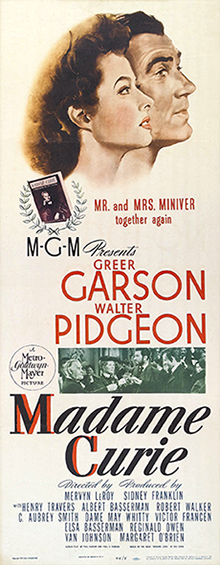
(Lisa is currently in the process of cleaning out her DVR! How long is it going to take her? Probably about as long as it took scientists to discover radiation. Still, she’s not giving up! She recorded the 1943 best picture nominee, Madame Curie, off of TCM on February 16th.)
It would appear that if you wanted to produce a best picture nominee in the early 40s, the easiest way to do it was to cast Walter Pidgeon and Greer Garson as husband and wife.
Consider the evidence: In 1941, Blossoms in The Dust was nominated for best picture. Greer Garson and Walter Pidgeon played wife and husband.
In 1942, Mrs. Miniverwon best picture. Greer Garson and Walter Pidgeon played husband and wife. Interestingly enough, Garson actually starred in another best picture nominee that year, Random Harvest. Random Harvest is a far better picture than Mrs. Miniver and actually featured a better performance from Garson but it did not include Walter Pidgeon. Make of that what you will.
Then, in 1943, Greer Garson and Walter Pidgeon starred in Madame Curie. Again, they played husband and wife and, again, their film was nominated for best picture.
As you can tell from the poster above, Madame Curie was advertised as being “Mr. and Mrs. Miniver together again.” Actually, Garson and Pidgeon are playing characters far different from the stalwart and very British heroes of their previous film. Instead, they are playing the Curies, Marie and Pierre. The film opens with Pierre meeting Marie at a party and it juggles scenes of their romance with scenes of them discovering and playing with radiation. Of course, it’s a struggle at times. Their colleagues are dismissive of their efforts. Both Pierre and Marie tend to get so caught up in their research that they close themselves off from the outside world. Their efforts pay off when they isolate radium and win the 1903 Nobel Prize. Of course, then Pierre gets run over by a horse while out buying his wife a pair of earrings. Can Marie continue to do their research without him?
The unfortunate thing is that the movie pretty much ends with Marie winning her first Nobel Prize, which means that it leaves out some of the most interesting aspects of her life. For instance, during World War I, she developed mobile X-ray units and worked in field hospitals. She was also active in the struggle for Polish independence, even naming the first element that she ever discover polonium after her native country. She spent almost her entire career working with radioactive material, often carrying radioactive isotopes in her pockets. In 1934, Marie died of radiation poisoning. Her research notes and other papers are so highly radioactive that they’re kept in a lead box and I assume that they probably glow whenever the lid is shut. If you want to study Marie Curie’s notes, you have to put on a radiation suit. Unfortunately, none of this is discussed in the resolutely positive movie.
Judging from what I’ve seen on TCM, Greer Garson appears to have been the Meryl Streep of her day, undeniably talented but a bit too obvious in her technique and just a little boring. The same can be said of Madame Curie, which is a very well-made but not extremely memorable movie. It’s like a lot of the films that were nominated for best picture in the 30s and the 40s — a big, prestige picture that never exactly comes to life. The film is probably at its strongest in the beginning, when Walter Pidgeon does a pretty good job of playing Pierre as a brilliant introvert who is almost too shy to talk to Marie. But, as the film progresses, it just becomes another slow-moving MGM biopic.
(For those following at home, Lisa is attempting to clean out her DVR by watching and reviewing 38 films by the end of this Friday. Will she make it? Keep following the site to find out!)
Do you know who Florence Ziegfeld was?
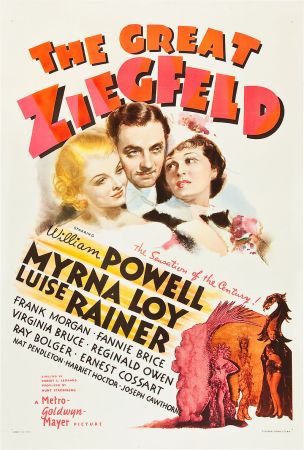
Don’t feel bad if you don’t because, until I saw the 1936 film The Great Ziegfeld, I had no idea and history is my number one obsession. Florence Ziegfeld was a theatrical producer who, in the early days of the 20th Century, produced huge spectacles. He was a showman who understood the importance of celebrity and gossip. He produced a show called The Ziegfeld Follies, which was considered quite risqué at the time but which looks remarkably tame today. Florence Ziegfeld was so famous that he even got his own Oscar-winning biopic.
The Great Ziegfeld features the always smooth William Powell as Ziegfeld. When we first meet him, he’s promoting a strongman and a belly dancer and nobody takes him seriously. But through hard work, good luck, and his own instinct for showmanship, he becomes famous and his shows gets bigger and bigger. The film follows Ziegfeld as he gets married, both times to someone he is grooming to be a star. His first wife is Anna (Luise Rainer), who loves him but divorces him when it becomes obvious that Ziegfeld’s life will always revolve around his work. His second wife is Billie Burke and we know that she is Ziegfeld’s true love because she’s played by Myrna Loy. Whenever you see William Powell and Myrna Loy in the same film, you know that they belong together.
The majority of The Great Ziegfeld is taken up with recreations of Ziegfeld’s stage shows. In fact, the film almost feels more like a musical variety show than a real biopic. (Judging from the credits, quite a few of Ziegfeld’s stars played themselves and recreated their acts on the big screen.) I can understand why this was attractive to audiences in the 1930s. With no end in sight to The Great Depression and Ziegfeld himself recently deceased, this movie was their only opportunity to see one of his spectacles. The film made sure that they got their money’s worth.
However, for modern audiences, all of the acts just add to what is already an oppressive running time. My main impression of The Great Ziegfeld was that it was really, really long. The movie itself is well-produced and William Powell and Myrna Loy are always fun to watch but the movie just goes on and on. As well, this biopic is so worshipful of Ziegfeld — the title is meant to be taken literally — that, as a result, he comes across as being one-dimensional. I did appreciate the film as a historical artifact but otherwise, it didn’t do much for me.
However, it did something for the Academy. The Great Ziegfeld was named the best picture of 1936! Luise Rainer won best actress despite only being on-screen for a handful of scenes. So many people were critical of Rainer’s award that, the very next year, the Academy introduced the award for best supporting actress.
As for why Ziegfeld won that Oscar — well, if you look at its competition and some of the other 1936 films that received nominations, you’re struck by the lack of truly memorable films. It would appear that, in a weak year, the Academy decided to give the award to the biggest production they could find.
And that was The Great Ziegfeld.
(Incidentally, if Flo Ziegfeld were alive today, he would probably be a reality TV producer.)
This morning, as a part of my continuing effort to watch 38 films by Friday and clean out the DVR, I watched Random Harvest, a romantic melodrama from 1942.
And when I say that Random Harvest is a melodrama, I’m not exaggerating. During the first hour of the film, I found myself thinking that if Random Harvest were made today, it would probably be a Lifetime movie. By the time the second hour started, I realized that it would actually probably be one of those heavily hyped miniseries that ends up being broadcast on A&E, Bravo, and Lifetime at the same time. This is one of those big, epic stories where, every few minutes, a new plot twist emerges.
When the film opens during the first World War, John Smith (Ronald Colman) is a patient at a British asylum. He knows that he was once a soldier. He knows that he was gassed during a battle. He knows that he’s recovering from extreme shell shock and it’s still a struggle for him to relate to other human beings. He knows that he will probably spend the rest of his life as a patient at the asylum. He also knows that his name is not John Smith. He’s not sure what his real name is because he suffers from amnesia.
One night, a message comes to the asylum. The war has ended! All of the doctor and orderlies go out to celebrate, leaving Smith unguarded. Smith simply walks out of the asylum and eventually makes his way to a nearby town. It’s there that he meets Paula (Greer Garson), a kind-hearted singer who invites Smith to join her traveling theatrical troupe.
Paula and Smith fall in love, end up getting married, and have a child together. Paula encourages Smith to become a writer and eventually, a publisher in Liverpool asks to meet with him. However, when Smith goes to Liverpool, he ends up getting hit by a car. When he regains consciousness, he suddenly knows that his name is Charles Rainier and that he’s rich! However, he no longer remembers that he was once named John Smith, that he’s married to Paula, or that he has a child.
The years pass. Charles returns to his old life of servants, money, and political ambition. His stepniece, Kitty (Susan Peters), falls in love with him but Charles, for his part, cannot stop wondering about what happened between getting gassed in World War I and getting hit by that car in Liverpool.
Meanwhile, Paula refuses to believe that Smith had abandoned her. Even after she has him legally declared dead, she continue to believe that he’s out there. And then one day, she sees a picture of Charles Rainier. She also learns that Rainier needs an executive secretary, which just happens to be what Paula does when she’s not singing…
Just from reading that plot, you probably think that Random Harvest is an incredibly silly film, that type that, if it were made today, would star Katharine Heigl and maybe a British guy who had a minor role on Game of Thrones. But, dammit, Random Harvest works! Filmmakers in the 30s and 40s knew how to make this type of melodrama totally compelling and believable. There’s not a hint of snarkiness or cynicism to be found in Random Harvest and, as a result, it feels almost churlish to criticize the plot for being implausible. Sincerity saves this film.
Random Harvest was nominated for Best Picture but it lost to another film starring Greer Garson, Mrs. Miniver.However, Garson gave a far better performance in Random Harvest than she did in Miniver. When you watch most of her film today, Greer Garson always comes across as talented but a little boring and obvious in her technique. (She was the Meryl Streep of her day.) In Random Harvest, Garson actually gets to sing and danger and laugh and behave like a human being. After seeing her in Blossoms In The Dust, Mrs. Miniver, and Sunrise at Campobello, watching her performance in Random Harvest is akin to an acting revelation.
Meanwhile, Ronald Colman also does a great work at both Smith and Charles (and they really are two separate characters). Admittedly, Colman does come across as being a little bit too old for the role (and the age difference between him and Susan Peters does add a certain odd subtext to the scenes between Charles and Kitty) but, otherwise, he’s totally and completely credible as the character. When he’s Smith, he speaks in a halting, uncertain tone and he walks like he’s still learning how to put one foot in front of the other. When he becomes Charles, he’s definitely more confident but he still moves like a man who feels as if it’s his duty to carry the weight of the world on his shoulders.
(I have to admit that I’ve always found it strange that Margaret Mitchell apparently wanted Ronald Colman to play Rhett Butler in Gone With The Wind. Watching his performance here, I still could not see Colman as Rhett but he would have made a great Ashley Wilkes.)
The beautiful Susan Peters was nominated for best supporting actress for her performance as Kitty. Random Harvest was her first major role and she gives such a great and likable performance that it makes it all the more tragic that her career was cut short. Just three years after appearing in Random Harvest, Susan was accidentally shot by her husband. Though she survived, she would never walk again. When she died, at the age of 31 in 1952, the official cause was pneumonia but it was also said that she had stopped eating and drinking and had literally lost the will to live. Whether you love Random Harvest or you think it’s just a silly melodrama, you should watch it just to see Susan Peters’s great performance and to consider what could have been.
Mrs. Miniver, which won the Academy Award for Best Picture of 1942, is often treated somewhat dismissively by film historians. The film tells the story of the Minivers, an upper middle class British family whose peaceful lives are changed forever by the start of World War II. When the film initially went into production, the U.S. was still a neutral country. As shooting commenced, the U.S. edged closer and closer to entering the war and, as a result, the script was continually rewritten to make Mrs. Miniver even more pro-British and anti-German than before. The finished film was released four months after the attack on Pearl Harbor, by which point Mrs. Miniver had gone from being domestic drama to being both a celebration of British resilience and the Allied war effort. “If the Minivers can do it,” the film told audiences, “why can’t you?” As a result, Mrs. Miniver is often described as being merely effective propaganda.
Well, Mrs. Miniver may indeed be propaganda but it’s amazingly effective propaganda. I recently DVRed it off of TCM and I have to admit that, as a result of those previously mentioned film historians, I wasn’t expecting much. But I was in tears by the end of the film. Yes, World War II has long since ended. And yes, I could watch the movie and see all of the tricks and the heavy-handed manipulations that were employed to get the desired emotional response from the audience but it didn’t matter. The film is so effective and so well-acted that you’re willing to be manipulated.
(Of course, it helps that there’s not much nuance to World War II. As far as wars go, WWII was as close to a fight between good and evil as you can get. If you can’t celebrate propaganda that was designed to defeat the Nazis, then what can you celebrate?)
As for the film itself, Greer Garson plays Kay Miniver, matriarch of the Miniver Family. Her husband, Clem (Walter Pidgeon) is a successful architect. When we first meet Kay and Clem, the only thing that they have to worry about is the annual village rose show. (Henry Travers — who everyone should love because he played Clarence in It’s A Wonderful Life — plays the eccentric stationmaster who is determined to win with his rose.) However, that all changes when they go to church and the vicar (Henry Wilcoxin) announces that Great Britain has declared war on Germany.
Life changes. Soon, Kay must hold her family together while bombs are falling from the sky. When Clem is away, helping out with the Dunkirk evacuation, Kay comes across a wounded German flyer (Helmut Dantine) in her garden. The flyer demands that Kay give him food and when she does, he snarls that the Third Reich will be victorious. He then passes out from his injuries, allowing Kay to take his gun and call the police. (Reportedly, this scene was rewritten and reshot several times, with the German becoming progressively more hateful with each new version.)
Kay’s son, Vincent (Richard Ney), joins the Royal Air Force. He also falls in love with Carol Beldon (Theresa Wright), the daughter of the aristocratic Lady Beldon (Dame May Whitty). Over the concerns of Lady Beldon, Carol marries Vincent and she becomes the second Mrs. Miniver. They do so, despite knowing that Vincent will probably be killed before the war ends.
Of course, there is tragedy. People who we have come to love are lost, victims of the German onslaught. Throughout it all, the Minivers (and, by extension, the rest of Great Britain) refuse to give into despair or to lose hope. The film ends with them singing a hymn in a church that no longer has a roof and listening as the vicar tells them why they will continue to fight.
And yes, it’s all very manipulative but it’s also very effective. I did cry and the film earned those tears. In many ways, Mrs. Miniver is perhaps most valuable as a time capsule. It’s a film about World War II that was actually made during the war and, as such, it provides a window into the attitudes and culture of the time. But, if the film is valuable as history, it’s also just as valuable as a well-made melodrama.
I’m not sure if I would say that Mrs. Miniver deserved to defeat Kings Row for best picture of 1942. But it’s still an undeniably good film.
— Mildred Rogers (Bette Davis) in Of Human Bondage (1934)
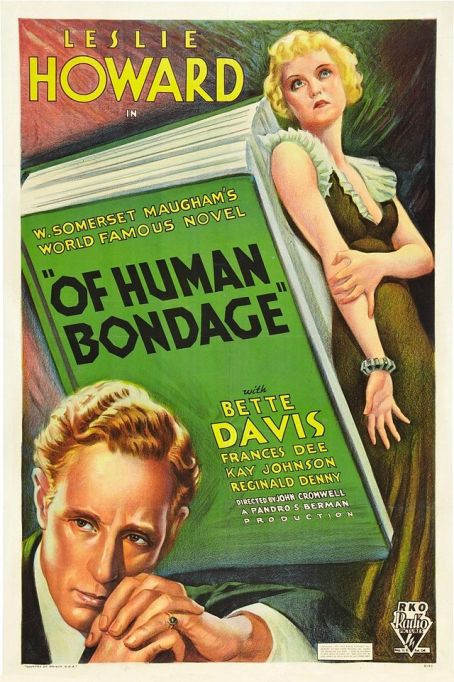
For the next three weeks, I will reviewing, in chronological order, 126 cinematic melodramas. It’s a little something that I like to call Embracing the Melodrama Part II. We started things off yesterday by taking a look at the silent classic Sunrise. Today, we continue with a quick look at the 1934 literary adaptation, Of Human Bondage.
Of Human Bondage opens with Philip Carey (Leslie Howard) living in Paris and struggling to make a living as a painter. The son of a prominent doctor, Philip is self-conscious about both his club foot and his abilities as an artist. When he invited an older artist to take a look at his work, Philip is informed, “There is no talent here. You will be nothing but mediocre.” Philip gives up his artistic ambitions and instead enters medical school.
Philip turns out to be just as miserable and moody as a medical student as he was when he was a painter. (Indeed, Philip may be one of the most miserable characters in cinematic history.) However, he does meet and becomes rather obsessed with a waitress named Mildred (Bette Davis). For her part, Mildred has little use for Philip or any of the other men who are constantly hitting on her. Whenever Philip asks her out, Mildred replies, “I don’t mind.” When Philip asks if he might kiss her goodnight, Mildred coolly replies, “No.”
Philip remains obsessed with Mildred, to the extent that he nearly flunks out of medical school because he can’t stop thinking about her. Mildred, however, eventually leaves Philip for the far more wealthy Emil Miller (Alan Hale). Eventually, Philip meets Norah (Kay Johnson), a romance novelist who falls as deeply in love with Philip as he did with Mildred. However, when the now pregnant Mildred reenters his life, Philip abandons Norah and goes back to her.
And so it goes for the next few years. Philip obsesses over Mildred. Mildred abandons Philip. Philip moves on. Mildred reenters Philip’s life. With each reappearance, Mildred appears to be growing weaker and sicker but she’s never so weak that she can’t yell at Philip and ridicule him for having a club foot…
It’s a little bit strange to admit to enjoying a film like Of Human Bondage because, when you get right down to it, it’s an unpleasant story about an unlikable man being manipulated by a heartless woman. But, interestingly enough, it’s Mildred’s unapologetic anger that make her such a compelling character. If Philip was in any way a sympathetic character, the film would be almost unbearably grim. But since Philip is such a weak-willed character and is so full of self-pity, you can’t help but be happy that Mildred is around to call him out on his bullshit. Everyone else in the film is so awful and boring, that you can’t help but appreciate the fact that Mildred never holds back.
Have you ever wondered why, every Oscar telecast, the Academy makes a point of letting us know that an independent accounting firm counted all of the ballots? Well, it’s because of this film. Or, more specifically, it’s because of Bette Davis’s ferocious performance. In 1935, when Davis somehow failed to be nominated for best actress, there was such outrage and so many people assumed that the nomination process had been rigged that the Academy actually allowed people to write in her name on their ballots. (Davis still lost to Claudette Colbert.) In order to avoid any future controversy, the Academy hired a private accounting firm to count and hold onto the ballots. (And if you’re curious about how that desire to avoid controversy is working out for the Academy, I was one words for you: Selma.) When, the next year, Bette Davis won the Oscar for best actress, it was widely assumed that it was largely to make up for being snubbed for Of Human Bondage.
If you want to see a good Leslie Howard film, go with Berkeley Square. But if you want to see a great Bette Davis film, watch Of Human Bondage.


 Through the Shattered Lens