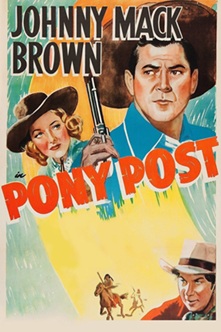
Pony Post (1940, directed by Ray Taylor)


In the days of the Old West, Griff Atkins (Stanley Blystone) manages a Pony Express station but, because of his gambling debts, he actually encourages the Indians and the outlaw Richard brothers (John Rockwell and Ray Teal) to attack the Pony Express riders and steal their horses.  Major Goodwin (Tom Chatterton) tries to put a stop to all this by firing Griff and putting Cal Sheridan (Johnny Mack Brown) in charge.  Griff and the Richard brothers continue their outlaw ways and eventually, the head of one of the relay stations is killed in one of their raids.  While the dead man’s daughter, Norma (Nell O’Day), investigates the murder, Cal works to bring peace the line and falls in love with Goodwin’s daughter, Alice (Dorothy Short).  Meanwhile, aspiring Pony Express rider Shorty (Fuzzy Knight) tries to invent a trampoline system that will help him to mount a horse.

No matter how bad things get in the west, you can always count on Johnny Mack Brown to bring some order and to get it done in less than an hour.  Johnny Mack Brown was always a good hero and that’s the case here.  Eventually this film has all of the horse riding and tough fighting that fans of the genre expect from these westerns but, for a short movie (it only runs for 59 minutes), it still seems to take a while for it to really get going.  The first half of the movie is more about Fuzzy Knight singing songs and trying to become a rider than it is about anything else.  I usually enjoy Fuzzy’s antics but, like the B-western themselves, they are definitely an acquired taste for most viewers.

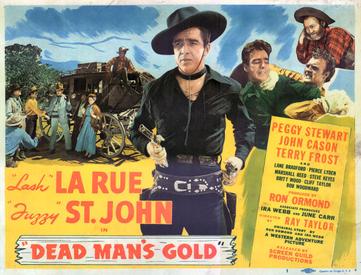
Dead Man’s Gold (1948, directed by Ray Taylor)


Jim Thornton (Britt Wood) has discovered a gold mine so he writes to his old friends, Lash LaRue (Lash La Rue) and Fuzzy (Al St. John), asking them to come help him guard it.  When Lash and Fuzzy arrive, Jim is nowhere to be found.  With the help of Jim’s niece (Peggy Stewart), they discover that Jim’s been murdered.  It doesn’t take a genius to realize that the murder was carried out by Conway (Jason Cason) and his men and that’s a good thing because a genius is something you will never find in a Lash La Rue western.  However, Lash suspects that Conway was following someone else’s orders.  He and Fuzzy set up a trap to reveal the true identity of the mastermind.

Lash dresses in all black and often uses a whip instead of a gun but this is still a standard B-western.  Historically, it’s important because it was the first movie that La Rue made with producer Ron Ormond.  Ormond later went from producing Lash La Rue films to directing them and Lash’s career never really recovered.  (Ormond, whose non-Lash LaRue films included Mesa of Lost Women and If Footmen Tire You, What Will Horses Do?, was never much of a director.)  Fortunately, Dead Man’s Gold was directed by the dependable Ray Taylor, who keeps the action moving and crafts an adequate if not exactly memorable western.

There is one cool scene in Dead Man’s Gold, in which Lash uses his whip to knock a shot glass out of a bad guy’s hand.  Let’s see The Lone Ranger do that!

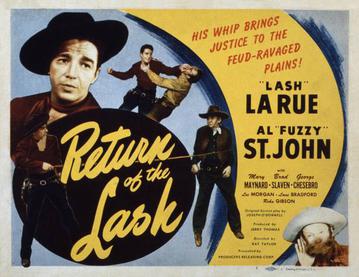
Return of the Lash (1947, directed by Ray Taylor)


There’s another range war brewing on the frontier.  Big Jim Kirby (George Chesebro) knows there’s plans for a new railroad so he wants to steal the land from the ranchers so he can make a fortune off a selling it.  Kirby calls in everyone’s mortgage, knowing they’ll never be able to pay.  Rancher Tom Grant (Buster Slaven) reaches out to Cheyenne Davis (Lash LaRue, a look alike for Humphrey Bogart)) and Fuzzy Q. Jones (Al St. John) for help.  Cheyenne raises the money but then he makes the mistake of trusting Fuzzy to deliver it.  Fuzzy takes a knock to the noggin and now, he’s got amnesia.  Where’s the money?

This is a standard B-western and you know the drill.  Big Jim’s henchmen don’t want that money to get paid.  Cheyenne is on the side of the angels.  Fuzzy provides comic relief.  Lash LaRue appeared in several B-westerns.  He never became as big a star as some of his contemporaries but he did have a gimmick that made him memorable.  Most westerns stars used guns.  LaRue had a bullwhip.  When LaRue was first offered the role of Cheyenne, he lied and said he could crack a whip.  After he struggled to teach himself, tiny production company PRC hired a professional trainer.  That was a huge expense for a poverty row studio but it paid off because LaRue became proficient with the whip and he had a surprisingly long career.  He was born Alfred LaRue.  The studio came up with the Lash nickname.  Many western stars, like Johnny Mack Brown, played characters who shared their name.  Lash almost always played Cheyenne Davis.

Lash LaRue’s movies were cheap and never that memorable.  In this one, Lash barely appears and most of the action is carried out by Al St. John as Fuzzy.  But Lash LaRue did play an important part in Hollywood history when he briefly came out of retirement to teach Harrison Ford how to crack a whip for a little film called Raiders of the Lost Ark.

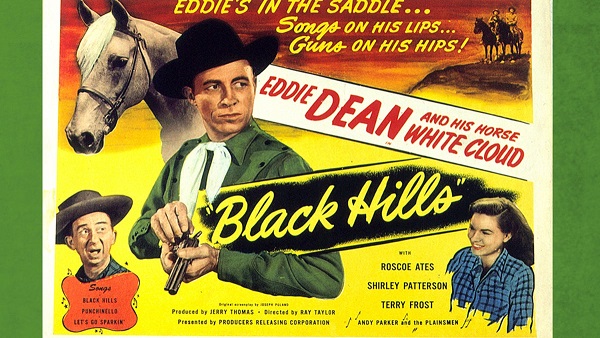
Black Hills (1947, directed by Ray Taylor)


Times are hard and rancher John Hadley (Steve Clark) is running the risk of losing his ranch. When Hadley finds gold on his property, he think that all of his problems have been solved. He makes the mistake of revealing the existence of the gold to his friend, Terry Frost (Dan Kirby). Terry’s not much of a friend because he shoots and kills Hadley and then, working with a corrupt county clerk (William Fawcett), he tries to steal Hadley’s property away from the rancher’s children and rightful heirs.

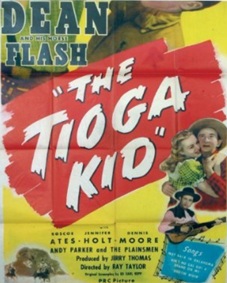
Luckily, singing cowboy Eddie Dean (played by real-life singing cowboy Eddie Dean) rides up and, with the help of his comic relief sidekick (Roscoe Ates), helps to get things sorted out. Even with Terry trying to frame Eddie for a murder he didn’t commit, Eddie still finds time to sing a few songs.

This was Eddie Dean’s final feature film before he moved into television. Black Hills is better than Romance of the West, the Eddie Dean movie that I reviewed yesterday. The plot actually has a few interesting twists and, though it doesn’t appear that he was ever much of an actor, Eddie Dean appears to be more comfortable with his role here than he was in Romance of the West. Black Hills emphasizes that Eddie could throw a punch just as well as he could sing and veteran western actor Dan Kirby is a credible villain. It makes Black Hills into an entertaining if not exactly memorable western diversion.

One final note about Black Hills: Eddie’s horse, White Cloud, gets second billing in the credits.

A Movie A Day #53: Ghost Town Renegades (1947, directed by Ray Taylor)


gtrWhen a federal surveyor disappears while checking out the ghost town of Waterhole, the U.S. Marshall sends Cheyenne Davis (Lash La Rue) and Fuzzy Jones (Al “Fuzzy” St. John) to investigate.  It turns out that gold has been discovered around Waterhole, on land owned by the Trent Family.  Bad guy Vance Sharpe (Jack Ingram) is trying to kill the last remaining Trents — Rodney (Steve Frost) and his daughter, Diane (Jennifer Holt) — so that he can claim the land as his own.  As Cheyenne and Fuzzy investigate, there are plenty of shootouts, fist fights, and an out of control stagecoach.  Since this is a Lash LaRue film, there is also a lot of exciting bullwhip action.

If you’re like me, the name Lash La Rue immediately makes you think of Pulp Fiction and Harvey Keitel asking John Travolta, “What about you, Lash La Rue, can you keep your spurs from jingling and jangling?”  But, long before Quentin Tarantino ever came up with that line of dialogue, Lash La Rue was a legitimate Western star, starring in several B-westerns in the 1940s and 50s.  What set Lash apart from other western stars was that he looked like he could have been Humphrey Bogart’s younger brother, he always wore black, and he often used a bullwhip instead of a gun.  In fact, when Harrison Ford needed someone to train him how to use a bullwhip for Raiders of the Lost Ark, 65 year-old Lash La Rue was the man that they called.

I have read that Ghost Town Renegades is considered to be the best of La Rue’s movies.  I haven’t seen enough of them to say whether it’s the best but Ghost Town Renegades is an entertaining and fast-paced B-western.  Lash La Rue is good with a whip, Jennifer Holt is beautiful, and not even the broad comedy of Fuzzy St. John detracts.

Interesting to note: Jennifer Holt, who co-starred in several of La Rue’s movies, was the daughter of Jack Holt and the sister of Tim Holt, both of whom were prominent western stars themselves.