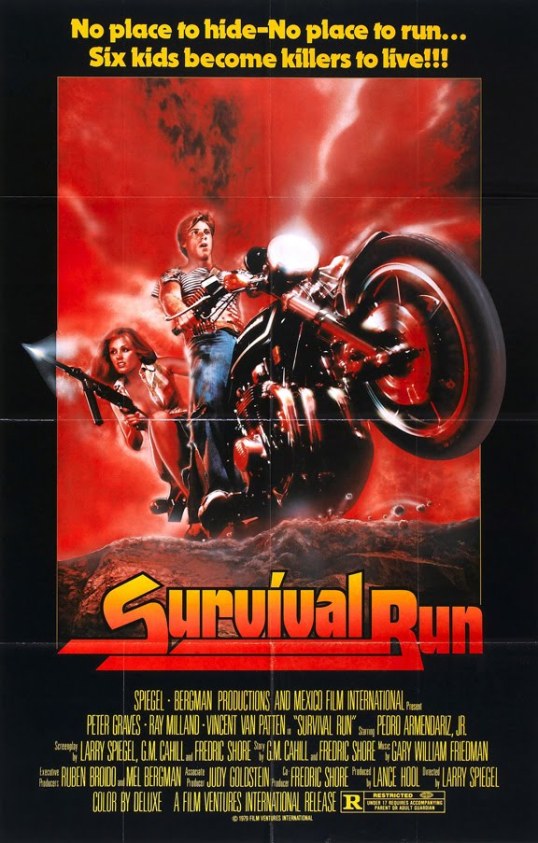
This poster for Survival Run reflects absolutely nothing that happens in the movie.
“We are young/ We are free/ Anyone know a better place to be?/ Takin’ it easy/ My baby and me….”
So goes the deceptively mellow opening theme song of Survival Run. In this one, teenager Chip (Vincent Van Patten) and his five best friends take off for the weekend. When their van breaks down in the middle of the desert, they light a campfire, sing a song, and have sex.
Takin’ it easy, my baby and me.
When they later decide to search for help, they stumble across a group of men in the valley. The men are being led by Peter Graves, who tosses one of the teens a beer and says, “This’ll put hair on your chest, kid.” The kid looks down at his chest, says, “Where’d it go!?,” and then touches him armpits. “There it is!” he says.
We are young, we are free
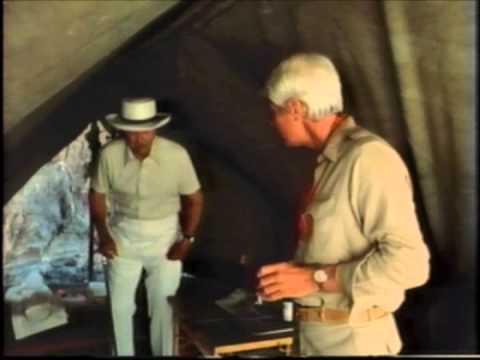
The men say they’re prospectors but they’re actually drug smugglers. When the same teen who couldn’t find his chest hair is murdered, a fight for survival begins. Despite that killer opening song, Survival Run takes forever to get started, the action scenes are poorly directed, and the teens are too stupid and poorly written to be sympathetic. However, Survival Run does feature Peter Graves and Ray Milland as the two most unlikely drug smugglers in the world. Peter Graves wears a red ascot and an all khaki outfit with rapidly spreading sweat stains. Ray Milland wears a suit while sitting out in the broiling desert. Milland, who was 72 at the time, spends most of the movie sitting. One of the teenage girls thinks he’s intriguing.
Infamous international drug smugglers Ray Milland and Peter Graves
When I was growing up in Baltimore, Survival Run used to frequently come on TV in the afternoon. I’m still not sure why but I imagine a lot of fans of the Biography Channel were tricked into tuning into this one, just to watch in shock as Peter Graves killed teenagers in the middle of the desert. Ray Milland did this 35 years after winning an Oscar for The Lost Weekend. As for Vincent Van Patten, he was the Van Patten who didn’t appear in Mel Brooks films or win an Emmy for his work on Boardwalk Empire.
Peter Graves and Ray Milland vs. the least known member of the Van Patten family.
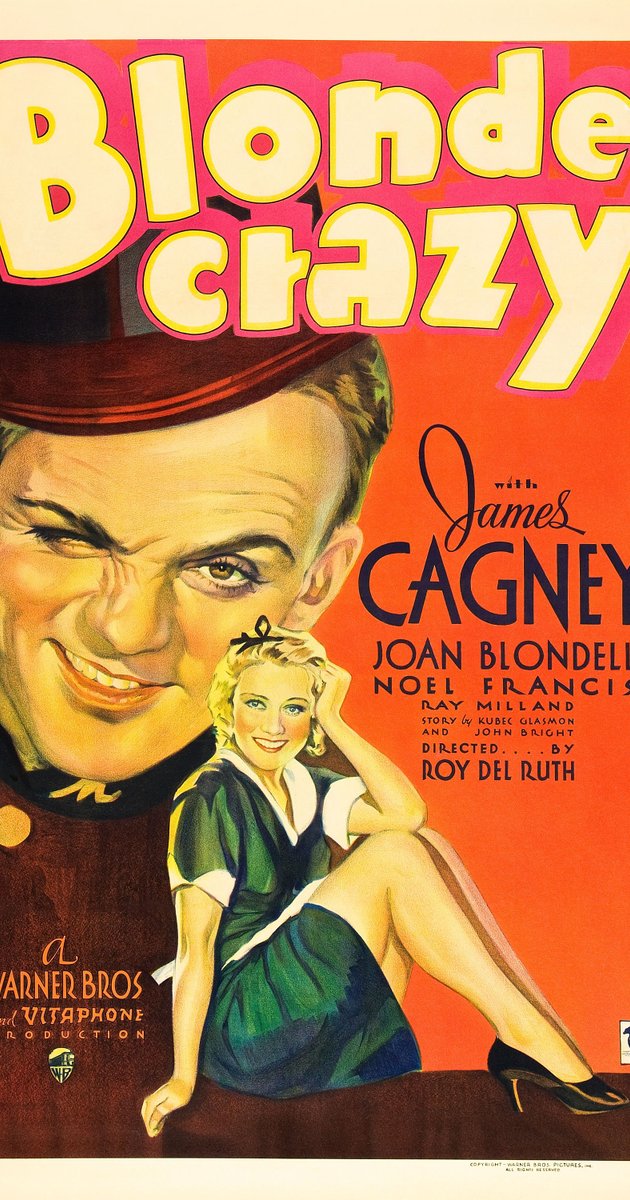
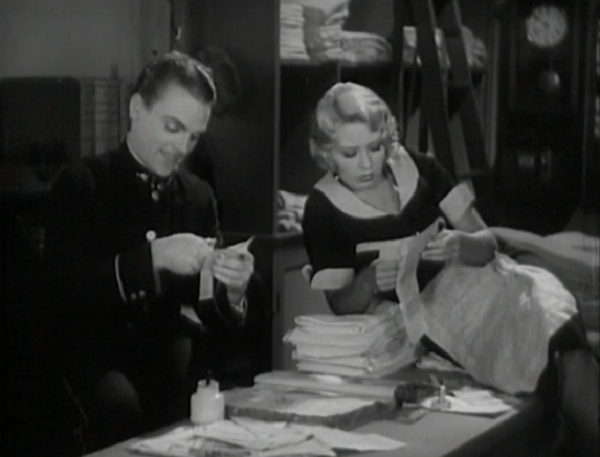
When James Cagney burst onto the screen like a machine gun barrage in 1931’s THE PUBLIC ENEMY, a star was immediately born. His rough-and-tumble personality was perfectly suited to films of the era, and he’s given a good showcase in BLONDE CRAZY, along with Pre-Code cutie Joan Blondell , who could dish it out with the best of them. Though it’s a little creaky in spots, BLONDE CRAZY is tons of fun, and Cagney gives everybody a lesson in what being a movie star is all about.
Cagney plays Bert Harris, a bantamweight bellboy looking to make a fast buck during the Depression running crap games and selling bootleg hootch. When he first meets blonde Anne Roberts (our girl Joan) he ogles her body lecherously, and we know right from the get-go what his intentions are! But Ann’s no sucker, she a been-around-the-block kinda gal, and soon this dynamic duo are…
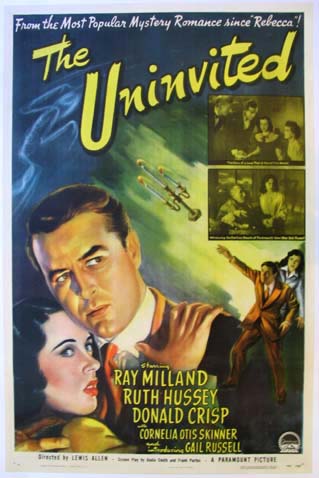
If you want to see a really good haunted house movie, allow me to recommend that you track down the 1944 film, The Uninvited. The Uninvited may not have been the first movie about a haunted house but it’s definitely one the best and one of the most influential. None other than Guillermo Del Toro has regularly cited The Uninvited as an inspiration and, as I watched the film last night, I could definitely see where the film had influence Del Toro’s Crimson Peak.
The Uninvited tells the story of Rick Fitzgerland (Ray Milland) and his sister, Pamela (Ruth Hussey). They’ve just purchased a long-empty seaside house and, incredibly, they were able to get it at an amazingly low cost! The house’s owner, the frail Commander Beech (Donald Crisp, alternating between being menacing and sympathetic), was apparently desperate to get rid of it.
Far less happy about the selling of the house is Beech’s granddaughter, the mysterious Stella (Gail Russell). As Stella explains it, she grew up in the house, her mother died in the house, and Stella is still attached to the house. Beech has ordered Stella to stay away from the house but, with Rick falling in love with her, Stella is soon visiting on a regular basis.
Of course, Stella isn’t the only unexpected visitor that the Fitzgeralds get to know. It quickly becomes obvious that there’s something strange about the house. Rick and Pamela discover an artist’s studio that is always cold. They both hear the sound of a woman crying. Beech claims that it’s nothing to worry about. Old house make weird noises, he informs them. However, Rick and Pamela start to become convinced that the house is haunted.
Stella not only agrees that the house is haunted but she also informs them that she knows the identity of the ghost. It’s Stella’s mother! But if that’s true, why does the ghost constantly seem to be encouraging Stella to put her life at risk? Why does Stella go into a trance and, much as her mother did 16 years earlier, attempt to jump over the side of a cliff?
Is Stella’s mother trying to manipulate her daughter into joining her in death? Or is there something even more sinister happening?
Well-acted and perfectly paced, The Uninvited is an effectively creepy film, one that remains memorable even 72 years after it was initially released. Visually, The Uninvited resembles a film noir and, if not for a brief scene towards the end of the film, viewers would be justified in wondering if the house really is haunted or if everyone in the film is just letting the isolation and the shadowy atmosphere get to them. It’s that hint of ambiguity that elevates The Uninvited and makes it a truly thought-provoking haunted house story.
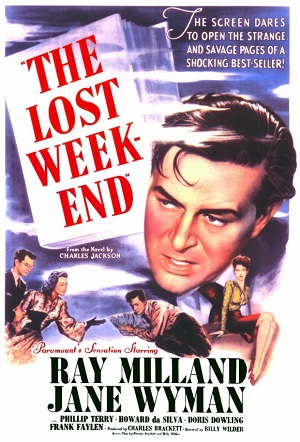
I’m currently stuck at home on this beautiful day, dealing with a really bad cold. (Even as I sit here typing this up, I am currently in a feverish haze.) It’s frustrating but, fortunately, I’ve got a lot of movies to watch. After all, TCM is wrapping up their 31 Days of Oscars and my DVR is currently full of nominated films waiting to be reviewed.
For instance, I just watched the 1945 best picture winner, The Lost Weekend. The Lost Weekend was directed by Billy Wilder, a director who is most often associated with sad-eyed comedies like Some Like It Hot, The Apartment, and The Seven Year Itch. However, The Lost Weekend is most definitely not a comedy. Instead, it’s an incredibly harrowing and rather depressing portrait of addiction and lost promise.
Don Birnan (Ray Milland) is a struggling writer. When we first meet him, he’s packing for a weekend trip with his brother, Wick (Philip Terry). The conversation between Don and Wick at first sounds friendly but soon, we start to hear hints of suspicion in Wick’s voice. Wick seems incredibly concerned about what exactly Don is packing and Don starts to get defensive. Don says that it’s been ten days since he had a drink and that there is no more liquor in the apartment. However, whenever Wick turns his back, Don starts to search for the bottles that he’s hidden around his bedroom. (He’s even got a bottle of whiskey hanging on a rope outside the window.) It gets to the point that, whenever Wick isn’t looking, Don is holding a bottle.
And while that may sound potentially humorous, there’s nothing funny about the scene. Don’s desperation is too real. As someone who grew up having to deal with an alcoholic father, I recognized Don and his addiction immediately. Everything about him — from his fast smile to his continual assurances that he’s cleaned himself up — is a facade, designed to help him survive until he can get his next drink.
The main thing about alcoholics is that they’re extremely clever. Don knows that Wick wants to get him away for the weekend so that he can’t drink. When Don’s girlfriend, Helen (Jane Wyman), mentions that she has two tickets for a concert, Don convinces Wick to go to the show with her. Once Wick is out of the apartment, Don can sneak down to the neighborhood bar. When it comes time to leave for that dry weekend vacation, Don manages to accidentally on purpose miss the train.
Left alone for the weekend, Don can now do what he wants. He tries to write about his life as an alcoholic but discovers that his brain is too muddled for him to think straight. So, instead, he drinks. Unfortunately, Wick hasn’t left him any money and has also ordered all the local bars and liquor stores to not allow his brother to run up a tab. As a result, Don finds himself scrounging for money.
In perhaps the film’s most famous scene, Don carries his typewriter down to the local pawnshop so that he can get money to buy a drink. However, the pawnshop is closed for Yom Kippur. The camera follows Don as he staggers around New York City, looking for an open pawnshop. Wilder shot this scene on the streets of New York City, using a hidden camera. The people who we see reacting to Don are not Hollywood extras but instead are actual New Yorkers who had no idea that the pathetic drunk they were gawking at was actually film star Ray Milland.
As the weekend plays out, Don transforms. He goes from being smooth and outwardly confident to being unshaven and desperate. Eventually, Don ends up in a sanitarium, where he’s taunted by a sadistic nurse. (The nurse is played by Frank Faylen, who played Ernie the cab driver in It’s A Wonderful Life.) Even when Don manages to get back to his apartment, he finds himself screaming as he hallucinates a bat eating a mouse. Blood runs down the walls.
Does the film, at least, have a happy ending? It depends. The local bartender, Nat (Howard Da Silva), returns Don’s typewriter to him. Helen convinces Don to write about his lost weekend. Don says that he’s never going to drink again but, at the same time, we can’t help but remember that the movie started with Don saying the same thing…
As directed by Billy Wilder, The Lost Weekend plays out like a noir thriller, full of menacing shadows. The score, composed by Miklos Rozsa, uses a theremin to let us hear the addiction-fueled chaos within Don’s head. Best of all, Ray Milland totally loses himself in the role of Don Birnan, with the vanity of film stardom soon replaced with the pathos of addiction. Even watching the film today, it’s easy to understand how The Lost Weekend won the Oscar for Best Picture of 1945.
Of all of the world’s real-life monsters, Jack the Ripper is one of the most iconic. Whether it’s because he was never actually caught or because he committed his savage crimes during an era that we associate with emotional and sexual repression or maybe just because he has a memorable name, Jack the RIpper continues to both fascinate artists of all genres and haunt the nightmares of viewers and readers like me.
Tonight’s episode of televised horror on the Lens deals with Jack the Ripper. This episode of Thriller was originally broadcast on April 11, 1961 and is based on a short story by Robert Bloch. It was directed by actor Ray Milland.
Without further ado, here is Yours Truly, Jack the RIpper…
In the 60s, there were gang debs and in the 70s, there were cheerleaders. And there were an awful lot of movies about cheerleaders that apparently were a lot more sordid than Bring It On.
They’re not just cheerleaders — they’re swinging cheerleaders! Believe it or not, this was directed by the same Jack Hill who directed Switchblade Sisters and countless Pam Grier films.
Eventually, filmmakers ran out different adjectives to place before the word “Cheerleaders.” And that is how this movie ended up being called The Pom Pom Girls.
Needless to say, this is the edited version of this particular’s film’s trailer. If I ever get a chance to watch Debbie Does Dallas, I’ll have tobecause I live in Dallas. And if Debbie thinks she’s going to do Dallas better than I do Dallas, she might want to jump off that dream train. Just saying…
(By the way, I know that there’s a small group of you out there who probably think I’m just using this post an excuse to kid my sister Erin about her high school cheerleading days. Perish the thought! In fact, to prove my good intentions, the next 6 trailers will be, in absolutely no way, related to cheerleading.)
I’m including this trailer specifically for one of our regular and loyal readers. He knows who he is and here’s hoping he’s having himself a good weekend.
8 ) The Naked Bunyip (1970)
I’ve never seen this film, I just came across it while I was specifically looking up trashy cheerleader-centric trailers on YouTube. It appears to be an Australian mondo film.
Film looks terrible but I love that tagline: “It seemed like a good idea at the time!” I have a feeling that’s what Ray Milland spent all of 1973 telling himself.
This was on the Fox Movie Channel earlier this week and I actually set the DVR for it. Ben Gazzara chews the scenery of Al Capone and then a really young Sylvester Stallone pops up as Frank Nitti. This is one of those 70s mafia films that tries to be The Godfather, just with less running time and a smaller budget. It’s kinda boring, to be honest.
I’ve discovered something as I’ve pursued my mission to see every single film ever nominated for best picture. Quite a few of the nominees (perhaps the majority of them) are no longer impressive because they’ve simply become dated by the passage of time. We can still watch these films and understand (and believe) that they were probably quite groundbreaking and impressive when initially released.
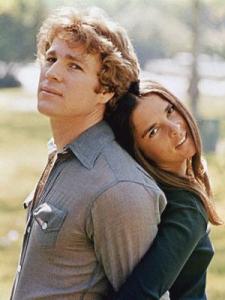
And then there’s the films like the 1970 best picture nominee, Love Story. These are the nominees that you quickly realize were never good. These are the films that were nominated because they either dominated the box office or perhaps they just lucked out and were released in a bad year for cinema in general. At least that’s what we tell ourselves. In all honesty, the circumstances of how they came to be nominated are often enigmatic and shrouded in mystery. I have yet to read a single critic — from either 1970 or the present day — who has had a single kind thing to say about Love Story and, after sitting through it last night, I can say that for once, me and the critical establishment are in agreement.
The plot of Love Story is pretty simple and I’m going to go ahead and include the entire story here because quite frankly, it’s impossible to spoil something this predictable. Oliver (Ryan O’Neal) meets Jenny (Ali MacGraw). Oliver is a rich jock who is attending Harvard. Jenny is a poor music student. Upon first meeting her, Oliver calls Jenny a “bitch.” Jenny calls Oliver “a dumb jock.” Oliver falls in love with Jenny. Jenny calls Oliver “a dumb jock.” Oliver and Jenny get married. Oliver’s father (Ray Milland) disapproves. Jenny’s father (John Marley) is just kind of confused. Cut off from the family fortune, Oliver struggles to provide for Jenny. (Apparently, the 70s were a tough time to be a graduate of Harvard Law School.) Jenny and Oliver have a fight. Oliver cries. Jenny says, “Love means never having to say you’re sorry,” which seems to be an underhanded way of admitting that most guys aren’t ever going to say that anyways. Oliver is happy. Jenny comes down with a never-named terminal illness and dies. The end.
I know that I’m supposed to watch a movie like Love Story and just shrug my shoulders and go, “Oh well, it’s not very good but I’m a girl so I’ll love it unconditionally.” And God knows, I tried my best, I tried so very hard to just shut down my mind and give control over to my heart. Because, believe it or not, I’m just a dorky, asthmatic romantic. I’m the type of girl who gets all giggly and excited when she gets flowers, despite all of my allergies. I can remember every sunset I’ve ever watched. The rare times we actually do have a winter down here in Texas, I’m all about the snowball fights that end with a long, passionate kiss. I love Valentine’s Day and I remember anniversaries. I still have every gift that I’ve ever been given, even the really cheap and ugly things that I wouldn’t be caught dead wearing in public. Every trinket, every stuffed animal, every card, every piece of jewelery, every note, every article of lingerie, every movie ticket — if it’s an artifact of a past or current relationship, I have it all safely stored in a place of honor.
Yes, I adore everything that Love Story was selling and yet, as I watched Love Story, I felt myself growing more and more cynical with each passing moment. Fortunately, the movie only last 99 minutes because if it had gone on for a few 120, I probably would have ended up “an old maid…closing up the library!” like Donna Reed in It’s a Wonderful Life. The problem with Love Story isn’t that it’s not romantic; it’s that it takes the standard clichés of romance and embraces them to such an extent that I didn’t feel as if I was being manipulated by the film as much as I felt like I was being brutally violated by it.
Seriously, the entire time I was watching, I felt like the film was screaming at me, “Look at how beautiful they are! Look at that sunset! Listen to that music! Cry, damn you, cry!” Never mind the fact that MacGraw and O’Neal — pretty as they are to look at — generate close to zero chemistry. Never mind that MacGraw responds to being terminally ill by laying in bed with her hair artfully spread on the pillow behind her while director Arthur Hiller practically bathes her in a warm, saintly glow. Never mind that “Love means never having to say you’re sorry,” doesn’t make any freaking sense at all. Trust me, if you love me and yet you still insist on acting like an asshole, you sure as Hell have to apologize to me.
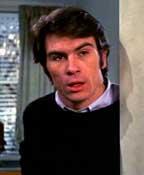
On the plus side, the film’s got one of those overdone, lush soundtracks; the type that can make you cry as long as you don’t pay attention to what’s happening on-screen. (That said, Taylor Swift is nowhere to be found.) Ryan O’Neal is surprisingly likable as Oliver but Ali MacGraw — oh my God, where do I begin? Actually, I don’t think I will because there’s simply no way I can explain just how bad of a performance she gives here. Instead, I’ll just point out that Love Story also features the film debut of Tommy Lee Jones. He’s credited as Tom Lee Jones here and he plays Oliver’s roommate. He’s an on-screen for about 12 seconds and he delivers exactly one line.
Needless to say, he pretty much steals the entire film.

 Through the Shattered Lens