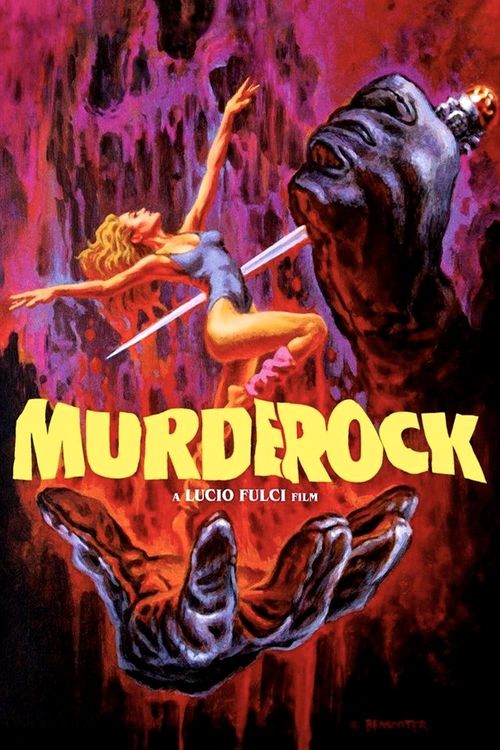
October Hacks: Murder Rock (dir by Lucio Fulci)


Are the streets to blame?  Paranoia’s coming your way….

Ah, Murder Rock.

This 1984 film is often dismissed as being one of director Lucio Fulci’s lesser efforts, an attempt to combine the trappings of the giallo genre with the sexy, choreographed dance routines of Flashdance.  And certainly, the film does lack the visceral, dream-like horror of The Beyond trilogy and Zombi 2.  The film’s killer isn’t even as interesting as The New York Ripper‘s killer who talked like a duck.  That said, I think some critics have been a bit too hard on Murder Rock over the years.  Taken on its own terms, it’s a well-made slasher with a healthy does of 80s style.  Of course, I should admit that, as someone who grew up attending dance classes and dancing through the pain, I could relate to the film’s milieu.  I’ve never had to deal with a zombie in real life but I did meet my share of dancers who would do anything to move up.

The film takes place at the Arts For The Living Center in New York City, where young dancers are hoping to land a spot on a televisions show and also hoping to avoid getting killed by the murderer who is haunting the locker rooms and using a long hairpin needle to stop the hearts of his victims.  (The sound of a previously healthy victim’s heart beating on the soundtrack and then abruptly stopping is far more powerful than one might expect.)

Previously seen losing an eye in Fulci’s Zombi 2, Olga Karalatos plays Candice Norman, the owner of the dance studio.  When one of her dancers is murdered while taking a shower, Candice is just one of many suspects.  Candice, however, is haunted by a dream in which she sees herself being stalked by a handsome man (Ray Lovelock) carrying a hairpin.  Later, Candice realizes that she’s seen the handsome man before.  He’s George Webb, a male model whose face adorns a billboard.  Candice starts to investigate George on her own, discovering that he’s apparently an alcoholic who lives in a run-down apartment.  When evidence starts to show up suggesting that George could be the murderer, he claims that he’s being framed.

Of course, George isn’t the only suspect.  There’s also Willy Stark (played by Christian Borromeo), a dancer whose girlfriend ends up as a victim of the murder spree.  With his blonde hair and aristocratic bearing, Christian Borromeo was one of the most handsome actors to appear in Italian films in the early 80s.  He didn’t do many films before retiring but he still managed to appear in films directed by Dario Argento, Federico Fellini, Ruggero Deodato, and Lucio Fulci.  He played very different characters in all of his films and gave a good performance each time.  One reason why I specifically want to single out Christian Borromeo here is because there’s still a lot of people online who are under the impression that Borromeo died a heroin overdose in the 80s.  This is largely due to a comment that was made during an interview with David Hess, who co-starred with Borromeo in The House At The Edge of the Park.  Hess was confusing Borromeo with their co-star, Garbiele Di Giulio.  Di Giulio did indeed die of a heroin overdose.  Christian Borromeo is still alive, though retired from acting.

As for Murder Rock, the killings are nowhere near as gory as in Fulci’s other films but that actually adds to the film’s creepy atmosphere.  The killer is frightening because the killer is coolly efficient and can kill without resorting to the out-of-control, manic violence of quacking sociopath at the center of The New York Ripper.  As is usual with Fulci, the film’s visuals are Murder Rock‘s greatest strength.  The first murder occurs while the locker room’s light blink on and off, creating a truly frightening sequence as the camera seamlessly assumes the killer’s point of view.  When the police investigate the crime, the flashes of the police cameras are almost blinding as they record the stark crime scene.  Candice’s nightmares play out like a particularly macabre perfume commercial (and yes, that it meant as a compliment).  Fulci’s camera roams from location to location, keeping the audience off-balance throughout the film.  As he did in so many of his other films, Fulci makes New York look like the grimiest, most claustrophobic city in the world.

As for the dance sequences, they’re so over-the-top that you can’t help but love them.  The film was obviously envisioned as a way to cash in on the popularity of Flashdance but Fulci’s dispenses of the romanticism that made Flashdance a hit and instead just focuses on bodies moving in a explosion of choreographed carnality.  There’s nothing subtle about the way the film lingers on the spandex-clad dancers but then again, that’s why we love Fulci.  He was not one to make apologies.

Fulci once said that Murder Rock was meant to be the first part of a projected trilogy of musical gialli.  Who knows whether or not that’s true.  (As an interview subject, Fulci was always quick to boat of the grand projects he had planned for the future.  As the diabetic Fulci was in precarious health at the same time that he made his most popular horror films, there was always something rather poignant to Fulci’s constant boasting about all of the great films he planned to make.)  As I said at the start of this review, Murder Rock is one of Fulci’s less-appreciated films but, as someone who loves both dancing and watching horror movies, I’ve always liked it.  Even the fact that the killer is exposed in a way that doesn’t really stand up to close scrutiny just adds to the film’s charm.  (Seriously, a good giallo rarely makes that much sense.)

In closing — SING IT!

Are the streets to blame?

Paranoia’s coming your way!


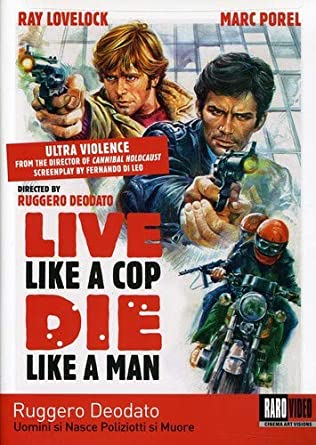
The TSL’s Grindhouse: Live Like A Cop, Die Like A Man (dir by Ruggero Deodato)


The 1976 film, Live Like A Cop Die Like A Man, takes place during the Christmas season.

We know this because the film opens with a man dressed like Santa Claus standing on a street corner in Rome and impotently watching as a woman is dragged behind a motorcycle by two men who were attempting to snatch her purse.  When she doesn’t let go of her purse, one of the men hops off the motorcycle and proceeds to kick her in the face until she stops moving.  Suddenly, two other men — our heroes, as it were — came driving up on a motorcycle of their own.  A chase ensues, through the streets of Rome, during which a blind man’s dog is graphically run over.  The chase which, it must be said, is very well-shot and directed, lasts for over 10 ten minutes and it ends with the two thieves being executed by, once again, our nominal heroes.

A lot of people are executed over the course of Live Like A Cop, Die Like A Man.  That’s because Detectives Fred (Marc Porel) and Tony (Ray Lovelock) have been given a license to kill anyone who breaks the law.  The film is a bit vague on just how exactly the license works and why, apparently, it’s only been given to Fred and Tony.  One major set piece features several dozen cops all waiting outside a house, powerless to get the three criminals within, until Fred and Tony arrive.  Fred and Tony, of course, solve the problem by killing everyone.  Why couldn’t the other cops have done that?  The film doesn’t really make that clear.

Admittedly, Fred and Tony aren’t the first movie cops to get results through unorthodox means.  The French Connection was a popular film in the 70s and it inspired a whole genre of Italian rip-offs, of which Live Like A Cop Die Like A Man is a definite example.  What sets Fred and Tony apart from cops like Popeye Doyle and Dirty Harry is the amount of joy that Fred and Tony seem to get out of killing people.  Early on, they show up at a party and proceed to set all of the cars on fire. They also set two criminals on fire, with Fred doing a happy little dance as the two men go up in flames.  It’s disturbing but there’s also a strange integrity to the film’s shameless embrace of violence.  Live Like A Cop, Die Like A Man doesn’t pretend to be about anything other than satisfying the vigilante fantasies of its audience.

And indeed, it should be considered that Live Like A Cop, Die Like A Man was released during the so-called Years of Lead, when a combination of political terrorism and open crime had made violence an almost daily part of Italian life.  When you’re living day-to-day with the knowledge that you could be blown up at any minute by the Red Brigade, the Ordine Nero, or the Mafia, I imagine that there would be something appealing about watching two young men who are perfectly willing to just shoot anyone who appears to be up to no-good.  It’s easy to imagine that, for audiences in 1976, the random violence of this episodic film mirrored the random violence of everyday life.  Though Live Like A Cop, Die Like A Man was obviously inspired by The French Connection, it perhaps has more in common with the original Death Wish, with the main difference being that Live Like A Cop’s vigilantes are officially sanctioned.

The film also places a good deal of importance on just how close Tony and Fred are supposed to be.  They live together in a ramshackle flat, they apparently spend all of their free time together, and, towards the end of the film, the only thing that keeps the two of them from taking part in a threesome is the sound of someone else being shot.  Unfortunately, Ray Lovelock and Marc Porel did not get along in real life and, as a result, there was never a Live Like A Cop Die Like A Man Part IILive Like A Cop would also be director Ruggero Deodato’s only stab at the polizieschi genre.  He went on, of course, to direct Cannibal Holocaust and The House on the Edge of the Park.  (Interestingly, Tony and Fred’s relationship is mirrored, to sinister effect, by the relationship between the characters played by David Hess and Giovanni Lombardo Radice in House On The Edge of the Park.)  Live Like A Cop, Die Like A Man has gone on to become a bit of a cult film and, as offensive as some will find it to be, it’s also so over-the-top in its violence and its celebration of officially sanctioned bad behavior that it becomes rather fascinating to watch.  It’s so without shame or apology that it’s hard to look away from it, even though you may want to.

Halloween Havoc!: THE LIVING DEAD AT MANCHESTER MORGUE (Hallmark Releasing 1974)


gary loggins's avatarcracked rear viewer

manchester1

While doing some background research on actor Arthur Kennedy for my post about DESPERATE JOURNEY  back in June, I came across an IMDb entry for a movie titled THE LIVING DEAD AT MANCHESTER MORGUE. It’s description is as follows: “A cop chases two hippies suspected of a series of Manson-family like murders; unbeknownst to him, the real culprits are the living dead, brought to life with a thirst for human flesh by chemical pesticides being used by area farmers”. Sounded right up my alley, and a perfect candidate for this year’s ‘Halloween Havoc!’ horrorthon!

manchester2

Though the description isn’t 100% accurate, THE LIVING DEAD AT MANCHESTER MORGUE is a surprisingly good Italian-Spanish made chiller with elements of giallo movies, as our lead George is traveler who stumbles into murder. His motorcycle (a nice looking vintage Norton) is backed into by Edna on his way to Wyndhamere. She gives him a lift, and…

View original post 468 more words