Horror Film Review: Eegah! (dir by Arch Hall, Sr.)


First released in 1962, Eegah! has a reputation for being one of the worst films ever made.

Usually, whenever I come across a film with that type of reputation, my natural instinct is to be a contrarian and to argue that the film is not so much bad as its just misunderstood.  I can’t really do that with Eegah!  Eegah! is a legitimately bad movie, though I don’t know if I’d call it one of the worst.  It’s a low budget vanity project and, quite frankly, I think snarkiness is better directed at big budget vanity projects.  Eegah! is bad but it’s also bad enough to be entertaining in a train wreck sort of way and there’s something to be said for that.

While driving at night, 30 year-old teenager Roxy Miller (Marilyn Miller) runs over Eegah (Richard Kiel), a giant caveman who has somehow gone unnoticed up until that moment.  Eegah runs off into the desert.  Roxy tells her boyfriend, Tom (Arch Hall, Jr.) and Tom’s father, Robert (Arch Hall, Sr., who also directed) about her encounter.  While Tom plays his guitar and sings a sappy ballad, Robert goes into the desert in search of Eegah.  When Robert doesn’t return, Tom and Roxy grab a dune buddy and head into the desert.

Roxy finds Eegah and Robert first.  Eegah grabs Roxy and takes her to a nearby cave, where Robert is waiting for them.  Eegah can’t speak and does most of his communication by swinging around a club and being a bit too handsy.  (There’s one painting on the wall of his cave but it’s not very good.)  Eegah, despite his fearsome appearance, seems to actually be pretty amiable.  But then he falls in love with Roxy and becomes rather possessive.  When Roxy gives Robert a shave, the bearded Eegah demands a shave as well.  He’s fairly handsome without the beard but still, it’s hard not to get grossed out by the way he tries to lick up the thick shaving cream that’s covering his face.

Eventually, Tom rescues Roxy and Robert and not a minute too soon!  There’s a party in town and Tom and his band are scheduled to play!  Eegah, upset that Roxy has left him, picks up his club, puts on his best animal skin, and heads into town on a rampage!

Eegah (and, yes, I’m dropping the exclamation point) was produced and directed by Arch Hall, Sr.  (He receives a story credit as well.)  It was actually one of many movies that Hall Sr. made, all in an effort to make his son into a film star.  In Eegah, Arch Hall, Jr. performs two songs and dances with Roxy.  The film positions him as a teen idol but Hall, Jr. doesn’t seem to be particularly comfortable with the role.  Of course, it doesn’t help that he’s working with an absolutely terrible script.

I do, however, appreciate the performance of Richard Kiel as Eegah.  Kiel does the best that anyone could with the role, playing him as being  giant who simply doesn’t understand that you can’t walk around with the a club in public without someone calling the police.  Poor Eegah!  He doesn’t even know what the police are.

Eegah! (yeah, I’ll return it’s exclamation point for the next-to-last paragraph) is a film that is so ineptly done and poorly written that it becomes rather fascinating to watch.  It’s boring only if you’re the type who can’t appreciate terrible dialogue, terrible camera placement, and the type of acting that can only be found in a film that was directed, produced, and essentially written by one guy trying to make his reluctant son into a star.

Arch Hall, Jr. was far less interested in being a star and instead became a pilot and pursued his love of flying.  As for Richard Kiel, he went on to play Jaws, one the greatest of the James Bond henchmen.

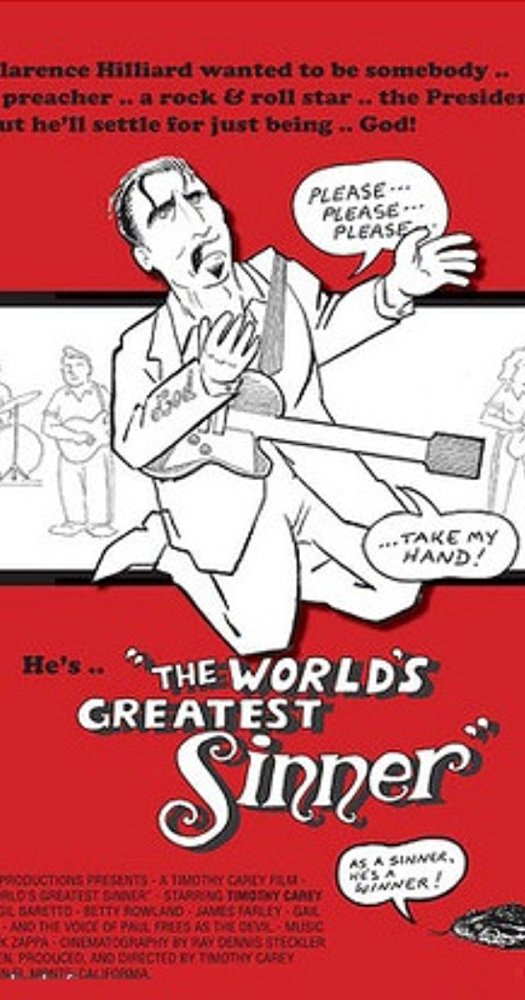
Prophet Without Honor: Timothy Carey’s THE WORLD’S GREATEST SINNER (Timothy Carey 1962)


gary loggins's avatarcracked rear viewer

Timothy Agoglia Carey (1929-1994) was an eccentric, oddball actor who played in everything from early Stanley Kubrick films (THE KILLING, PATHS OF GLORY) to AIP Beach Party romps (BIKINI BEACH, BEACH BLANKET BINGO ). He had the look of an overfed vampire, and was noted for his off-the-wall characterizations. Carey didn’t play the Hollywood game, considering himself an artist, and you’ve got to admire that. In 1962, he made a film called THE WORLD’S GREATEST SINNER, which he produced, directed, wrote, starred in, and released himself. Top THAT, Orson Welles!.

This ultra-low-budget film is totally bizarre right off the rip. Insurance man Clarence Hilliard (Carey) gets himself fired from his job after telling people they don’t need insurance. He wants more out of life, believing man is a superbeing, and begins to set himself up as a God. After watching a rock’n’roll teen idol, Clarence becomes a charismatic, guitar-toting, fiery…

View original post 373 more words

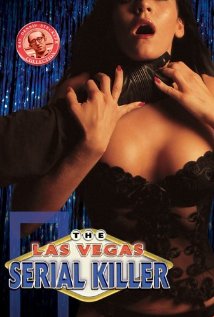
“The Las Vegas Serial Killer” Goes Back To A Dry Well


lv

As we painstakingly established around these parts a few days back, The Hollywood Strangler Meets The Skid Row Slasher was not exactly Ray Dennis Steckler’s finer hour (okay, hour and ten minutes). It’s a definite head-scratcher of a movie, to be sure, but as mind-bogglingly weird as Steckler’s idea to shoot a silent slasher flick on a budget of $1,000 in 1979 was, that decision seems positively logical in comparison to his decision to actually make a sequel to said silent $1,000 slasher flick seven years later!

Still, in 1986, for reasons known only to the the pseudonymous “Cash Flagg” himself, that’s exactly what he did. Sort of. I think.

vegasserial2

The setup here is, as you might expect, something of a puzzler in spite of its simplicity. Pierre Agostino is back as our strangler, but he’s called “Johnathan Glick” rather than “Johnathan Click,” and his stomping grounds have changed from Tinseltown to Sin City. He’s let out of the joynt  on the flimsiest technicality you can possibly imagine — they never found any bodies, so his convictions for a series of murders are all overturned — and he hits the streets again and starts killing.

Now, that might seem to make sense apart from the inexplicable swapping of the C in the character’s last name for a G, but that’s really just the tip of the iceberg. What’s he doing in prison in Nevada when his kill-spree took place in California, for instance? And, oh yeah — what he even doing alive, since he was murdered by the Skid Row Slasher at the end of the last one?

You begin to see the problem here. But “problems” are a relative concept, I suppose, and the logical gaps in the story’s basic premise are absolutely nothing compared to the problems in this film’s pacing and execution.

4080196602_815a9d0305

Steckler, here operating once again under his “Wolfgang Schmidt” nom de plume, has opted, no surprise at this point, to shoot the proceedings without sound — but instead of just telling the whole story via voice-over narration, he’s dubbed in actual, honest-to-goodness dialgoue in this one, and it’s never synched up even close to properly. Not that it really matters, because no one’s saying anything interesting — and nothing interesting is happening, either, with Click/Glick/whatever cruising downtown Vegas, the Strip, and neighborhood streets for ladies to choke with his bare hands. It’s, as you’ve no doubt come to expect, a pretty drawn out and tedious affair, and the killings themselves, when they do finally happen after interminable set-up periods, are all uniformly blase and aggressively nondescript.

Then we’ve got the subplot about two low-rent hoodlums who stand around making cat-calls at women, snatching their purses, and taking long lunch breaks. They always seem to show up in roughly the same locales as G(C)lick, and at roughly the same times, but their importance —  and I use that term very loosely, trust me — to the goings-on isn’t fully explained until very nearly the end, at which point you’ll have long since stopped giving a shit, and this little “revelatory twist” is so underwhelming that it would almost be insulting if you weren’t so begrudingly impressed at Steckler’s bravado for thinking he could get away with an “explanation” so lame.

MV5BMTc1MTk5NjMwNl5BMl5BanBnXkFtZTcwMjg5NzkyMQ@@._V1_SY317_CR4,0,214,317_

Unleashed  on a by-and-large uncaring populace via the straight-to-VHS route, The Las Vegas Serial Killer is, naturally, available on DVD these days (it’s presented full-frame with mono sound, both of which are, I guess, adequate enough all things considered), and while Media Blasters, under their Guilty Pleasures sublabel, have given us a nice (-r than this flick deserves) set of extras, including an on-camera interview with the director and a full-length commentary track where he opines at length on the making of the production, at the end of the day it still makes no sense, simply because all the explanation in the world  couldn’t begin to shine any light on why this was made and who Steckler thought his audience was.

Shit, I’ve seen this thing a few times now, and I’m still none the wiser. Is it a sequel to The Hollywood Strangler Meets The Skid Row Slasher? Is Agostino playing the exact same guy? How did he manage to survive when it sure as shit looked like he was dead? Why was he doing his time in a state other than that in which his (first) crimes were committed?

Fortunately, all of these questions have the exact same, simple answer — it doesn’t matter.

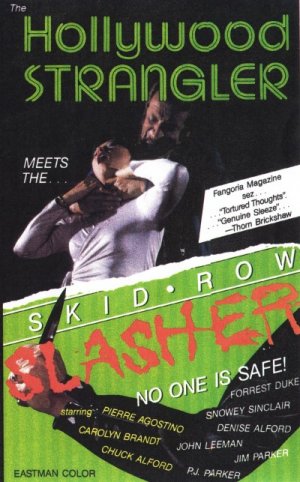
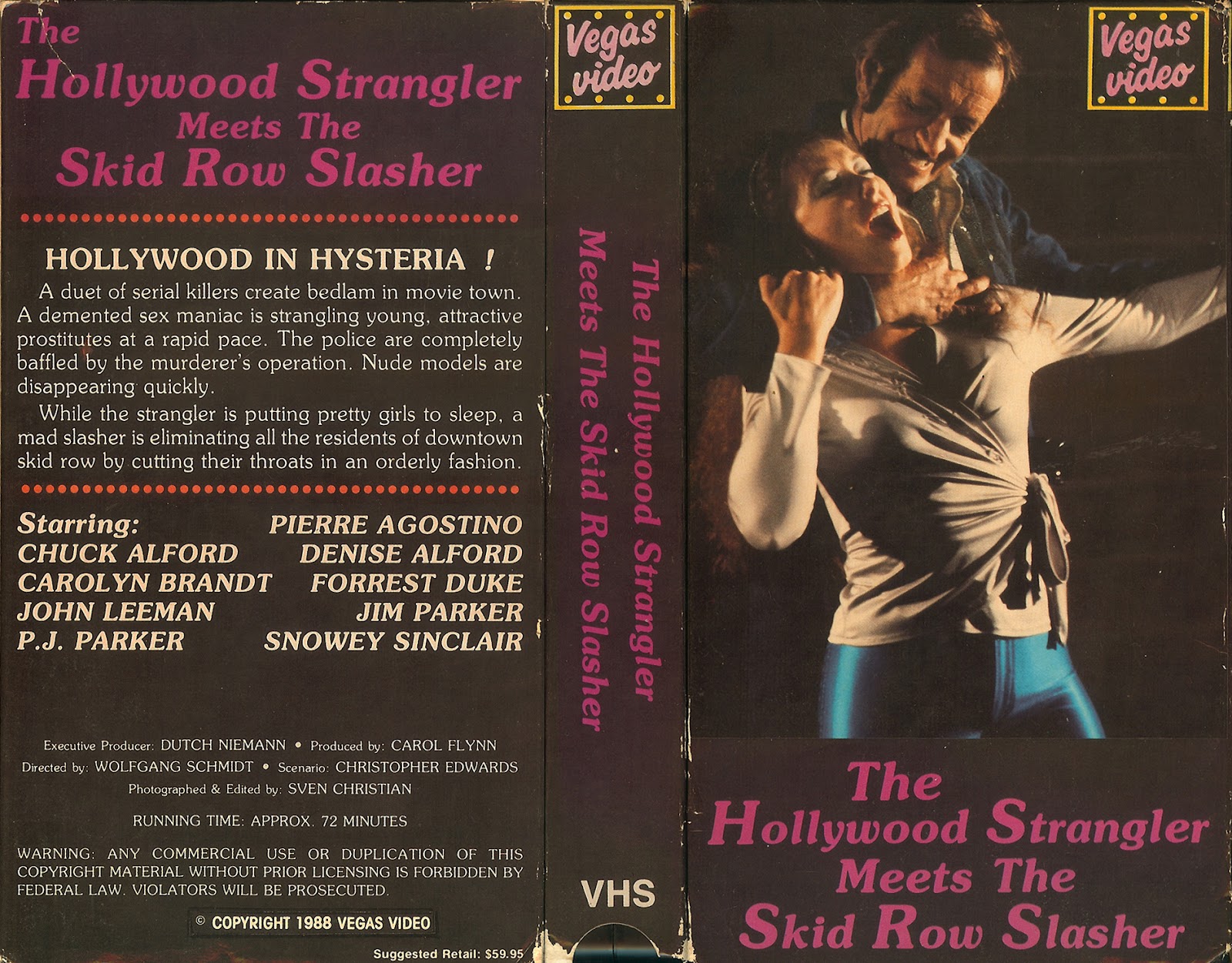
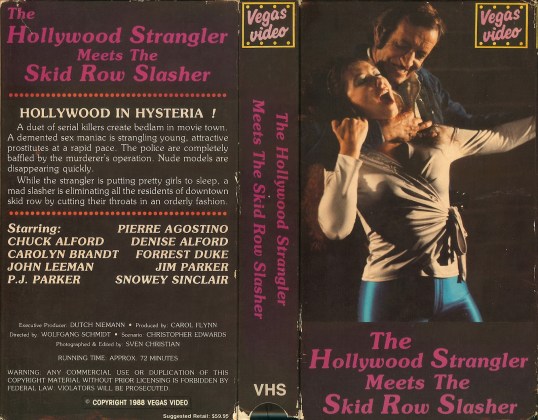
Grindhouse Classics : “The Hollywood Strangler Meets The Skid Row Slasher”


l_79300_4d2680e6

Sometimes, it’s almost impossible to know where to begin. Watching cult auteur Ray Dennis Steckler’s less-than-no-budget/dual-slasher mash-up The Hollywood Strangler Meets The Skid Row Slasher feels like a step back in time to the late 50s/early 60s, when ultra-cheap productions like The Creeping Terror and The Beast Of Yucca Flats were shot not only without sound, but with what sound was dubbed in later in post-production coming primarily in the form of voice-over narration, since the producers were too stingy and/or lazy to match up dialogue with actors’ moving mouths and only wanted to have to hire one person to tell their “story” anyway.

There’s just one wrinkle — Steckler (under his often-used “Wolfgang Schmidt” pseudonym) made this thing in 1979, hoping for a quick cash-in on the success of John Carpenter’s Halloween and the fly-by-night slasher genre that was then burgeoning in its wake! Honestly, by this point even Doris Wishman wasn’t cooking up her home-baked celluloid casseroles in a manner this frugal.
hwood vhs

Still, you’ve gotta give RDS at least some credit here — his dialogue-free, ultra-minimalist approach results in a style that can only be described as uber-naturalist, simply because when you spend this little on a production (the film’s total budget is reputed to be somewhere in the range of $1,000 — yes, you read that right) it literally can’t come out any other way. Honestly, his more “well-known” 1960s efforts such as The Thrill KillersThe Adventures Of Rat Pfink And Boo BooThe Lemon Grove Kids Meet The Monsters and, of course, The Incredibly Strange Creatures Who Stopped Living And Became Mixed-Up Zombies feel like big-money blockbusters in comparison with this effort, which is more akin in terms of its production “values” and “standards” to one of those old 8mm (although this was shot on 16) “educational” films they used to show you in school (if you’re old enough to have been around for them) on subjects ranging from photosynthesis to slaughterhouse operations and everything in between.

Purely as a side note,  I have to say that I have no idea what teachers do when they’re feeling lazy these days — I guess give a power-point presentation or something, but I do know what Ray Dennis Steckler does when he’s feeling like mailing it in — he makes a movie like this one.
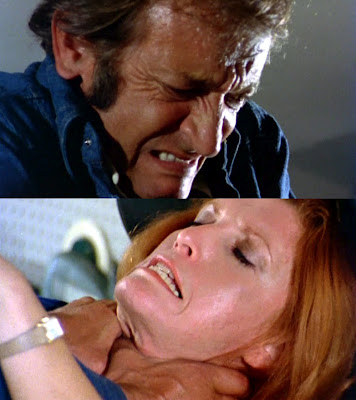
Hollywood Strangler Meets Skidrow Slasher 271 - 273

This was made at the apex of our guy Ray’s so-called “dark period” — when he got divorced from actress Carolyn Brandt (although she continued to star in his features, including this one), split LA broken-hearted, set up shop in Vegas, and generally spent his time seething with bitterness toward the Hollywood system that had rejected his admittedly unique — if not good by any standard definition of the word — brand of film-making. Returning to the streets of Hollywood Boulevard for the first time in many years for this one, there is, in fact, a palpable sense of rage that oozes from the frames of The Hollywood Strangler Meets The Skid Row Slasher, and if you do a little game in your head while you’re watching it whereby you replace the young, female victims of the strangler and the derelict, destitute victims of the slasher in your mind with the various exploitation producers and distributors that ripped Steckler off over the years, the flick becomes a lot more interesting.

Truth be told, though, that’s about the only way you can draw any sort of “entertainment” from this 71-minute snooze-fest because Ray doesn’t really do anything on his part to keep you involved in the proceedings — it falls entirely on your shoulders as a viewer to invent a reason to keep watching. The “plot” alone’s certainly not gonna do it — our psycho narrator, one “Johnathan Click” (Pierre Agostino) poses as a nudie photographer in order to lure women whose phone numbers he’s obtained via the various hooker newspapers littering the boulevard over to his pad, where he dutifully proceeds to strangle them after they’ve disencumbered themselves of most or all of their clothing, while just a few block over an unnamed used bookstore clerk played by the aforementioned ex-Mrs. Steckler gets so sick of the bums and winos coming into her shop drunk off their asses that she starts slitting their throats (sometimes, curiously enough, with a knife that’s already got blood on it before she even sticks ’em ). As they both go about their business slicing,dicing, and choking their way through tinseltown, their paths are bound to cross — especially once Click rumbles his fellow traveler’s identity — but when they do, will they become uneasy allies in their mutual quest to, as they see it, clean up the streets, or will they have to duke it out to the death, figuring the town’s not big enough for the both of them?
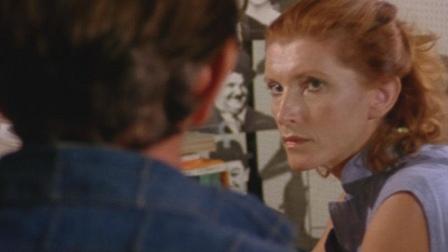
the-hollywood-strangler-meets-the-skid-row-slasher

Don’t worry — by the time their confrontation finally does take place, you won’t give a shit about the outcome. Hell, if you’re a normal human being, you won’t even be awake anymore. Even as a morbid curiosity piece centered around the less-than-burning question of “how can Ray Dennis Steckler  make a movie with absolutely no money?,” this one runs out of gas pretty fast, and once the end credits (such as they are) roll, it feels more like a relief than anything else.

Perhaps the weirdest of all weird things in relation to this production, though, is that Steckler somehow, for some reason, must have felt that it worked (or at the very leaast turned a profit), because seven years later — long after what very few people who would have cared stopped doing so — he decided to make a sequel, this time featuring only “Mr. Click,” called The Las Vegas Serial Killer. I think he spent even less on that one since he didn’t have to  leave town to make it, and most of Hollywood Strangler‘s micro-micro-micro budget was, I’m guessing,  probably consumed by the director’s own travel and lodging expenses, given that the on-screen product looks like it didn’t cost  so much as one thin dime.

All that being said, Steckler performs something of an entirely accidental occult ritual here, by managing to warp our perceptions of the passing of time itself. At barely over an hour, this feels more like seven. You’ll swear that you can sit through the entire Godfather trilogy plus Lawrence Of Arabia  in the time it takes to watch The Hollywood Strangler Meets The Skid Row Slasher. At some point along the way, this passes the point of being merely dull and obtains the power to warp the laws of the universe merely through the force of its lethargy. This is a movie that works hard to be as boring as it is, goddamnit, and as a result it manages to completely take over our minds even if it can’t sustain our attention.

Don’t ask me how that works. I have no idea. Nor does Steckler. This kind of thing just comes naturally to a master of the craft such as himself.
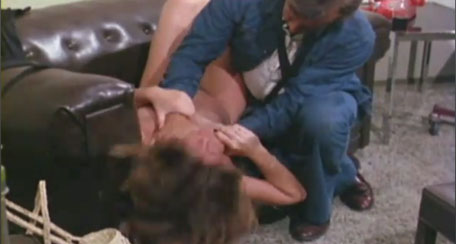
Untitled-2

Fortunately, if you spring for either the purchase or rental of The Hollywood Strangler Meets The Skid Row Slasher on DVD, Media Blasters (under the auspices of their “Guilty Pleasure” sublabel) has done some things to make sure this can, indeed, sustain your interest. The widescreen transfers looks, well, as good as it can, the mono sound is bearable enough (not that it really matters that much), there are on-camera interviews with Brandt and Steckler, and we get two commentary tracks — one from Steckler which is pretty good, and one from the inimitable and legendary Joe Bob Briggs, which is, as you would expect, packed full of awesome from start to finish. A better overall package than this movie deserves, to be sure, but you’ll be grateful for it nevertheless.
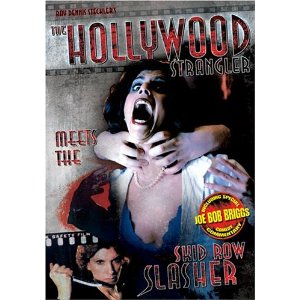
51KK023JF3L__SL500_AA300_

All of which leads this review to one of those schizo conclusions that only seem possible with bottom-of-the-barrel exploitation cinema — the film sucks, but the DVD is great. At this point in his career, Steckler’s admitted one over-riding goal was to spend as little on his productions as possible, and here it really shows. He also prided himself on his intense hatred for actors and refused to hire any real ones, but that doesn’t matter much in this instance, since even the most talented performers in the world couldn’t save this thing. This is still, however,  a film worth sitting through, if not actively or actually watching — and not just as an endurance test (even though those can be fun sometimes). I know a statement like that positively demands an explanation, so try this — pop this disc into your player and keep one eye on your watch. Hell, keep both eyes on your watch since it’ll be more interesting than the movie. I guarantee you, at some point, the hands will stop moving, and they won’t start up again until “The End” comes up on the screen. That, my friends, is some real movie magic.