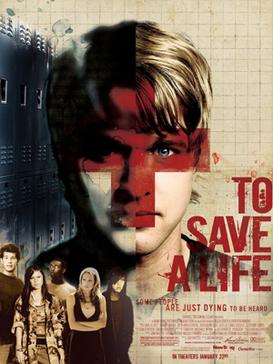
The 2009 film, To Save A Life, tells the story of two friends.
When they were children, Roger saved Jake’s life by pushing him out of the way of a car. Roger ended up with a permanent limp while Jake was able to continue playing basketball. By the time they start high school, Jake (now played by Randy Wayne) is a basketball star while Roger (Robert Bailey, Jr.) is an outcast. Jake and Roger start to drift apart, with Jake even abandoning Roger so that he can go to a party with his popular new girlfriend, Amy (Deja Kreutzberg). By the time that they’re seniors, Jake and Roger barely acknowledge each other’s existence. When Roger brings a gun to school and kills himself in front of his classmates, Jake is wracked with guilt. When Jake goes to Roger’s funeral, he discovers that he’s the only one of Roger’s classmates who bothered to show up.
Jake tries to go back to his normal life. He plays basketball. He dates Amy. He continues to be the school’s beer pong champion. He desperately seeks approval from his mother and his father, both of whom are too busy dealing with their own failing marriage to pay much attention to Jake. However, Jake cannot shake the feeling that he not only betrayed Roger but that his current life is empty.
To the shock of everyone, Jake starts to attend the meetings of a church youth group. Jake gets to know the other members of the group and discovers that quite a few of them are not particularly sincere in their faith. The local preacher’s kid, Danny (Bubba Lewis), tells Jake that the church’s youth pastor, Chris (Joshua Weigel), is only using him because he knows that Jake is a popular student and Chris believes that Jake will bring more members into the group. When Jake convinces Amy to attend church with him, she finds the whole experience to be weird and off-putting. When she tells Jake that he’s pushing her too hard to be a part of his new group, it’s hard not to feel that she has a point and, fortunately, Jake realizes that she has a point. Later, she reveals a secret that could change both her life and Jake’s life forever.
With the help of his friend Andrea (Kim Hidalgo), Jake starts to try to reach out to all the other students who, like Roger, believe themselves to be outcasts. For his efforts, he is shunned not only be his former friends but also by several members of the youth group. When Jake befriends troubled Johnny Garcia (Sean Michael Afable), Johnny is framed for a crime he didn’t commit….
I’ve reviewed several faith-based films this month, mostly because I felt it would serve as an interesting and occasionally humorous counterpoint to all of the horror reviews. For the most part, I’ve been fairly snarky in my reviews and I think that snark is justified. Faith-based films, no matter how sincere they may be, are often rather cringey to sit through. That said, I actually really liked To Save A Life, which is a generally well-acted, well-directed, and not particularly preachy film. Unlike a lot of other faith films, To Save A Life doesn’t idealize Jake’s experience. His problems don’t disappear once he starts going to church and the film makes clear that his guilt over Roger’s death is something that he will always carry with him. Instead, the film’s emphasis is less on preaching at people and more on just treating them decently and with respect. The film is willing to concede that Amy has a point when she says that the relentless positivity of the church youth group is all a bit much and that the members themselves can be just as judgmental and hypocritical as anyone else in the world. Indeed, the film stands out from other faith-based films by featuring a villain who largely hides his activities behind the fact that his father is a preacher. The film benefits from a cast who, for the most part, all give naturalistic performances. Randy Wayne and Kim Hidalgo especially do a good job of making their characters seem like actual human beings as opposed to idealized symbols.
To Save a Life is actually pretty good. And that’s a good note on which to end this October Positivity series.

 Through the Shattered Lens