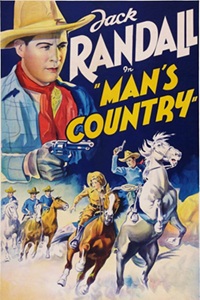
 When his innocent son, Ted (David Sharpe), is accused of committing a murder, Lex Crane (Walter Long) turns him over to Texas Ranger Jack Haile (Jack Randall) because he knows that Jack will make sure that Ted gets a fair trial. Lex says that he and his men are accused of every crime that happens in the area, even though they’re always innocent. Jack understand and respects Lex as a man and a father. But when someone shoots and kills Ted, Lex and his men set out for revenge. The twist? Lex has a twin brother named Buck (also played by Walter Long) and the two brothers hate each other.
Most poverty row westerns blend into each other but Man’s Country stands out as an intelligent and well-acted western. Even though the twin twist is undoubtedly an overdone one, Man’s Country does a good job with it and Walter Long gives such a good performance that both Lex and Buck emerge as individual, identifiable characters. Jack Randall may not have been the greatest of the old western actors but he’s believable as the tough but fair Texas Ranger. There’s enough western action for fans of the genre but, for once, the plot is interesting enough that it might hold the attention of other watchers as well.
Of course, this is a Poverty Row western so Charles King does appear as one of the bad guys. He gets into a fist fight, like he almost always did. I wonder how many onscreen punches Charles King actually threw over the course of his career in the westerns. It had to have been a lot.

 Through the Shattered Lens