Film Review: Speed (dir by Edwin L. Marin)


1936’s Speed takes place in Detroit, at the home of Emery Motors.

When Joan Mitchell (Wendy Barrie) shows up to start her new job in the PR department, one of the first things she sees is a car being driven around a race track at a high speed until eventually it crashes.  Automotive engineer Frank Lawson (Weldon Heybourn) explains that it’s all a part of making sure the car is safe.  At Emery Motors, they crash cars on a daily basis to make sure that both the car and the driver will survive.

Terry Martin (James Stewart), the driver of the crashed car, proceeds to give Joan a tour of the factory.  There’s an obvious attraction between the two of them but Joan also seems to have feelings for Frank.  Terry and Frank are rivals.  Terry may not have Frank’s education but he has instincts and he has common sense.  He and his friend, Gadget Haggerty (Ted Healy), have an instinctive understanding of cars.  They know how to drive them.  They know how to fix them.  They know how to make them go really fast.

In fact, Terry is working on a new carburetor, one that he says will increase the speed of Emery’s cars.  Frank is skeptical but Terry knows that, if he can enter his car into the Indianapolis 500, he’ll be able to prove that he knows what he’s talking about.  Joan comes to believe in Terry and his carburetor.  And, fortunately, Joan has a secret of her own that will be very helpful to Terry’s ambitions.

Speed was not Jimmy Stewart’s first feature role but it was his first starring role.  28 years old when he starred in Speed, Stewart is tall, a little bit gawky, and unbelievably adorable.  From the minute that Terry climbs out of that wrecked car and introduces himself to Joan, Stewart’s a true movie star.  He and Wendy Barrie have a lot of chemistry and are a truly cute couple but Stewart is the one who dominates the film with his straight-forward charisma.  Terry may not be the best educated engineer at Emery Motors but he is determined to prove himself and Stewart does a great job of portraying that determination.

As for the film itself, it’s low-budget and it’s short.  Automotive enthusiasts might enjoy seeing all of the old cars and getting a chance to see what a car race was about in the days when cars themselves were still a relatively new invention.  The film itself starts out as almost a documentary, with Stewart (as Terry) explaining how each car is manufactured on the assembly line.  He points out all the machinery that goes into making the car in an almost-awed tone of voice.  If the information is a bit dry, it doesn’t matter because it’s impossible not to enjoy listening to Jimmy Stewart speak.  In his pre-WWII films, Stewart was the voice of American optimism and that’s certainly the case with Speed.

Speed was not a huge box office success but, in just two years, Stewart would be working with Frank Capra on You Can’t Take It With You, the first Stewart film to be nominated for (and to win) the Oscar for Best Picture of the year.

Lisa Reviews An Oscar Winner: The Life of Emile Zola (dir by William Dieterle)


The Life of Emile Zola, the winner of the 1936 Oscar for Best Picture of the Year, opens with two French artists living in a drafty apartment.

Emile Zola (Paul Muni) is destined to become one of France’s most popular and important writers.  Paul Cezanne (Vladimir Sokoloff) will eventually become one of the most important artists of the post-impressionist movement.  But for now, they’re just two struggling artists who have sworn that they will never sell out their principles.  They are poor but they’re happy.  That changes for Zola after he meets a prostitute named Nana (Erin O’Brien-Moore) and he uses her life story as the inspiration for a novel.  The book is controversial and its frank content scandalizes France.  The public censor comes close to banning it.  But it also becomes a best seller.  It’s the book everyone secretly owns but claims to have never read.

Zola writes several more books, all about the conditions of the working class in France.  Eventually, he becomes what he claimed he would never be, a wealthy man living in a mansion and having little contact with the poor and oppressed.  Cezanne sees Zola one last time, calling him out for having sold his talent for money.  Cezanne explains that, on general principle, he can no longer be Zola’s friend.

Meanwhile, a quiet and rather meek family man named Captain Alfred Dreyfus (Joseph Schildkraut) has been arrested and accused of being a spy for Germany.  There’s little evidence that Dreyfus is a spy.  Indeed, most of the evidence seems to point to a Major Walsin-Esterhazy (Robert Barrat).  But, because Dreyfus is considered to be an outsider, he is convicted in a show trial and exiled to Devil’s Island.

(In real life, it’s generally agreed that Dreyfus was a victim of anti-Semitism.  As the only Jewish member of the army’s General Staff, Dreyfus was viewed with suspicion by his colleagues even before anyone knew that there was a German spy.  The Life of Emile Zola doesn’t specifically state that Dreyfus was a victim of anti-Semitism, with the exception of a brief moment when one of his accusers looks at his personnel file and says, “He’s not one of us,” while pointing at the word “Jew.”  Otherwise, the fact that Dreyfuss was Jewish is never mentioned in the film.  It’s as if the film is going out of its way to avoid offending the very people that the movie is criticizing.)

After speaking to Dreyfus’s wife (played by Gale Sondergaard, who would later become the victim of a show trial herself when she was blacklisted as a suspected communist), Zola decides to take up Dreyfus’s case.  He publishes an open letter — J’Accuse — in which he states that Dreyfus was not given a fair trial and that Dreyfus is innocent of the charges against him.  Zola finds himself in court, accused of libel.  Zola uses his trial to give Dreyfus the hearing that he never received.  While the army boos his every utterance, the people of France rally to his side.

The Life of Emile Zola is an early example of the type of prestige production that today is often referred to as being an “Oscar picture.”  It tells a true story.  As a film that condemns the treatment of Alfred Dreyfus but avoids stating the obvious reason why Dreyfus was targeted in the first place, it’s political without being radical.  And it features a performance from the most acclaimed actor of the era, Paul Muni.  Muni gives a powerful performance as Zola, holding the viewer’s attention even during the lengthy trial scenes that take up most the second half of the film.  That said, the true star of the film is Joseph Schildkraut, who plays Dreyfus as being a kind and trusting soul who finds himself caught up in a Kafkaesque nightmare.  At one point, Dreyfus is given a gun and told that there’s one way that he can avoid being put on trial for treason.  Schildkraut played the scene so well that I wanted to cheer when he refused to surrender.

The Life of Emile Zola is a big and, at times, self-consciously important production.  It was clearly designed to win a bunch of Oscars and it certainly managed to do that.  Compared to some of the other films nominated that year — The Awful Truth, Dead End, A Star is Born, Lost Horizon, Stage Door, In Old Chicago — The Life of Emile Zola can seem a bit stodgy.  However,  the performances of Muni and Schildkraut continue to make the film worth watching.

Small But Powerful: HITLER’S MADMAN (MGM 1943)


gary loggins's avatarcracked rear viewer

Culver City’s MGM “dream factory” and Gower Gulch’s PRC were miles apart both literally and figuratively.  Metro-Goldwyn-Mayer boasted “more stars than there are in heaven”, while tiny Producer’s Releasing Corporation films starred faded names like Neil Hamilton, Harry Langdon, Bela Lugosi , and Anna May Wong. MGM films featured lavish, opulent sets; PRC’s cardboard walls looked like they would fall over if an actor sneezed. Poverty Row PRC movies were dark and grainy; MGM created glossy, gorgeous Technicolor productions. MGM specialized in big budget extravaganzas, whereas PRC rarely spent more than $1.98. Miles apart – so why did major studio MGM purchase and release a movie originally made for minor PRC, HITLER’S MADMAN?

For one thing, it’s a damn good film, and an important one as well. Based on the true-life atrocity of the destruction of Lidice, Czechoslovakia on June 10, 1942 after the assassination of Nazi Reichsprotektor Reinhardt Heydrich, known as “The Hangman of Prague”, HITLER’S MADMAN was…

View original post 1,071 more words

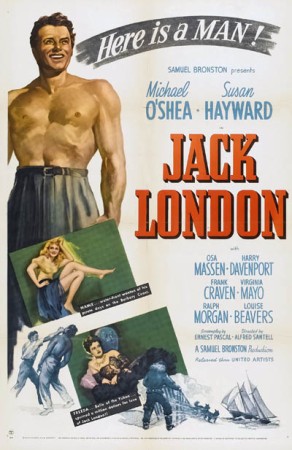
The Fabulous Forties #28: Jack London (dir by Alfred Santell)


Jack-London-1943

The 28th Film in Mill Creek’s Fabulous Forties box set was a 1943 biopic about the writer, Jack London.  Not surprisingly, the title of the film was Jack London.

Now, I should start this review off by mentioning that I know very little about Jack London.  I don’t think that I have ever read any of his short stories or his novels.  I know that he wrote a novel called White Fang but that’s largely because there’s been so many different film versions of the book.  (Long before directing Zombi 2, even Lucio Fulci made a version of White Fang.)  Here’s what I do know about Jack London:

  1. He was a prominent writer at the turn of the century.
  2. He was reportedly an alcoholic.
  3. He was a Socialist who even ran for mayor of Oakland, California on the party’s ticket.
  4. He was an atheist.
  5. In 1916, depending on the source, he either committed suicide, died of alcohol poisoning, or simply passed away as the result of 40 years of hard living.

Of those 5 facts, 4 are totally ignored in Jack London.  The film does acknowledge that Jack London eventually became a prominent writer, even going so far as to open with stock footage of a U.S. warship being named after him.

As for his alcoholism, we never see London drunk.  Indeed, the film’s version of Jack London is so earnest that it’s hard to believe he’s ever had a drink in his life.

As for his Socialism, we are shown that London grew up in a poor family.  When, after serving at sea, he takes a writing class, he argues with a professor over London’s desire to write about the poor.  However, we never hear London express any specific ideology.  We certainly don’t see him running for mayor of Oakland.

As for his atheism — yeah right.  This film was made in 1943!  There’s no way that Jack London was going to be portrayed as talking about why he didn’t believe in God.

As for his death — well, Jack London ends with the writer very much alive.  There’s not even a title card informing us that London eventually died.

Instead, Jack London is much more concerned with Jack (played by Michael O’Shea) dealing with the Japanese.  Oh sure, we get some scenes of Jack London watching a shootout and breaking up a bar fight in Alaska.  And Susan Hayward shows up as Jack London’s always supportive wife.  (For that matter, Louise Beavers also shows up as Jack London’s always supportive house keeper.)

But, in the end, the majority of the film features Jack London as a war correspondent covering the turn of the 20th century war between Russia and Japan.  When he’s captured by the Japanese, he observes the harsh way they treat prisoners and is shocked when he witnesses several prisoners being ruthlessly executed.  When he talks to a Japanese commandant, he’s outraged as the commandant explains how the Empire of Japan is planning to take over the world.  When Jack finally gets back to America, he’s less concerned with writing White Fang and more concerned with warning the American people to remain vigilant…

Jack London is basically wartime propaganda disguised as a biopic.  The entire point of the film seems to be that if Jack London was still alive, he would want the men in the audience to enlist and the women to buy war bonds.  None of it is subtle and, beyond its value as a time capsule of how Americans viewed the Japanese in 1943, none of it is particularly interesting as well.

In the end, Jack London plays out like one of those earnest but dull educational films that tend to show up on PBS when no one’s watching.

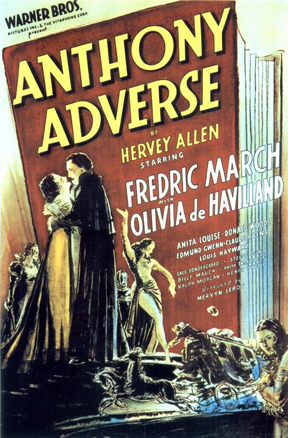
Cleaning Out The DVR: Anthony Adverse (dir by Mervyn LeRoy)


AnthonyAdverse

Late last night, I continued to clean out my DVR by watching the 1936 film, Anthony Adverse.

I recorded Anthony Adverse off of TCM, where it was being shown as a part of that channel’s 31 Days of Oscars.  Anthony Adverse was aired because it was nominated for Best Picture of 1936.  That’s significant because, if not for that nomination, I doubt that anyone would ever have a reason to watch Anthony Adverse.  It’s certainly one of the more obscure best picture nominees.  Despite a prestigious cast and being directed by the respectable Mervyn LeRoy, Anthony Adverse only has a handful of reviews over at the imdb.  And most of those reviews were written by Oscar fanatics like me.

Anthony Adverse is an epic historical film, one that tells the story of Anthony Adverse (Frederic March).  Anthony is the illegitimate son of Denis Moore (Louis Hayward) and Maria (Anita Louise), the wife of evil Spanish nobleman, Don Luis (Claude Rains, convincing as a nobleman but not as someone from Spain).  Luis murdered Denis and Maria died giving birth so Luis abandons the baby at an Italian convent.  Anthony is raised by nuns and priests and then, 10 years later, is apprenticed to an English merchant named John Bonnyfeather (Edmund Gwenn).  Bonnyfeather just happens to be Anthony’s grandfather!  Though Luis told him that Anthony died as soon as he was born, Bonnyfeather quickly figures out that Anthony is his grandson.  However, Bonnyfeather doesn’t share that information with Anthony and instead, he gives Anthony the surname “Adverse.”

Bonnyfeather raises Anthony as his own son.  Anthony grows up to be Frederic March and ends up falling in love with and marrying the beautiful Angela (Olivia De Havilland).  However, Anthony is suddenly called away on business to Havana, Cuba.  He doesn’t even have a chance to tell Angela that he’s leaving.  He does leave her a note but it blows away.  Assuming that she’s been abandoned, Angela goes to France, becomes an opera singer, and is soon the mistress of Napoleon.

Meanwhile, in Cuba, Anthony becomes convinced that Angela has intentionally abandoned him.  Consumed by grief, he ends up running a slave trading post in Africa.  He takes one of the slaves, Neleta (Steffi Duna), as his mistress and becomes known for his cruelty.  However, he eventually meets Brother Francois (Pedro de Cordoba) and starts to reconsider his ways.

(The film’s treatment of the slave trade is …. well, it’s awkward to watch.  The film is undoubtedly critical of slavery but, at the same time, it’s hard not to notice that the only slave with a prominent part in the film is played by a Hungarian actress.  Anthony may eventually reject cruelty but it’s left ambiguous as to whether or not he rejects the slave trade as a business.  If Anthony Adverse were made today, one imagines that this section of the film would be handled much differently.)

Meanwhile, back in Europe, Bonnyfeather is dying and his housekeeper, Faith (Gale Sondergaard, who won the first ever Oscar awarded for Best Supporting Actress for her performance here), plots to claim his fortune.

After I watched the movie but before I started this review, I did some research and I discovered that Anthony Adverse was based on a 1,222-page best seller that came out in 1933.  I’m going to guess that the film’s long and ponderous story may have worked better on the page than it does on the screen.  As a film, Anthony Adverse clocks in at 141 minute and it feels even longer.  Despite the impressive cast, the film just never clicks.  It’s never that interesting.

At the same time, I can understand why it was nominated for best picture.  It’s a big movie, full of characters and extravagant sets and ornate costumes.  You can tell it was an expensive movie to make and there’s enough philosophical dialogue that you can pretend there’s something going on underneath the surface.  In the 1936, Anthony Adverse may have been quite impressive but seen today, it’s forgettable.

Anthony Adverse lost best picture to another overproduced extravaganza, The Great Ziegfield.  Personally, I would have given the award to the unnominated My Man Godfrey.

http://www.youtube.com/watch?v=c_OyZlSCpo4