Cleaning Out The DVR Yet Again #15: Quintet (dir by Robert Altman)


(Lisa recently discovered that she only has about 8 hours of space left on her DVR!  It turns out that she’s been recording movies from July and she just hasn’t gotten around to watching and reviewing them yet.  So, once again, Lisa is cleaning out her DVR!  She is going to try to watch and review 52 movies by Wednesday, November 30th!  Will she make it?  Keep checking the site to find out!)
quintet

The 1979 post-apocalyptic film Quintet aired on FXM on November 15th.  I recorded it because this film is often cited as being one of director Robert Altman’s worst but I’ve also read some very passionate defenses of Quintet.  Since I’ve enjoyed several of Altman’s films (Nashville, Gosford Park, Short Cuts, The Company, The Player, The Long Goodbye, and many more), I wanted to experience Quintet for myself.

I mean, seriously — a postapocalyptic sci-fi film from Robert Altman!?  That would have to be at least interesting, right?

Anyway, I watched Quintet and to be honest, I wasn’t really sure what the Hell was going on for most of the film.  Things made a bit more sense after I did a little bit of research and I discovered that Quintet was 1) inspired by a fragment of a dream that Altman had and 2) went into production despite not having a completed script.

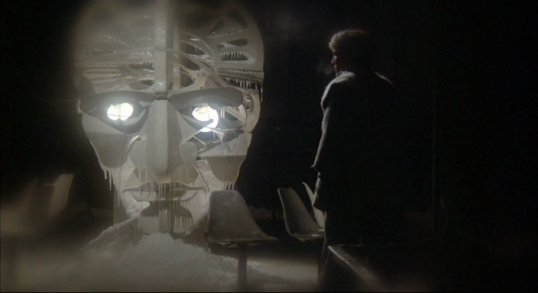
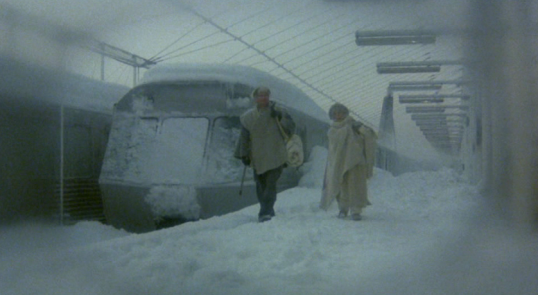
Quintet opens with a breath-taking shot of a frozen landscape.  There’s been a new ice age.  The entire Earth is frozen.  There’s only a few hundred humans left and their number is rapidly dwindling.  Some, like Essex (Paul Newman) and Vivia (Brigitte Fossey) spend their days hiking across the tundra and hunting seals.  Others — like practically everyone else in the entire freaking film — spend their times in ramshackle villages, pursuing what little pleasure they can find while waiting to die.

In this new frozen world, the most popular activity — outside of getting drunk — is playing a board game called Quintet.  I have no idea how Quintet is played, though the film is full of scenes of people playing it.  From what we do see, it really doesn’t look like that fun of a game but I guess you can’t be picky when you’re waiting to freeze to death.  I mean, honestly, if the world’s ending, I’d rather play a board game than charades.

Anyway, in one of the frozen towns, a group of people are having a Quintet tournament, with the rule being that, once you’re eliminated in the board game, you are also killed in real life.  (And again, this is where it would have been helpful for the film to take just a few minutes to clarify just how exactly Quintet is played.)  One of the Quintet players is killed by a bomb, which unfortunately blows up Viva as well.  Seeking revenge (or, at least, I’m guessing that was his motivation because Paul Newman didn’t exactly give the most communicative performance of his career in Quintet), Essex assumes a fake identity and enters the tournament.

Soon, he’s running around the frozen landscape, killing people.  He knows that the final player standing will receive a prize of some sort but he doesn’t know what the prize is.  How deep!  Or something.

Dammit, I really wanted to defend Quintet.  I really did.  Whenever I see a movie that has gotten almost universally negative reviews, my natural instinct is to try to find something good about it.  And I will say this: visually, Quintet is fascinating.  A lot of care was put into creating this frozen world and it’s interesting to note how every location is decorated by elaborate ice sculptors.  The ice may be destroying civilization but it can’t squelch humanity’s natural creativity.

Unfortunately, Quintet  may be well-designed but it’s also a painfully slow film.  Just because the film takes place on a glacier, that doesn’t mean that it needs to move like one.  The slow pace is not helped by the fact that many of the characters have a tendency to suddenly start delivering these faux profound philosophical monologues, the majority of which are about as deep as the typical Tumblr post.

Quintet stars Paul Newman, who was both an iconic movie star and a legitimately great actor.  He spends most of Quintet alternating between looking confused and looking stoic.  That said, it’s always interesting to watch an actor like Paul Newman slog his way through an artistic misfire like WUSA or Quintet.  Let’s give Paul Newman some credit: he delivered his lines with a straight face. Just as Essex knew he was trapped on a glacier, Paul Newman understood that was trapped in Quintet.  Both did what they had to do to survive.

Robert Altman was a great director but Quintet is not a great film.

It happens.
quintettrain

VGM Entry 62: Enix


VGM Entry 62: Enix
(Thanks to Tish at FFShrine for the banner)

Today Square might be remembered as the uncontested kings of Super Nintendo RPGs, but this is not an accurate assumption. As a young kid obsessed with anything approximating the genre, I anticipated every new Enix release with nearly equal glee. What I didn’t realize at the time was that Enix was a publisher. You won’t find games developed by them. While Square’s games emerged in house from the drawing board, Enix released titles developed by a wide variety of companies.

http://www.youtube.com/watch?v=Dk8BDJLEHew

Quintet was the leader of this pack. Quintet is a Japanese video game developer officially founded in April 1989. According to Wikipedia, the first game credited to them is Legacy of the Wizard (Nihon Falcom, 1987), an installment of the Dragon Slayer series. Hence a bit of a to-do is made about their origin, with “June 1987 / April 1989” listed as the ambiguous founding date. The source for their official founding date links to a nearly illegible magazine scan (in English), and I don’t want to give myself a headache trying to decipher it, so I’ll take the Wikipedia editor’s word on that one. (The fact that whoever edited the article noticed an ambiguity in the first place marks them as more attentive than the vast majority of game-related editors.)

But the article and its relevant links lead me to believe the issue isn’t as complex as it seems. Tomoyoshi Miyazaki, director and president of Quintet, was a Nihon Falcom employee (he was involved in developing the first three Ys titles), and it just so happens to be the case that Legacy of the Wizard was released in North America in April 1989. The only real confusion is that Wikipedia suggests that Quintet developed both the Famicom and the NES ports, and that the former was released in 1987. If both were released in 1989, or alternatively if Quintet only developed the NES release (if the division of labor between developer and publisher renders this thought unintelligible, my apologies), then there is no issue. And moreover, if Tomoyoshi Miyazaki was a Nihon Falcom employee, the ambiguity may capture a simple gap in time between Miyazaki beginning to call his development team Quintet and his registering the name as a corporate entity.

Whatever the case may be, Quintet were busy in 1993. Following ActRaiser in 1990 and Soul Blazer in 1992, they managed to pump out two games in a span of two months. This probably wasn’t a great idea in retrospect. Illusion of Gaia, composed by Yasuhiro Kawasaki, was musically pretty shallow (this might account for why I never bought the game after renting it as a kid), and as an installment in the unofficial Soul Blazer Trilogy it was a sad decline from the quality of Yukihide Takekawa’s Soul Blazer. In its subtler moments, 2:49 to 5:35 for instance, it boasts an atmospheric vibe vaguely reminiscent of Jeremy Soule’s Secret of Evermore two years later, but the rest is of poor quality.

http://www.youtube.com/watch?v=Mfr_C429oBY

ActRaiser 2 on the other hand had an outstanding score, and is a real testament to the diversity offered by Yuzo Koshiro. While I remain unmoved by his more popular Streets of Rage sound, as a classical composer he not only competes outside of the video game spectrum, but makes the Super Nintendo sound like a real symphony with unprecedented professionalism. Nobuo Uematsu is always quick to point out that he had no professional training, and my own musical inclinations lead me to treat such claims with an appreciative nod of respect, but where he did try to emulate an orchestra on the Super Nintendo he never came close to the level of Koshiro. (Indeed, “Dancing Mad”‘s charm is it’s quintessentially SNES sound within the orchestration.)

http://www.youtube.com/watch?v=6ukmCm8QBrI

Koshiro’s work in ActRaiser 2 in contrast might as well have been a live recording. Koshiro is, like Chris Hülsbeck, an artist I’ve I in many ways simply failed to appreciate, but not here. Quintet’s problem in this instance is that Koshiro’s stellar score was ActRaiser 2‘s only redeeming value. I mean, I never played it, but that fact is directly relevant to its commercial failure. In choosing to abandon the simulation side of the gameplay and go for a straight side-scroller they essentially ostracized their entire fanbase and entered a much more competitive field in which the Enix seal of approval meant jack.

http://www.youtube.com/watch?v=O3n_Qt6cgbs

Produce was a pretty obscure developer founded in 1990, probably most known for Super Adventure Island (Hudson Soft, 1992) and The 7th Saga. My most vivid memories of The 7th Saga are of the obnoxious pseudo-avoidable encounters that were for all practical purposes random but gave you the sensation of just being bad at avoiding them. Still, as with most Enix titles it was a refreshing change of pace from the Dragon Quest-patterned norm, and perhaps it had a good plot of which I was simply oblivious at the time (I doubt it though.)

What really strikes me though, listening to this video, is that it actually had a really great soundtrack. Norihiko Yamanuki doesn’t even have a vgmdb entry, and he’s surely one of the most obscure SNES composers to have actually accomplished something. There’s nothing really compositionally striking about the music of The 7th Saga, and it doesn’t really surprise me that I overlooked it as a kid. Yamanuki’s accomplishment here is more in the subtle qualities of the arrangement. The bubbly little tapping tones that prevail throughout this collection, most dominantly in the track at 1:00, really give the game a heartwarming sort of appeal; it’s quite pretty.

http://www.youtube.com/watch?v=wq4LGNGd5ik

Ogre Battle was probably the most successful real-time strategy game for the SNES, at least in the United States. It stemmed from a long lineage of similar titles in Japan, but few had found sufficient success for overseas ports. Quest, the developer, had worked on similar projects in the past, though Ogre Battle would be the first in their Ogre series. A game of few settings and themes–the entire plot unfolds within the combat setting, and there are no separate story scenes as in say, Final Fantasy TacticsOgre Battle demanded a whole bunch of tunes well suited for long, drawn-out conflict.

The game did, nevertheless, have a pretty extensive soundtrack. Masaharu Iwata did the bulk of the composition, contributing 24 tracks, while Hitoshi Sakimoto added 12 and Hayato Matsuo added 6 (based on the ost liner notes on vgmdb). If the music sounds a little similar to the score of Final Fantasy Tactics, that’s no coincidence. Masaharu Iwata and Hitoshi Sakimoto composed it too.

VGM Entry 53: Soul Blazer


VGM Entry 53: Soul Blazer
(Thanks to Tish at FFShrine for the banner)

A personal SNES favorite of mine is Soul Blader (Soul Blazer in North America), composed by Yukihide Takekawa and released by Enix in January 1992. Takekawa is not a big name in the video game music industry, but he’s composed a number of other soundtracks for film and anime. I gather his main profession is as a vocalist. Whatever influences he brought to the table, Soul Blader is a much more diverse soundtrack than your standard orchestral-centric fantasy fair.

http://www.youtube.com/watch?v=UP5emCsGjSI

Quintet made a lot of amazing games for the Super Nintendo, but this one was probably their best. Like ActRaiser, the game revolves around a heaven and hell scenario, where The Master faces off against The King of Evil, in this case named Deathtoll. Basically, a powerful king corrupted by greed forces a scientist, Dr. Leo, to invent a portal to hell so that the king can strike a deal with the devil. Deathtoll agrees to give him all the riches in the world in exchange for all of the souls in his empire, and King Magridd promptly goes about replicating these hell portals all over the place and trapping pretty much all life and material connected to it within them. The Master sends you, his messenger, to earth to destroy the portals and set the Freil Empire free.

That’s the entire plot, really. There aren’t any major twists or turns. You just make your way across a fantasy realm freeing souls until you finally confront and defeat Deathtoll. As far as an actual story is concerned, yeah, it’s pretty bland, but Quintet manage to really turn it into something wonderful.

You may have heard of the “Soul Blazer” series, consisting of Soul Blader, Illusion of Gaia, and Terranigma. I never played Illusion of Gaia, and Terranigma was never released in North America, but I gather the unofficial series attribution is derived from subtle commonalities and returning side-characters rather than any overt consistency in plot or gameplay. If that is the case, then I think we can safely regard ActRaiser as an equal shareholder in the collection. But before I get into that, let’s look at this initial track compilation. It consists of:

(0:00) Intro Theme
(1:27) Lonely Town
(2:14) World of Soul Blader
(3:32) Solitary Island
(4:34) The Mines
(6:01) Into the Dream
(6:40) Dr. Leo’s Lab
(7:37) The Marshland of Lost Sight
(8:24) Lisa’s Song

Solitary Island, The Mines, Dr. Leo’s Lab, and The Marshland of Lost Sight are all combat zone themes, and perhaps the most obvious examples of what an amazing job Yukihide Takekawa did here. If you’re struggling to really define his style, I think the appropriate term is “video game music”. I mean, Takekawa transcends all style standards in precisely that way Super Nintendo music ought to. If you check out Solitary Island especially, you’re going to here an amalgamation of folk, orchestral, and rock elements so thoroughly intertwined that any attempt to distinguish between them would be simply misguided. The effect produced in the listener is what really counts at this point. Takekawa’s combat music, aside from the final boss theme, is never really intimidating. It’s adventurous and, as a consequence of the bass and drums, a little bit grimy, precisely as it ought to be. I mean, you’re God’s avatar here. You can’t ‘die’. There’s no serious danger, just work to be done. This is music for getting down to business, and your business is killing demons. If the regular boss battle music (“The Battle for Liberation”) is utterly generic and “Dr. Leo’s Lab” gets old quickly, I would still say Takekawa did an outstanding job over all.

http://www.youtube.com/watch?v=_cEa03NXtOY

And besides that, the combat music is all extraordinarily relevant. The sort of creatures you’ll be fighting in Dr. Leo’s lab is obvious enough through the music, and likewise “Solitary Island” has a sort of pirate vibe going on. “Icefield of Laynole” (or “The Icy Fields of Leinore”, or “Ice Field of Lanoyle”, depending on your source) is one of the best at this. Without ever devorcing the drum and bass style that ties the whole soundtrack together, it nails a snow and ice-themed zone sound. It doesn’t bend to any stereotypes of what a winter zone ought to sound like, but the jazzy overtones lend some real credence to the expression “smooth as ice”.

http://www.youtube.com/watch?v=b1YcMB9eK-c

Isn’t this just gorgeous? I think so. Takekawa let his imagination run wild with some of these, and you can hear the whole game in action even if you’ve never actually seen it. “Seabed of Saint Elle’s” (or “The Depths of the Sea of Saint Elle’s”) is obviously the water level. Like “Icefield of Laynole”, it doesn’t feel nearly as dirty as the other combat zone tracks, and it’s no coincidence that these are the two most fanciful zones in the game, inhabited by dolphins on the one end and gnomes on the other.

Dolphins? Really? Well, Quintet were a bit more creative about that than you might think. One of the big reoccurring themes throughout Soul Blazer is reincarnation, and as God you can communicate with anything that has a soul. So you’re not dealing with some weird anthropomorphic society here. They’re certainly a bit more, well, technologically advanced than real dolphins, but so are plenty of fictional human societies. The souls you encounter everywhere are all capable of more or less the same level of intelligence and are only restricted by their physical bodies. The gnomes, for instance, have an incredibly short lifespan, and their souls often reflect on how much they’d taken for granted in past lives as humans. You get used to this pretty quick; the first character you meet in the game is a tulip.

http://www.youtube.com/watch?v=8Wr6npVETxE

I’m not sure why these track titles are so screwy. I have this song as “Temple of Light”. RPGFan, who I consider reputable, have it as “A Temple in Ruins”, and the youtube video says “Rotting Temple”. Your guess is as good as mine. Anyway, here is one of the few combat zone tracks that sets aside the drum and bass drive. Aside from the simple fact that this made for a great song, the change of pace fits its situation in the game as a dungeon within a dungeon; you enter the temple from the “Marshland of Lost Sight” combat zone.

Anyway, the biggest parallel between Soul Blazer and ActRaiser is really in the whole city-building simulation appeal. Quintet didn’t give Soul Blazer an actual city simulation side, but each town does grow as a direct consequence of your actions. Each town zone starts out as an empty map, and it’s only as you release souls within the combat zones that their bodies reappear and their homes are rebuilt. You certainly don’t have to save every soul to beat the game, and a number of them are hidden, so you do retain a modest degree of control over how each town will ultimately appear. Any possibility of boredom with the game’s fairly basic combat mechanics is nullified by it; you essentially build cities by killing monsters, which is a perfect amalgamation of ActRaiser‘s two different modes.

http://www.youtube.com/watch?v=sUXL3xUoAAM

Did I mention Yukihide Takekawa was a vocalist? He might be the only video game composer to sing on his own score. This rendition of Lisa’s Song (also credited as A Night Without Lovers /Koibito no Inaiyoru) appeared on the official soundtrack released about a month after the game, and I think it’s safe to assume that it would have appeared in the game’s ending credits had the technology of the day allowed for it.

And now if you’ll go excuse me, I have a date with ZSNES. And I’d been so good about not wasting time on replays up to this point…